


Innovating with GenAI was the theme of Frost & Sullivan’s Innovation Workshop and Tour: A Quarterly Series, held in St. Paul, Minnesota at the 3M Innovation Center. The event was sponsored by Frost & Sullivan’s Growth Innovation Leadership Council, which aims to achieve transformational growth for members and their companies through enlightened leadership and the sharing of best practices.
Thought leaders from Bayer, CoBank, Medtronic, New Balance and other notable companies shared timely innovation insights and strategies while collaborating with peers in an inspirational setting. The event included a tour of the 3M Innovation Center, where participants learned about many of the technologies underlying the thousands of products developed by the 3M Company. Like the other companies who participated, 3M is in a state of transition, moving from a traditional R&D model to digitally enabled innovation.
Read on for summaries of key ideas, insights and best practices shared at this dynamic event:
HEADLINER – Navigating the Hype: Balancing Confidence and Caution in the Age of GenAI
Onur Yüce Gün, Director of Computational Design, New Balance
Onur Yüce Gün challenged the narrative of GenAI as a revolutionary creative force and instead, urged participants to rethink it as a [soon to become] generic tool or medium. Focusing on meaning, intent, and responsible integration, he offered strategies to build resilience against AI hype while reinforcing the human values that drive innovation:
- Evaluate GenAI tools by asking: What value are we adding—and for whom?
- Ensure outputs reflect human intention and contextual purpose—not just efficiency or technical novelty
- Rethink how teams engage with AI by prioritizing non-average solutions that emerge from domain expertise rather than statistical convergence
KEY TAKE-AWAYS
AI and machine learning should be understood as pattern recognition systems rather than anthropomorphic entities that “hallucinate” or “understand.” There’s a philosophical difference between how machines and humans perceive and process information that’s critical to understand when implementing AI systems.
The concept of “data” is not neutral or objective—it’s a human projection and interpretation of the world (“we don’t collect data, we project data”). AI can be valuable for product design but requires thoughtful integration with existing systems and human expertise.
KEY INSIGHT
True innovation often comes from the outliers beyond the bell curve of statistical data, posing a challenge for AI systems trained on mainstream patterns.
ASK THE EXPERTS! Panel Discussion – Inside Our GenAI Journey: Real-World Uses, Challenges, and Lessons Learned
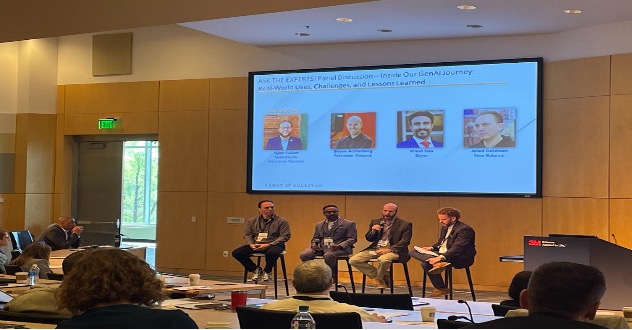
MODERATOR
Ryan Culver, Director, AI and Innovation, SelectQuote Insurance Services
PANELISTS
Vinod Das, Director, Pharma R&D, AI Solutions Enablement, Bayer;
Jared Goldman, Vice President Innovation & Digital Design, New Balance;
Shane Achterberg, Director of Innovation, Automation and Architecture, Schneider National
Organizations in different industries (transportation, pharmaceuticals, footwear manufacturing) are taking different approaches to GenAI adoption, based on their unique needs, regulatory environment, culture, and risk profile:
- Bayer’s pharmaceutical R&D began their generative AI journey with foundational applications like content summarization and document analysis before progressing to more sophisticated use cases such as protocol authoring, which achieved significant cycle time reductions
- New Balance is focused on product creation, using AI to transform athlete data into design solutions, achieving dramatic efficiencies in the rendering process from days to minutes
- Schneider National has evolved from decision science to GenAI applications focused on areas where previous automation attempts had limitations, for instance email automation and image recognition
KEY TAKE-AWAYS
- The concept of becoming “digital craftspeople” is emerging; companies are adopting AI tools to enhance creativity and expertise—not to replace human capabilities
- Expanding AI use cases across different departments can help build trust and confidence
- The rate of technological change in AI is happening in weeks, not years; organizations in regulated environments like pharmaceuticals segment applications strategically and maintain appropriate data governance
BEST PRACTICES
- Recognize that AI is “more art than science”— aim for 70% accuracy rather than expecting binary pass/fail results
- Maintain “human in the loop” processes, recognizing that “cognitive intelligence and lateral thinking” remain uniquely human capabilities
EXECUTIVE BULLETIN – Establishing Effective Governance Frameworks for GenAI
Alp Basol, Head of Innovation & AI Center of Excellence, CoBank
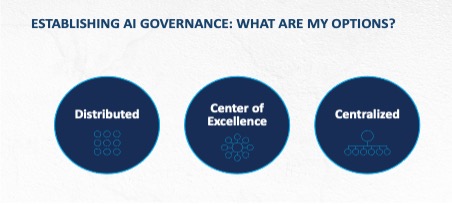
CoBank is a mission-driven organization of about 1,300 employees focused on rural America, providing funding for utilities, telecommunications, clean water, affordable food, and energy independence. The bank established an AI Center of Excellence (CoE) that evolved from a governance/risk body to an execution and technology body.
CoBank adopted a lean startup method through “The Forge”— treating each AI idea like a startup with 4-week innovation cycles:
- Core banking functions were surprisingly the earliest and most enthusiastic adopters of AI tools
- In the absence of established federal AI governance models for banking, CoBank adapted the EU’s AI risk framework (released March 2024)
- The bank implemented a risk classification model for AI use cases, ranging from low/no risk to unacceptable
BEST PRACTICES
- Start by understanding what business problem you’re trying to solve rather than implementing AI for its own sake
- Focus on customer needs first —”what are they doing today and what do they want to do tomorrow?”
- Separate innovation teams from process-heavy functions to allow for more experimentation
SUMMARY
The success of CoBank’s approach is evident in its rapid adoption of AI tools, particularly by core banking functions. By treating AI initiatives as startups and establishing appropriate risk classifications, CoBank has created a sustainable model for AI innovation that satisfies both regulatory requirements and business needs. AI governance isn’t just about restricting use but about enabling innovation within appropriate guardrails.
EXECUTIVE INSIGHTS – Unleashing the Potential of GenAI as Your Innovation Assistant
Nithin Ramachandran, Global Vice President – Data Analytics, MDM, AI/ML and Gen AI, 3M
This session focused on examples of Gen AI assistants in the enterprise, specialized agents in R&D, and lessons learned from driving these initiatives. Organizations often struggle to move from “Proof of Concept purgatory” (numerous pilots) to AI at scale with significant business outcomes.
Ramachandran presented two strategic archetypes for AI implementation:
- “Snowballs” – reusable capabilities that can be deployed across multiple departments with minor customization. This approach focuses on commoditized solutions (like Microsoft Copilot or Gemini) that have low individual ROI but accumulate value as they’re deployed across the organization
- “Summits” – bespoke, complex capabilities that require significant expertise and time to develop. The “summit” approach tackles complex, high value use cases specific to the organization’s core business (for 3M, this includes materials science innovations)
3M implemented an enterprise-wide GenAI assistant as a snowball strategy – initially deployed for security reasons (to prevent unauthorized ChatGPT use) but it evolved into a platform with new capabilities added every two weeks. The company analyzes user prompts to understand needs and prioritize new capabilities.
3M’s approach demonstrates how even large, complex organizations can implement AI at scale by being intentional about strategy. Their enterprise-wide AI assistant exemplifies the snowball approach—starting with a straightforward security use case and incrementally adding capabilities based on user needs. Meanwhile, their materials science applications represent summit initiatives that can transform core business functions.
BEST PRACTICES
- Balance your AI portfolio between snowball and summit strategies – initially focusing on snowballs to build credibility
- Deploy snowball solutions quickly while carefully selecting one or two summit projects to start
KEY INSIGHT
Don’t just apply AI to existing processes – reimagine processes to leverage AI capabilities.
CAPSTONE – Tangible Ways That Really Work to Drive Change
Vignesh Shetty, Vice President of Artificial Intelligence & Software Engineering, Enabling Technologies, Medtronic
Shetty discussed actionable strategies to implement and sustain change when integrating transformative technologies like Generative AI. He shared guidelines for fostering stakeholder buy-in, aligning cultural values, and embedding new processes into daily workflows to maximize the benefits of this innovation:
- Implement a structured change management framework to ensure a smooth transition to Generative AI technologies
- Cultivate stakeholder buy-in by identifying key influencers and engaging them in the change process
- Facilitate training sessions and workshops to empower employees and encourage collaboration
There are three pillars of successful change management:
- Building/owning culture
- Cultivating curiosity (not just compliance)
- Focusing on trust
KEY TAKE-AWAYS
- AI transformation is “10% technology and 90% psychology
- It’s not AI that people are afraid of, they’re afraid of their own potential irrelevance
- Successful digital transformation depends less on having the best AI models and more on how organizations engage people, build empathy, and rewire their culture
Medtronic is using AI in two key areas: personalized medical applications (spine/brain surgery tools) and internal productivity across departments. Internal productivity use cases provide a “laboratory” for understanding human-machine interaction; lower stakes than medical applications
IMPLEMENTATION GUIDELINES
- Start small with high value use cases
- Find ways to embed company/team values and normative behaviors into the AI models; don’t use one-size-fits-all models
- Measure both hard metrics (revenue, ROI) and soft metrics (engagement, trust) to track AI adoption success
FINAL THOUGHTS
The successful implementation of AI requires a fundamental shift in how organizations approach change management. It’s not about embracing new tools but embracing new ways of working. Companies that can do this will achieve success. Work to position AI not as a threat to employees, but as a “teammate” that can help them evolve their roles and contribute value in new ways.
Recent Comments