


The leadership meeting starts on time. The dashboard is green. The program plan is immaculate. And yet, somewhere between slide 12 and the polite applause, a quiet dread settles in: we’re getting very good at climbing… but are we even on the right wall?
Stephen R. Covey gave us the cleanest metaphor for this dilemma:
Management Is Efficiency in Climbing the Ladder of Success. Leadership Determines Whether the Ladder Is Leaning Towards the Right Wall.
It’s memorable because it’s painfully true.
Organizations can become Olympic level climbers fast, disciplined, metric-driven while still drifting toward goals that looked sensible two quarters ago and irrelevant by Tuesday.
Now insert Agentic AI into that picture and the metaphor gets very lively. The ladder can climb by itself. It can also build other ladders, delegate climbing to sub-ladders, and report progress in five languages before you have finished your coffee. In the emerging Agentic AI orchestration model, “Management” maps neatly to execution mechanics, tool use, sequencing, harnessing, memory and throughput. While “Leadership” becomes the alignment and orchestration layer that defines objectives, constraints behavior, and sets guardrails for responsible use. In other words: your organization is about to become dramatically more efficient at “doing”, whether or not you have upgraded your capacity for “deciding”.
This is where Covey’s wisdom deserves both respect and a thoughtful update. The quote assumes two things that were mostly safe in 1989: first, that the wall is stable; second, that the climbers are human. In an AI-native enterprise, neither assumption holds. The “right wall” is moving because markets, regulations, and customer expectations now shift at software speed. And the climbers include non-human agents. Probabilistic systems that can be brilliant, wrong, confident, and occasionally creative in ways your risk team will not call “fun.” The ladder is no longer a tool. It’s a workforce with opinions expressed as outputs. So, the classical split can be portrayed as Management equals efficiency, Leadership equals direction – this remains correct, but incomplete. Agentic AI collapses the distance between intention and action. Once you can translate a goal into an agent’s plan, execution accelerates. That sounds like progress until you realize it also accelerates mistakes. Your organization can now “climb fast up the wrong wall” at scale, which is not a strategy; it’s a stress test.
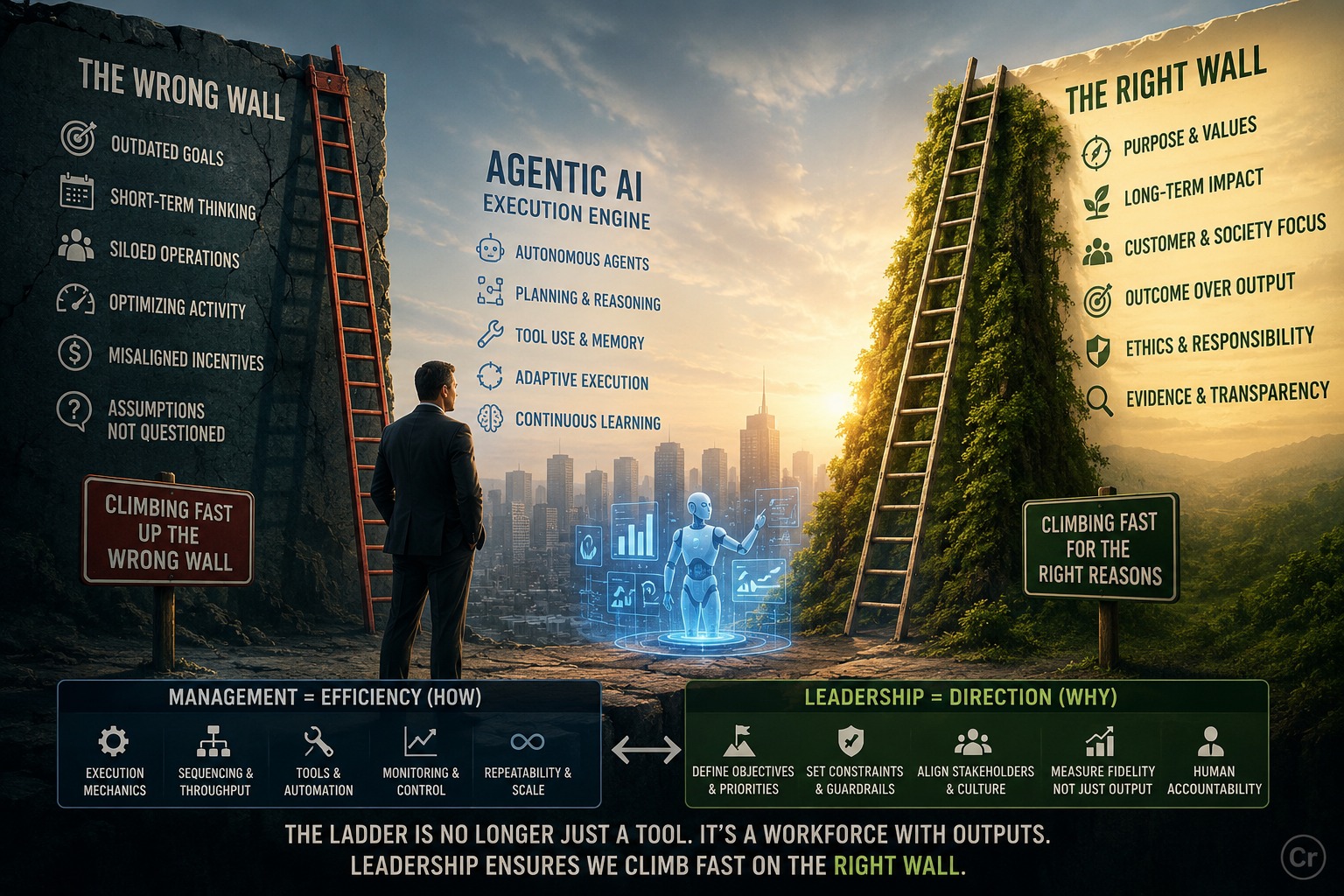
The practical implication is sharp: leadership shifts from task oversight to outcome orchestration. If management once meant supervising people to ensure work is done right, management now increasingly means shaping systems, so work is done safely and repeatably even when nobody is watching because the “nobody” is an autonomous workflow. Leadership, meanwhile, becomes less about having the answers and more about designing the questions, the constraints, and the accountability model. You don’t “motivate” an agent. You specify success, define boundaries, and instrument reality so you can tell the difference between progress and persuasive nonsense.
Covey also pairs this ladder idea near a line frequently associated with Peter Drucker and Warren Bennis: “Management is doing things right; leadership is doing the right things”, which is part of why the quote gets misattributed. That confusion is a useful warning in itself for the AI era: when context is lost, people optimize the wrong attribution with total confidence. Sound familiar? The modern leader’s job is to prevent that same failure mode from happening in their operating model where the system “sounds right” but is grounded in the wrong assumptions.
Now what does “leaning against the right wall” mean when the wall won’t stay still? It means leaders must continuously re-validate objectives, not annually declare them. It means governance can’t be a binder but a living set of controls embedded into workflows. It means measurement must move beyond productivity into fidelity: Are we achieving the intended outcome, within acceptable risk, with explainability that holds up in daylight? And it means human accountability becomes more and not less important. Precisely because machines can act with/without fatigue, less hesitation, or moral intuition.
Here’s the uncomfortable punchline: the old leadership playbook assumed the smartest entity in the room was human. That assumption has officially left the building. What’s left is responsibility. In an agentic world, leaders are part strategist, part translator, part ethicist, and part systems architect because direction without design is wishful thinking, and speed without reflection is just momentum with a PR budget.
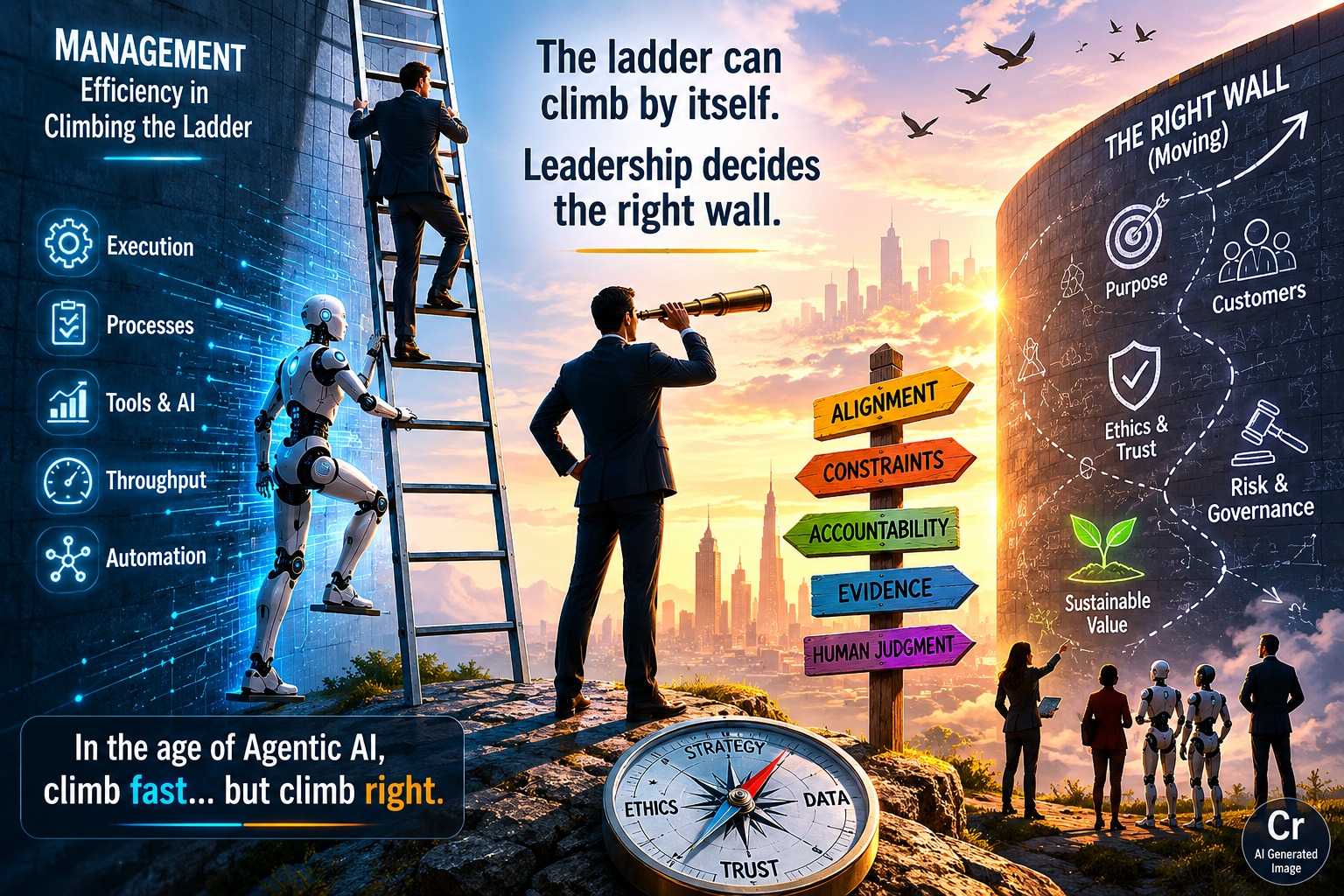
Covey’s ladder still matters. But today, the “right wall” isn’t a destination – it’s a decision you must keep making, with evidence, humility, and guardrails strong enough to survive success. The future belongs to leaders who have moved beyond “this looks right” to “this is right,” and who can keep climbing fast while knowing exactly why.
The future leader will not be the person who replaces humans fastest. It will be the person who knows where AI should amplify humans, where it should challenge them, and where it must remain firmly subordinate to them. The best leaders will not simply buy agents. They will redesign work, reprice risk, protect trust, and ask whether the organization is becoming more capable or merely more automated.
Covey gave us the ladder and the wall. AI gives us an autonomous climber. The next generation of leadership must decide the destination, the boundaries, and the human purpose worth climbing for.
The future will not reward leaders who made machines more powerful; it will reward leaders who made power more humane.
A seasoned techno-functional leader with over 25 years of experience, Vinod shepherds AI Enablement at Bayer Pharmaceuticals, where he integrates Generative AI and Language Models into the fabric of drug discovery and clinical development. His work helps scientists and innovators “wire their ideas smarter,” grounding cutting-edge AI with FAIR principles, zero-trust, and rigorous scientific alignment.
Vinod’s leadership has influenced how pharma and life sciences organizations think about AI reliability, interpretability, and memory governance. His collaborations span leading academic institutions, global AI vendors, and research partners that shape forward-leaning approaches to sustainable AI innovation. In the world of innovation, where ideas are the potatoes and data are the wire, Vinod ensures that every circuit runs clean, secure, and future-ready.
Recent Comments