This blog is based on our analyses, Top 10 Opportunities in Network Services, Strategic Imperatives in Enterprise Network Services, and Insights on Intelligent Network Automation, 2025 authored by Frost & Sullivan’s growth experts, Stephen Thomas and Amrit Singh, from the Enterprise Network Services team.
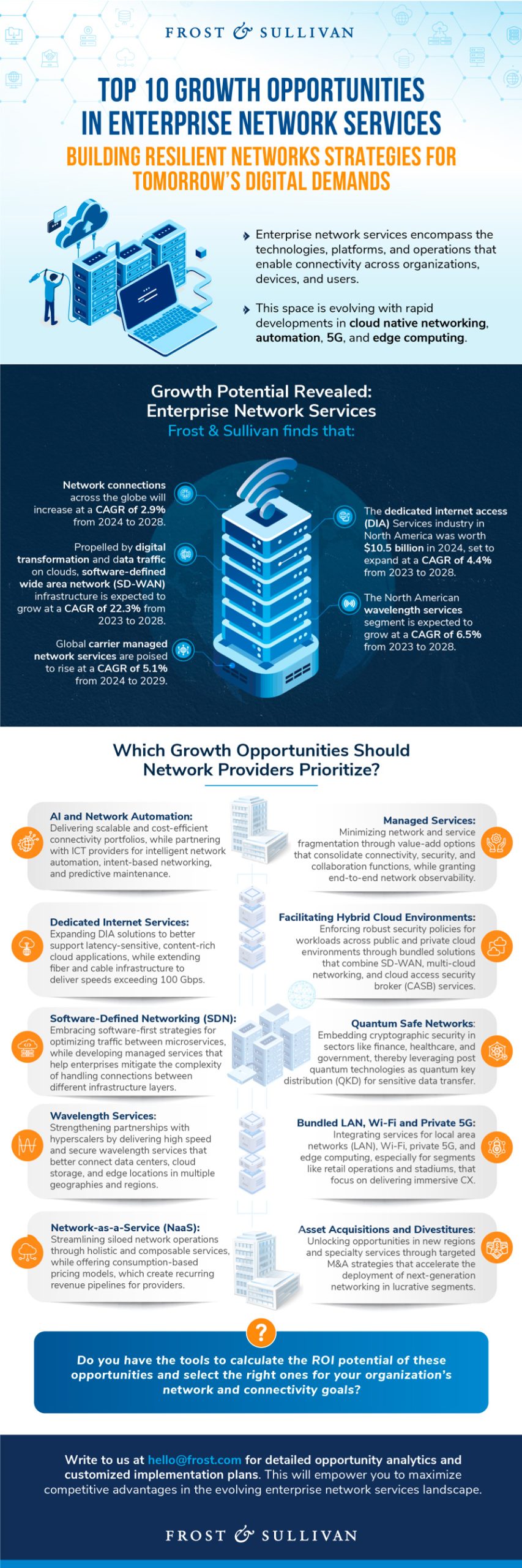
Enterprise network services encompass the tools, technologies, and systems that keep organizations, devices, and people connected. This space is quickly evolving, driven by advancements in cloud-native networking, automation, 5G, and edge computing. Together, these innovations are supercharging network architectures, making them more scalable, easier to manage, and capable of real-time reconfigurations. This is helping providers deliver low latency/high-capacity connections, and more efficient workplace communication — all with little need for manual input.
Now, to turn static networks into intelligent ones, industry incumbents must capitalize on:
- Network-as-a-Service (NaaS): enabling more agile and cost-effective access to network infrastructure, while generating recurring revenue.
- AI-first Network Automation: for analyzing data, automated threaten detection, intent-based networking, and self-healing capabilities.
- Software-Defined Networking (SDN): harnessing programable network tools for easy customization of network configurations.
- Integrated Security: leveraging secure access service edge (SASE) and zero trust networking for in-built security against vulnerabilities.
- Edge and Multi–Cloud Environments: orchestrating network management and security across cloud, on-prem, hybrid, legacy, multi-vendor, and edge layouts.
The Next Wave of Enterprise Networking: Why Network Management Must Evolve?
Frost & Sullivan’s latest network guide features emerging technologies, best practices, and futuristic network strategies. This is a must-read for providers updating legacy connectivity models and enterprises seeking more responsive network solutions.
- Actionable intelligence on upcoming megatrends in network services.
- Views on customer pain points and investment priorities for 2025.
- Ways to operationalize growth opportunities: intelligent network automation, dedicated internet access, SDN, wavelength services, and more!
- Best practices from companies like AT&T, Lumen Technologies, and Verizon.
Which tools will help you identify the most lucrative opportunities emerging from these headwinds?
The Next Frontiers in Networking: What to Watch in 2025+
Click here, to future-proof your organization’s network plans with these opportunities.
Modernizing Networks in a Digital Era
As enterprises move forward in their digital transformation journeys, traditional network models are falling short in meeting the performance and flexibility demands of cloud, edge, AI, and machine learning (ML) workloads. This is intensifying the pressure on providers to move beyond hardware-centric infrastructure to embrace agile, SDN-focused features that prioritize scalability and responsiveness.
To stay competitive, organizations must rethink their network strategies and embrace service-centric models built for speed and innovation.
Do you have competitive benchmarking tools to identify the right network providers for your organization’s upcoming growth initiatives?
Fueling the Push Towards Network Automation
Looking ahead, network automation is set to play a much bigger role than simply boosting efficiency, helping providers cut costs, deliver more reliable services (through NaaS), and develop AI-ready network solutions to stand out in an increasingly competitive landscape. Consequently, network service providers and equipment vendors are striving to collaborate with strategic technology partners across the ICT ecosystem, laying the groundwork for the following:
- Intent-based Networking: allowing users to define desired outcomes and automatically translating those into necessary configurations.
- Closed-loop Automation: facilitating continuous and repetitive interactions between network infrastructure and software elements, thereby supporting self-optimization.
- Automation-ready Devices: hardware that is intrinsically designed for programmability, high-bandwidth, and faster data transfers.
- API Standardization: for seamless integration and interoperability across different platforms and services.
Click here, for customer perspectives and investment priorities in network services.
Focusing on Innovative DIA Services
The Dedicated Internet Access (DIA) sub-segment continues to grow steadily, catalyzed by hybrid work and the rising demand for high-speed connectivity. Further, megatrends like SDN and cloud integration, combined with disruptive technologies like AI, ML, and IoT are spurring additional developments in this space. Moving forward, providers must harness the following drivers to mitigate growth challenges like pricing pressures, product commoditization, declining multiprotocol label switching (MPLS) revenues, and increasing competition from cable multi-system operators:
Top 3 Growth Drivers for Providers:
- The proliferation of Software-Defined Wide Area Networking (SD-WAN) increasing the demand for underlay DIA solutions.
- Exponentially growing data traffic with new GenAI applications.
- Increasing hybrid and multi-cloud architecture necessitating more reliable connectivity across industries.
Which Best Practices Will Help Industry Incumbents Extract Maximum Value From DIA?
Established providers with extensive network footprints are competing with coax and fiber cable companies, amplifying competition in a market that is swiftly moving towards maturity. To better differentiate themselves, providers feel compelled to implement the following best practices:
- Driving innovation in high-value features like intelligent network monitoring, automation, flexible billing, interactive customer portals, and wireless backup for automatic failover.
- Re-invigorating service portfolios with API (application programing interface) enabled tools that facilitate standards-based automation and network design between various ecosystem players.
- Streamlining the quote-to-cash process and visibility for customers with interactive portals and dashboards that factor in managed SD-WAN services.
Facilitating Network Transformation in Your Organization
As the synergy and convergence between AI, cloud computing, big data analytics, IoT, and cybersecurity grows, network traffic and bandwidth requirements are rising exponentially too. This means that businesses of the future need smarter, faster, and more adaptive connectivity strategies to thrive in tomorrow’s always-on landscape — What steps can you take to equip your organization for this change?
Looking for vertical-specific network and connectivity strategies?
Get in touch with our Enterprise Network Service experts to enable intelligent, secure, and scalable network workflows in your organization.