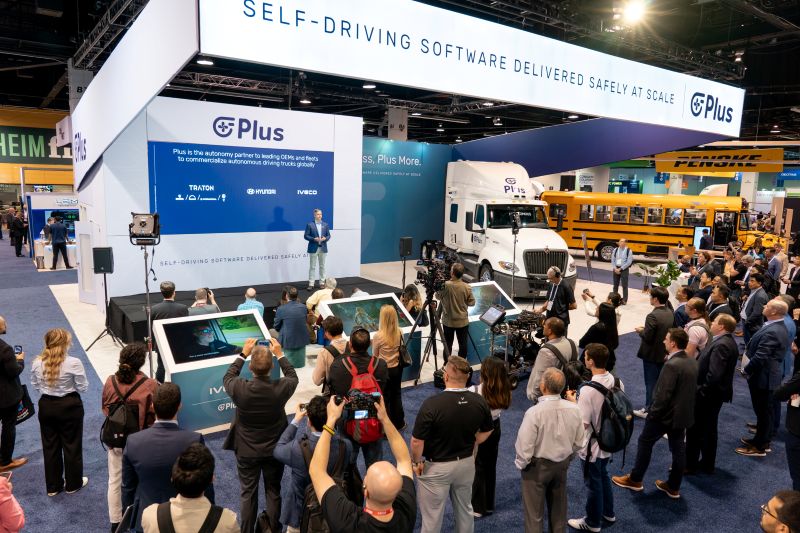
Commercial vehicle strategy is no longer about incremental change: it’s about transformation. At the recent Advanced Clean Transportation (ACT) Expo, held in Los Angeles, the world’s most advanced truck / commercial OEMs, powertrain innovators, and technology companies gathered to unveil solutions that are reshaping the ecosystem in real time.
Frost & Sullivan’s North America Advisory’s Mobility team attended the event to track exactly that — not just the technologies on display, but the strategic imperatives, best practices, and growth opportunities behind them. This write-up distills the highlights from our latest whitepaper based on insights from the event, and serves as your gateway to future-ready commercial vehicle strategies.
Explore detailed insights today!
Frost & Sullivan’s latest analysis, Growth Opportunities from the ACT Expo 2025: Your Roadmap to Future-ready Commercial Vehicle Strategies, dives into the best practices, strategic imperatives, key megatrends, and more observed during the event.
Four Strategic Imperatives Redefining Commercial Fleets
At the event, four key strategies were apparent among ecosystem leaders:
- Disruptive Technologies: EVs and hydrogen propulsion are maturing, encouraging new powertrain adoption and innovation.
- Innovative Business Models: From ownership to technology-as-a-service (TaaS), fleets are redefining value across software-defined architectures.
- Transformative Megatrends: Charging, refueling, and operational alignment are proving critical for adoption.
- Internal Challenges: Economic factors, return on investment successes, and infrastructure integration are separating winners from followers.
ACT Expo 2025 Highlights: Best Practices from Companies to Action
Electrification at Scale:
Companies like Peterbilt, Volvo, and Toyota are proving electrification isn’t a future concept, but today’s competitive edge. From modular battery designs to OEMs like Workhorse pushing the limits of EV range over 2,400 miles, real-world deployment was the theme of the hour.
Platform & Component Innovation:
ZF, Schaeffler, and Forvia showcased componentized, modular strategies that support multiple powertrain pathways: battery EV, hybrid, and fuel cell EV (FCEV). Integration, not isolation, is emerging as a key differentiator.
Infrastructure Ecosystem Shifts:
From ABB’s megawatt charging systems to EVConnect’s network optimization software and Revoy’s battery-as-a-trailer TaaS model, depot visibility and scalable infrastructure are shaping competitive advantage.
Have you built the partnerships and ecosystems needed to accelerate your zero-emission transformation?
Growth Opportunities Observed by Frost & Sullivan
Here’s where we see bold moves being rewarded:
- FCEV ecosystems are attracting fresh entrants and infrastructure investment.
- Depot-centric infrastructure is maturing, but public charging still lags; software innovation is helping bridge the gap.
- Software-defined vehicle (SDV) and autonomy layers are quietly gaining momentum, especially in long-haul logistics.
- Battery technology gains are slowing, shifting attention to fast charging and operational efficiency as key differentiators.
What Should You Do Next?
Sustainability, for commercial vehicles, is no longer a buzzword — it’s operational reality. The strategies on display at ACT Expo 2025 point to a future that favors:
- Modular product platforms
- Cross-sector collaboration
- Infrastructure-linked ROI clarity
- New models of uptime and TCO value delivery
Are your fleet and technology strategies built to win in this ecosystem—or just survive it?
Explore the Full Insights from ACT Expo 2025:
Download the Full Growth Opportunity Whitepaper
Schedule a Growth Pipeline Dialog™ with Our Experts
Why Frost & Sullivan?
Our North America Mobility Advisory practice doesn’t just analyze megatrends, we surface actionable growth opportunities, highlight companies to action, and align transformation with value chain strategies. Our Growth Pipeline Engine empowers OEMs, suppliers, fleets, and investors with custom roadmaps, total cost of ownership (TCO) models, and benchmarking to lead confidently through disruption. Get started with us today!