This blog is based on the recent Frost & Sullivan’s analysis, “Industrial Services Market, Global, 2025-2029,” authored by Sankara Narayanan, Industry Director, from the Industrial Team.
With the rapid proliferation of advanced digital tools and technologies, the industrial services are witnessing a transformative phase, paving way for new outcome-based revenue models. AI/machine learning (ML), robotics, digital twins, augmented reality (AR)/virtual reality (VR), the Internet of Things (IoT), and 3D printing are some of the emerging technologies that streamline operations, prioritize maintenance and support services, and ensure optimal performance.
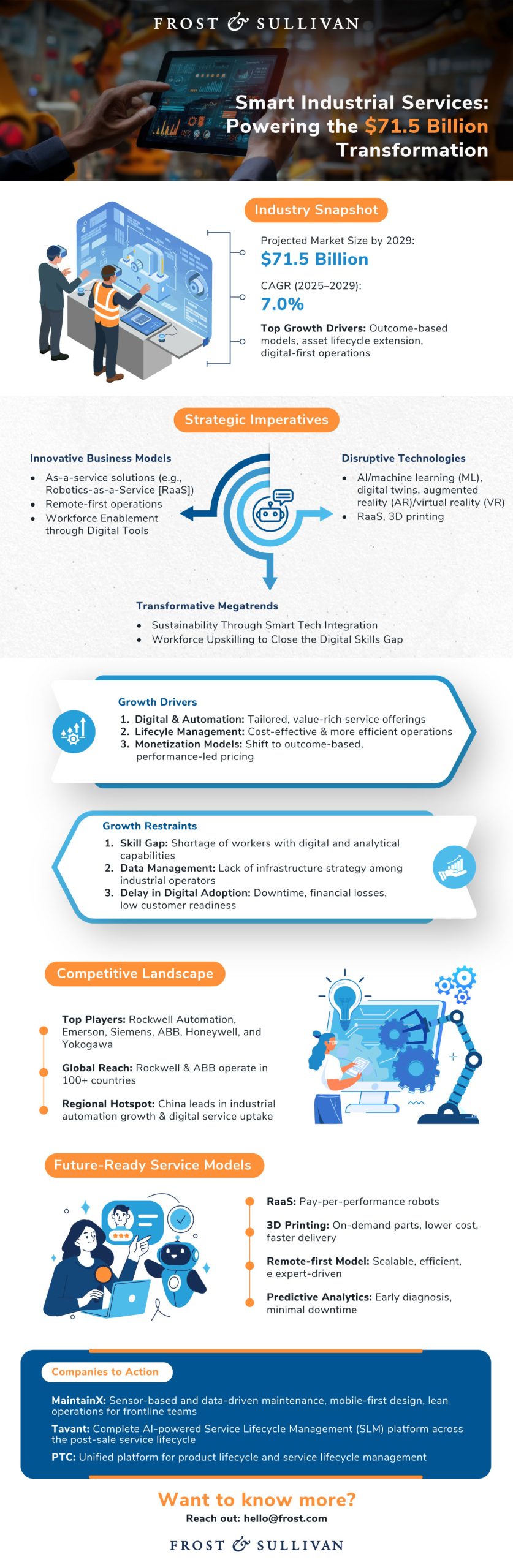
According to Frost & Sullivan’s latest analysis, the global industrial services sector is expected to grow at a CAGR of 7.0% from 2025 and reach $71.5 billion by 2029. A growing number of enterprises are outsourcing maintenance and repair tasks to other businesses, as they recognize investing in service offerings yields greater returns than replacing capital equipment.
Is your organization prepared to make the most of this transition and achieve long-term success?
Explore the latest technologies and strategic moves that will define success in the $71.5 billion industrial services market by 2029.
To help you navigate the challenges, let’s deep dive into the strategic imperatives, key growth drivers, megatrends, and adoption of smart technologies that will reshape the industrial services.
Strategic Imperatives Shaping the Future of Industrial Services
- Innovative Business Models: The traditional service model is giving way to agile, tech-enabled approaches. A remote-first mindset, combined with workforce empowerment through technology and data-driven decision-making, is redefining how industrial services organizations operate. Advanced offerings, such as “as-a-service” solutions, are enabling new revenue streams that prioritize flexibility, outcomes, and customer value over one-time transactions.
- Disruptive Technologies: Digital capabilities are now core to industrial service operations. Technology-enabled service delivery enhances workforce productivity and customer satisfaction by enabling real-time diagnostics, remote expert support, and automated dispatching. These capabilities streamline issue resolution and boost operational efficiency across distributed environments.
- Transformative Megatrends: As the demand for digital-first services grows, companies are navigating a tight labor market and a widening skills gap in areas such as analytics, automation, and AI. Bridging this gap requires proactive strategies to attract tech-savvy talent, upskill existing teams, and foster a culture of continuous learning that aligns with the digital evolution of the industrial sector.
Download the full analysis to discover the most profitable business models in industrial services.
Key Growth Drivers in Industrial Services
- Digitally Enabled Services: The integration of digital and automation technologies is enabling more sophisticated, tailored service offerings that meet the specific needs of each client enabling more efficient and cost-effective operations.
- Evolving Customer Expectations: Industrial customers now demand outcome-based models, where compensation is tied to performance rather than hours worked or tasks completed. This shift is opening new monetization pathways centered on value delivery.
- Asset Lifecycle Extension: With assets remaining operational for 15–20 years, organizations are increasingly focused on extending their lifespan rather than replacing them. Proactive monitoring and predictive maintenance are now critical to operational success.
Is your organization staying ahead of customer expectations and unlocking new revenue models in industrial services?
Futuristic Technologies Revolutionizing Industrial Services
Robotics-as-a-Service (RaaS) Model: RaaS is redefining warehouse automation. Unlike traditional leasing models, RaaS bills clients based on actual robot usage and performance, ensuring they pay for productivity, not just access.
3D Printing: Producing high-value complex parts can be expensive and time consuming for customers. 3D printing offers a fast, cost-effective and reliable option, with on-demand part delivery that significantly reduces equipment downtime.
Remote-first Model: Originally accelerated by the pandemic, remote-first model is now a mainstream approach. They improve customer experience, reduce response times, and lower overhead costs, while enabling faster issue resolution from anywhere in the world.
Data, Analytics, and Digitalization: Digitalization when combined with effective data management affect how the services are delivered. Organizations can diagnose problems earlier, optimize service schedules, and improve asset performance through data-driven decisions.
Skill Gap and Talent Management in Industrial Services
Traditionally, the industrial services workforce hasn’t been known for digital expertise. But that’s changing fast. Today, leading industrial companies are on the lookout for digitally savvy engineers who can deploy advanced solutions across global markets and collaborate with customers to co-create new offerings.
To attract younger, tech-forward professionals, businesses are investing in digital tools, including remote supervision capabilities. However, recruiting talent is only half the challenge. Retaining skilled workers and building digital capabilities across the workforce are essential in a labor-constrained market.
Global Leaders Driving Innovation in Industrial Services
A handful of visionary companies are redefining industrial services through digital transformation and lifecycle-centric service models:
- Rockwell Automation: Expanding globally with advanced lifecycle services and strategic acquisitions in AI, cybersecurity, and asset management.
- Emerson: Leading with connected services like Guardian and recent acquisitions such as AspenTech to enhance digital transformation.
- Siemens: Pioneering industrial software innovation through AI-powered tools, Software-as-a-Service (SaaS) models, and strategic acquisitions like Altair.
- ABB: Elevating service delivery with ABB Ability and ABB Care platforms that enhance process automation and efficiency.
- Honeywell: Integrating services through the Honeywell Forge platform and Accelerator framework to streamline operations.
- Yokogawa: Delivering 24/7 lifecycle care to boost maintenance efficiency, uptime, and digital readiness for industrial clients.
Get Full Access to the Latest Analysis
Growth Opportunities in Industrial Services
- Enhancing Customer Experience Through Digital Services and Self-service Tools
The services segment presents a significant opportunity to strengthen customer engagement and satisfaction. By digitizing service experiences, companies can build long-term customer relationships, drive repeat business, and unlock cross-selling or upselling opportunities.
Today’s industrial customers expect:
- Remote interactions and virtual sales engagements
- Streamlined, one-touchpoint transactions
- Easy, self-service digital reordering processes
However, many industrial service providers are falling short. Few have integrated digital solutions into their offerings or implemented self-service tools that align with modern expectations. To stay competitive, organizations must invest in digital interfaces, customer portals, and automation that personalize and simplify service interactions.
- Capitalizing on China’s Industrial Automation Boom
China represents one of the most dynamic and fast-evolving markets for industrial automation and services. Driven by the country’s shift from low-cost manufacturing to high-tech industrial capabilities, demand is soaring for:
- Industrial robots
- Distributed Control Systems (DCS)
- Intelligent manufacturing solutions
- Field instruments and advanced industrial automation technologies
Chinese manufacturers are embracing data-driven services, digitizing the service experience, and focusing intensely on customer outcomes. As equipment sales plateau, this transition creates a fertile environment for a service- and solutions-led growth strategy. Companies that move quickly to localize, customize, and digitize offerings for the Chinese market will gain significant competitive advantage.
Final Thoughts: The Future of Industrial Services
Industrial services landscape is at a crossroads where technological innovation, evolving customer expectations, and shifting workforce dynamics converge to create unprecedented opportunities.
Companies that can invest in smart technologies, develop future-ready talent, and partner with solution providers who can deliver integrated, data-driven services will become indispensable enablers of long-term value creation in this sector.
Wondering what strategic moves your organization needs to make to capitalize on emerging opportunities?
Want to speak to our experts? Schedule a Growth Pipeline Dialog or reach out to us on [email protected].