This blog is based on the detailed analysis, MetaBrain Whitepaper written by Frost & Sullivan’s growth expert, Subhranshu Shekhar Das, Executive Board Member and Regional Executive Board Member.
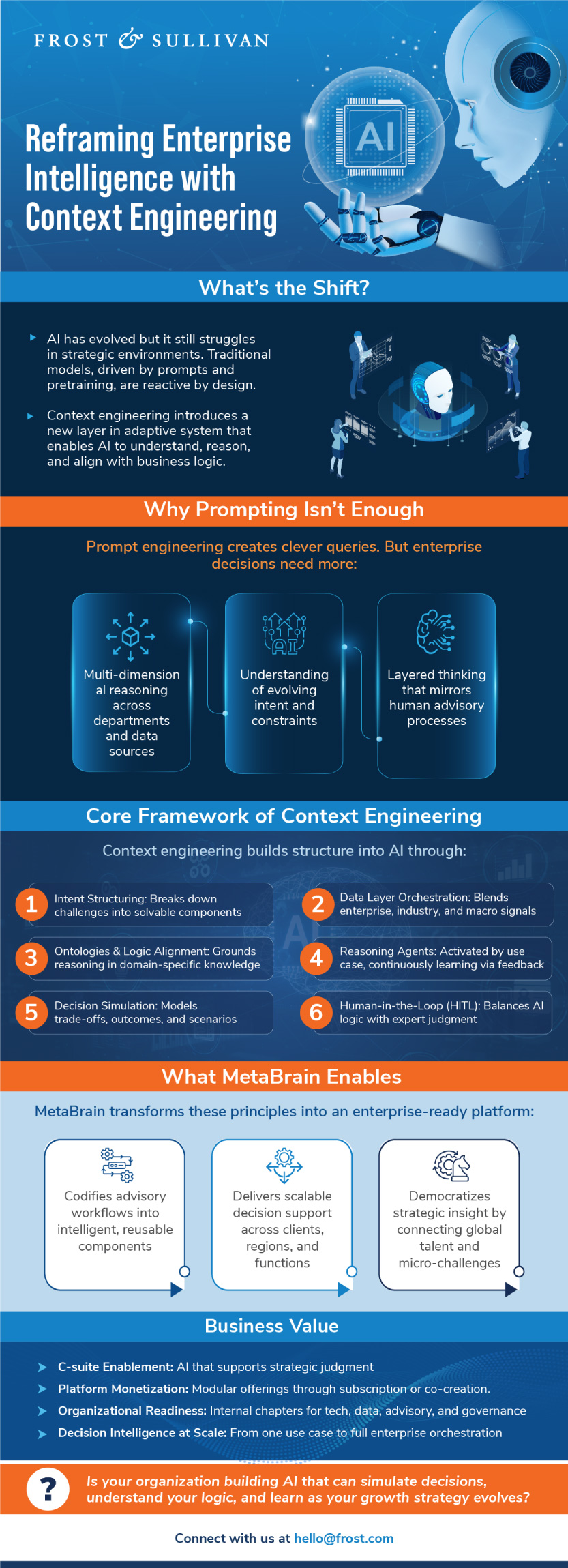
As enterprises push beyond automation and into high-stakes, cross-functional decision-making, traditional AI architectures are showing their limits. Static prompts and pre-trained models struggle to navigate layered challenges like risk balancing, strategic planning, and real-time market shifts. Context engineering is the critical shift. It introduces structured intelligence that enables AI systems to not just think for you but think with you. At Frost & Sullivan, we see this as the foundation for enterprise platforms like MetaBrain, built to codify logic, capture expertise, and deliver scalable, judgment-informed decision support.
“Context engineering marks a shift from automating tasks to amplifying enterprise thought.”
— Subhranshu Shekhar Das
What systems are you putting in place today to ensure your decision intelligence can scale across functions, geographies?
[Explore how MetaBrain enables strategic reasoning at enterprise scale.]
| Traditional advisory ecosystems are critical for: | Context engineering enhances these ecosystems by: |
|
|
Prompt Engineering Reaches Its Limits in Strategic Workflows
Prompts can guide Large Language Models (LLMs), but they can’t guide decisions. Real-world strategy involves evolving intent, cross-functional data, and constant trade-offs. Static inputs simply can’t match the dynamic nature of enterprise decision-making.
What will it take for your AI tools to adapt to the way your business actually reasons?
[Explore the shift from output to contextual understanding.]
Context Engineering: Making AI Strategically Relevant
Context engineering builds a scaffold around AI, infusing it with live enterprise data, industry signals, and domain logic. It simulates outcomes, supports reasoning chains, and incorporates human feedback in real time. The goal isn’t smarter models, but smarter systems of thought.
Is your enterprise building systems that mirror how strategic decisions are actually made?
What the Architecture Looks Like in Action
MetaBrain operationalizes context engineering through:
- Intent structuring – Captures and organizes user goals to guide AI responses.
- Real-time data orchestration – Integrates and processes live data streams for dynamic decision-making.
- Domain-aligned ontologies and business logic – Structures knowledge using industry-specific frameworks and rules.
- Reasoning agents with reinforcement learning – Enables agents to make decisions and improve through trial and feedback.
- Human-in-the-loop oversight – Maintains human supervision to validate and refine AI outputs.
This structure enables adaptive, scalable, and explainable intelligence.
Bridging Traditional Advisory Ecosystems with Scalable AI
AI does not replace trusted advisory workflows. It enhances them. Context engineering codifies frameworks, preserves domain depth, and scales human reasoning across geographies, clients, and industries. MetaBrain transforms knowledge into infrastructure.
Is your internal structure ready to support systems that learn and improve with each decision?
Real-world Example: MetaBrain in Strategic Supply Chain Planning
A global industrial manufacturer adopted MetaBrain to tackle cross-functional supply chain bottlenecks. By embedding context engineering into their planning workflows, they:
- Cut latency in decision cycles by 40%
- Aligned procurement, logistics, and risk planning into a single AI reasoning loop
- Empowered local teams to simulate the impact of strategic decisions before executing
This is the kind of adaptive intelligence context engineering makes possible.
Ready to explore how MetaBrain can turbocharge your decision-making process?
Contact Frost & Sullivan to schedule a demo or learn more about partnership opportunities. Write to us at [email protected]