Overview
The automotive aftermarket for original equipment (OE) accessories is evolving rapidly, shaped by changing consumer expectations, advances in vehicle technology, and shifting OEM strategies. The growing consumer demand for personalized, tech-enabled, and lifestyle-oriented experiences is stimulating significant demand for smart, connected, and sustainable OE accessories.
Personalization has emerged as a defining trend. From AI-powered infotainment systems and customizable ambient lighting to ergonomically tailored interiors, car buyers are increasingly looking for vehicles that reflect their individual preferences. This move presents OEMs with an opportunity to enhance customer satisfaction while tapping into high-margin aftersales revenue streams.
Simultaneously, the rise of eCommerce and digital retail channels is expanding OEMs’ reach. Digitalization is enabling direct-to-consumer (D2C) sales of OE accessories, supported by efficient logistics and robust online platforms. As consumers prioritize convenience, OEMs are investing in immersive, digital-first retail experiences that boost accessory sales as well as foster long-term brand loyalty.
The growing adoption of electric vehicles (EVs) and hybrid powertrains is emerging as another major growth catalyst. EV owners, who typically tend to be early adopters of technology, are spurring demand for accessories such as home chargers, cable organizers, and vehicle-specific inverters. Additionally, safety has become a top priority, with rising interest in dashcams, anti-theft devices, and advanced driver assistance systems (ADAS).
In essence, OE accessories are no longer being regarded as merely aesthetic upgrades or functional add-ons. They now offer extended value by enhancing vehicle functionality, safety, and personalization in line with broader industry trends.
Impact of C.A.S.E. Trends on Accessory Innovation
The automotive industry’s pivot toward Connected, Autonomous, Shared, and Electric (C.A.S.E.) mobility is reshaping the OE accessories landscape. These trends are influencing product design, material choices, functionality, and integration strategies.
For instance, connected mobility is driving the development of accessories that seamlessly interface with in-vehicle systems. Connectivity is enabling utility tracking, safety features, and comfort enhancements, exemplified by RFID-enabled racks, GPS-integrated cargo carriers, and in-cabin monitoring systems. Products like Rivian’s GearGuard, which uses cameras and sensors to monitor vehicle accessories and Michelin’s connected tire solutions underscore how OE accessories are evolving in tandem with C.A.S.E.
In parallel, autonomous driving is prompting a reimagining of vehicle interiors. As vehicles take over more driving functions, the focus is shifting toward the passenger experience. Accessories such as touchscreen climate controls, infotainment hubs, and customizable lighting are becoming integral to in-cabin environments. Brands like Waymo are leading this trend, transforming interiors into mobile lounges and workspaces.
Shared mobility is increasing the demand for durable, modular, and easy-to-maintain accessories. For example, ride-hailing and carsharing fleets require solutions such as stain-resistant seat covers, heavy-duty floor mats, and adaptive storage compartments. Products like WeatherTech’s floor liners, tailored for rideshare use, highlight how accessories are being adapted to this business model.
Electrification is also influencing accessory design. EVs require lightweight, aerodynamic external add-ons to preserve range and efficiency. Inside, environmentally friendly car care products and non-toxic cleaning agents are gaining popularity. For example, Lucid Motors recommends specific safe cleaning materials for its sensitive electric systems, aligning accessories with EV needs.
Regional Dynamics and Competitive Positioning
Regional dynamics are shaping OE accessory preferences and performance. North America is witnessing strong demand for performance-enhancing and personalized accessories. Consumers are seeking upgrades that improve connectivity, driving experience, and infotainment fueled by the widespread adoption of smartphone ecosystems and app-based vehicle management. Accessories that combine functionality with visual appeal are particularly popular with consumers.
Frost & Sullivan, 2025
In Europe, stringent environmental regulations and the rapid adoption of EVs are impacting accessory demand. Here, the focus on sustainability and safety is resulting in eco-friendly coatings, ADAS-aligned systems, and ergonomic interiors that meet Euro NCAP standards. Digital retail is also thriving, with OEMs leveraging online platforms to offer EV-compatible accessory bundles. This aligns with the European Green Deal and the region’s carbon-neutral goals.
Asia-Pacific (APAC) presents a more diverse landscape. Personalization remains important, but tech-enabled accessories, particularly in infotainment and smart storage, are popular. Emerging economies are generating demand for affordable, value-focused accessories, with local OEMs balancing cost-efficiency and innovation to meet varied consumer needs
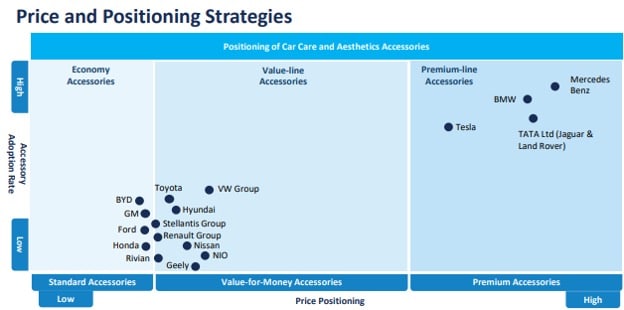
Leading OEMs such as Ford, Toyota, BMW, and Mercedes-Benz stand out for their comprehensive accessory portfolios and strategic initiatives. These include multi-channel distribution, subscription-based services, and deep integration of advanced technologies. Among noteworthy examples are Mercedes-Benz’s MBUX system, which integrates with multiple accessories, and BMW’s personalization configurators.
Meanwhile, Geely, BYD, and NIO are emerging players with strong potential. However, they currently confront challenges related to portfolio diversification and technology integration. NIO’s focus on premium EVs is notable, yet limited transparency over OES distribution strategies and weak digital integration could constrain future growth in the accessories segment.
Accessory Segments Adapt to Evolving Customer Expectations
External accessories such as body kits, roof racks, decals, and aerodynamic aids continue to have strong appeal for their blend of performance, aesthetics, and utility. In response to consumer demands for sustainability and personalization, OEMs are exploring recycled materials and bespoke designs. Examples of such products include BMW’s customized body trims and Porsche’s active aero kits.
Future innovations are expected to incorporate external accessories with telematics and sensors. Modular roof racks with integrated GPS theft alerts or load-monitoring pressure sensors are becoming increasingly viable. For instance, Thule’s connected roof racks represent this convergence of lifestyle functionality and smart design.
Simultaneously, internal accessories are evolving to deliver space optimization, comfort, and hyperpersonalization. For instance, Ford’s modular cargo systems and Alcantara’s premium seat materials showcase how ergonomics and aesthetics are merging. OEMs are also using eCommerce to provide a D2C platform for customized seat covers, floor mats, and sunshades, often bundled with financing and loyalty programs.
Electrical, electronics, and connectivity accessories are experiencing a surge in demand. Dashcams, parking sensors, and sophisticated infotainment systems are becoming standard. EVs, in particular, require additional solutions like home chargers, portable charging kits, and compliant adapters. Here, automakers like Hyundai and Tata Motors are already offering comprehensive accessory packages aligned with evolving EV safety and charging needs.
Frost & Sullivan, 2025
The car care and aesthetic accessories segment is being redefined by sustainability. Products with biodegradable materials, nano-coatings, and waterless cleaning capabilities are gaining traction among eco-conscious consumers. Brands such as Turtle Wax and 3M are leveraging OEM service (OES) channels to offer high-performance, environmentally friendly solutions that also improve vehicle durability.
Strategic Outlook
Looking ahead, OEMs and suppliers have numerous opportunities to create value in the OE accessories space. Subscription-based models are poised to redefine how accessories are accessed and monetized. For instance, Audi’s Functions on Demand initiative, which enables the post-purchase activation of digital features, highlights how OEMs can build recurring revenue and give consumers flexibility. Extending such models to include infotainment, lighting, or ADAS accessories will deepen customer engagement.
In parallel, the demand for safety and security accessories will become increasingly crucial. With the adoption of C.A.S.E technologies, consumers are progressively prioritizing in-vehicle safety and situational awareness. Dashboard cameras, tire pressure monitoring systems (TPMS), and collision-avoidance tools are becoming mainstream. While OEMs such as Tesla, Honda, and Ford are leading in this context, competing automakers like Renault, Nissan, and Geely are looking to enhance competitiveness by investing in advanced safety accessory portfolios.
Fleet-specific accessories will present another untapped opportunity. As commercial fleets seek ergonomic and safety solutions, OEMs can offer tailor-made accessory bundles. Adjustable seats, collision sensors, and storage optimization tools can improve driver comfort and operational efficiency. Aptiv’s Connect Edge device, which enables fleet health monitoring, is an example of this trend. Pairing such solutions with eCommerce platforms and subscription services will boost market penetration and ensure recurring revenue.
The OE accessories segment is emerging as a strategic growth lever for the automotive industry. For OEMs, it presents a path to diversify revenues, strengthen customer loyalty, and align with C.A.S.E. megatrends. For consumers, accessories are poised to enhance personalization, functionality, and convenience. By focusing on technology integration, sustainability, and user experience, OEMs will be optimally positioned to shape a future-ready OE accessories ecosystem.