This blog is based on Frost & Sullivan’s analysis, “Growth Opportunities in the Industrial Semiconductors Market, Global, 2024–2029,” authored by Prabhu Karunakaran, Industry Analyst, from the Industrial Practice Area.
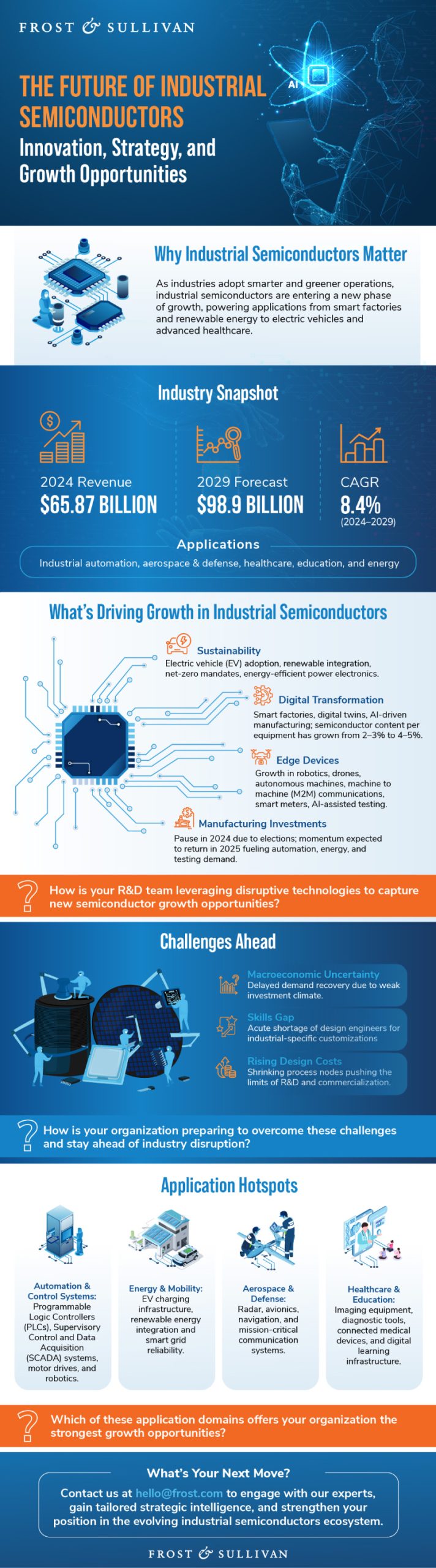
After a period of macroeconomic headwinds and inventory corrections, the industrial semiconductor industry is preparing for renewed momentum. According to Frost & Sullivan’s latest forecast, the industry is expected to grow from $65.87 billion in 2024 to $98.9 billion by 2029, at a CAGR of 8.4%.
Growth will be driven by sustainability imperatives, digital transformation, edge intelligence, and advanced materials that enhance efficiency and performance across automation, energy, aerospace, defense, and healthcare.
Discover how disruptive technologies and global strategies will shape a $98.9 billion industrial semiconductors landscape by 2029.
How is your strategy aligning to capture the next wave of growth in industrial semiconductors?
Strategic Imperatives Driving Growth in Industrial Semiconductors
- Disruptive Technologies
Industrial semiconductors are evolving beyond traditional silicon. Wide bandgap materials such as silicon carbide (SiC), gallium nitride (GaN), and indium phosphide (InP) are enabling superior efficiency, higher power density, and better thermal performance. In addition, silicon photonics is becoming integral to solving computing bottlenecks and enabling faster data transfer. - Internal Challenges
A shortage of skilled engineers and the rising costs of R&D continue to weigh heavily on development. AI-powered Electronic Design Automation (EDA) tools and design innovations are becoming critical to overcoming these challenges. - Geopolitical Chaos
Trade conflicts, global instability, and reliance on Asia for fabrication have exposed critical semiconductor supply chain risks. While complete independence is impractical, friend-shoring, near-shoring, and regional fabs for power semiconductors are emerging as essential steps to strengthen resilience and ensure continuity.
How is your organization aligning with these imperatives to capture new growth in the industrial semiconductors industry?
Emerging Technologies Transforming Industrial Semiconductors
- Wide Bandgap Semiconductors (SiC, GaN, InP): Powering electric vehicle (EV) charging, renewable grids, and mission-critical automation with higher efficiency and performance.
- Silicon Photonics: Addressing bandwidth and energy demands in high-performance computing and industrial communications.
- AI-powered Design Tools: Accelerating time-to-market by enabling faster, more efficient design cycles and testing processes.
- Gate-All-Around (GAA) Architectures: Enhancing scalability and performance for next-generation devices.
How are these emerging innovations redefining your organization’s competitive benchmarks for the years ahead?
Companies to Action
The industrial domain is highly competitive, with more than 50 participants. Top semiconductor companies such as Texas Instruments, Infineon Technologies, STMicroelectronics, Onsemi, Microchip Technology, and Renesas Electronics account for 40% of revenues in 2024.
Recent mergers and acquisitions (M&A) activity highlights a strong push toward wide bandgap semiconductor technologies:
- Renesas Electronics acquired Transphorm (2024)
- Infineon Technologies acquired GaN Systems (2023)
- MinebeaMitsumi acquired Hitachi Power Semiconductor (2024)
Growth Opportunities in Industrial Semiconductors
Growth Opportunity 1: Railways
Railways are emerging as a major growth area for semiconductors, driven by massive global infrastructure investments. India alone spends nearly $30–40 billion annually on interstate railways and another $10–20 billion on metro projects.
Rising demand for energy efficiency, automation, safety, and smart payments is accelerating the need for advanced chips across power management, connectivity, navigation, and HVAC (heating, ventilation, and air conditioning) systems. Semiconductor players are seizing this momentum by collaborating with subsystem providers to co-develop efficient, reliable solutions.
Looking ahead, electrification and renewable integration are creating even greater opportunities. Innovations such as solar-powered train cars and energy-harvesting technologies are increasing semiconductor content and value, positioning railways as a dynamic, high-potential market.
[Download Our Full Analysis to Access More Growth Opportunities]
The Road Ahead for Industrial Semiconductors
With advanced materials, digital transformation, and sustainability as key drivers the market is positioned for sustained growth. Success will depend on how quickly companies address design costs, time-to-market pressures, and semiconductor supply chain vulnerabilities while investing in emerging materials and architectures.
How is your organization turning disruption into innovation-led growth over the next decade?
Let’s connect! Schedule a Growth Pipeline Dialog™ with Frost & Sullivan’s experts or write to [email protected].