This blog is based on our voice of customer analysis, State of the Cloud, Europe: Firms Embrace Cloud and AI authored by Frost & Sullivan’s growth expert, Lynda Stadtmueller from the Cloud Business Solutions team.
In an era of macroeconomic challenges and cautious IT spending, digital transformation and digitalization journeys may be moving slowly, but the momentum remains steady. This means that organizations continue to lean on advancements in cloud and AI technologies to power growth, operational efficiency, and business resilience.
In Frost & Sullivan’s annual survey of IT decision makers across industries, we explored how businesses are preparing to adapt investment strategies in cloud and managed services to stay competitive. From multi-cloud architectures to app modernization and sustainability, here’s what tomorrow’s enterprises are prioritizing:
- Cloud migration: moving legacy applications, data, and workloads to the cloud for added flexibility and access to new technologies.
- Cloud cost optimization and sustainability: leveraging intelligent automation and specialized managed services.
- Hybrid cloud environments: for striking a balance between scalability, security, and cost-efficiency.
- High-performance, low-latency computing: for scaling AI across multiple functions.
The question is – How will you pivot your organization’s cloud strategies to keep pace with changing customer needs?
Enterprise Perspectives on Managing Cloud Complexity and Scaling AI
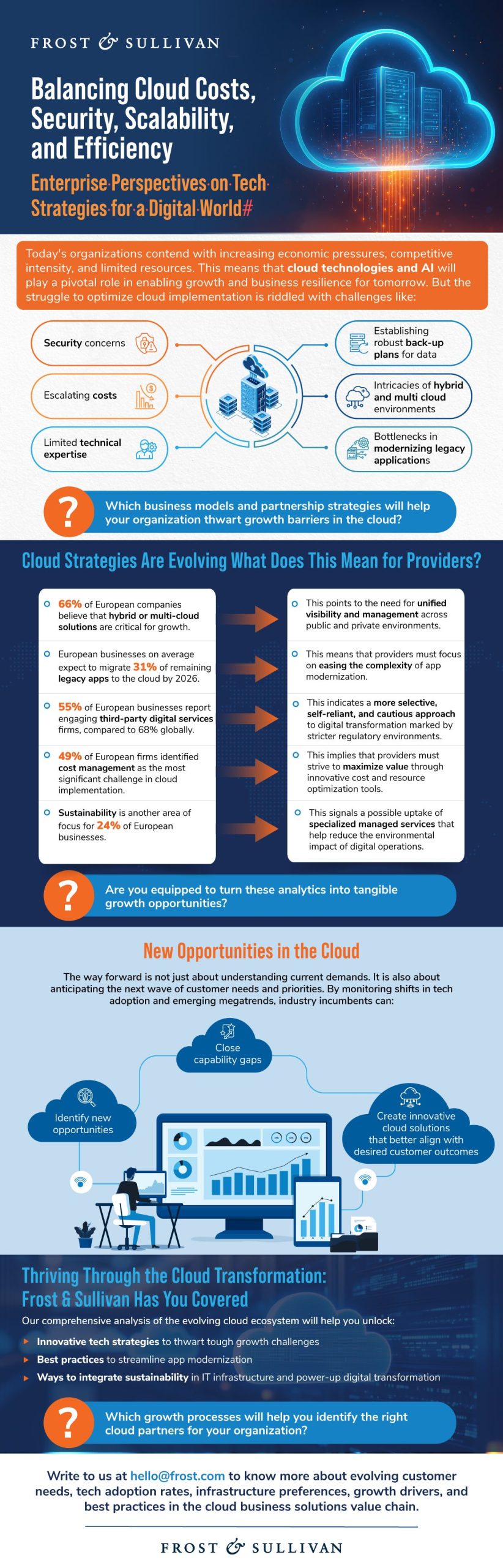
The use of hybrid cloud in Europe is expected to double by 2026, casting the limelight on advanced security and cloud cost management.
Access full analysis to turn these headwinds into new growth avenues for your business.
From Legacy Workloads to Modern Platforms: How Cloud Investment Strategies Are Evolving
Cautious Cloud Migration in Europe
Legacy application migration continues to be a work in progress. European businesses expect to migrate 31% of remaining workloads to the cloud by 2026—well below the global average of 39%.
This slower pace does not indicate a lack of interest. Rather, it highlights the complexity of app modernization. Many companies are still dependent on on-premises data centers for sensitive workloads or systems deeply tied to existing processes. For these organizations, hybrid cloud offers a practical middle ground: modernize at a manageable pace without disrupting business continuity.
- The takeaway for providers?
Cloud migration services cannot be one-size-fits-all. Success lies in offering flexible paths, robust interoperability, and frameworks that reduce the risks of moving mission-critical workloads.
Why Public Cloud Still Matters?
Public cloud remains an essential piece of the puzzle. European firms cite speed of app deployment, secure access for remote workers, and agility as top reasons for choosing public cloud platforms.
This is especially relevant in a work environment where distributed teams and remote set-ups are the norm. Businesses need infrastructure that scales quickly, supports remote collaboration, and provides reliable security. Public cloud answers these needs, but the demand is not to replace private or on-premises systems outright—it is to complement them as part of broader multi-cloud strategies.
Which best practices ensure seamless integration between public cloud, private cloud, and on-premises systems?
Sustainability as a Differentiator
Sustainability continues to be a uniquely European priority. While interest in green initiatives has dipped slightly in North America, Latin America, and Asia-Pacific, Europe holds steady: 24% of businesses in the region cite sustainability as a top organizational priority, compared to just 16–22% elsewhere.
This is not just a boardroom talking point. Companies are increasingly asking their providers how cloud infrastructure can reduce environmental impact as part of broader digital transformation initiatives. Managed services that enable energy-efficient data centers, optimize resource usage, and support compliance with ESG goals are becoming more attractive.
High costs and limited in-house expertise remain obstacles, but the commitment is clear.
- The takeaway for providers?
Those who can combine technical expertise with sustainability-focused services are well-positioned to lead.
SMB Perspectives and Investment Priorities
While small and medium businesses (SMBs) lag behind larger enterprises in technology adoption, they are turning to managed service providers (MSPs) to fill expertise gaps, especially in application development, data migration, and data management.
Access full analysis to view detailed digital investment plans from SMBs.
Which growth processes will you use to integrate sustainability into digital transformation strategies?
Selective Partnering in Europe: In-house First
One notable difference between Europe and other regions is how companies approach third-party support and managed services. Just 55% of European firms currently engage digital services partners, compared with 68% globally. Another 12% plan to do so by 2026, showing steady but selective growth.
This reflects three realities: strict regulatory environments, a strong preference for in-house control, and cost discipline in a slow-growth economy. When third-party partners are brought in, it is typically for high-impact, cross-functional projects where internal expertise in cloud security or specialized operations is limited.
- For providers, the message is clear: winning business in Europe requires trust, compliance, and specialization. Firms want partners who bring unique expertise, not generic offerings.
Wondering how SMB tech investment strategies will differ from those of larger enterprises?
Thriving Amid the Cloud Revolution
In conclusion, European businesses and SMBs may be moving at a measured pace, but they are moving with purpose. They see cloud and AI not as nice-to-have technologies but as essential foundations for growth, resilience, and sustainability.
For providers, the opportunity is not just to sell infrastructure but to become trusted partners in transformation. By addressing cost management, supporting AI-driven innovation, and aligning with sustainability goals, they can help businesses navigate complexity and unlock the true potential of the cloud era — Which business models and partnership strategies will help your organization thwart growth barriers in the cloud?
Get in touch with our Cloud Business Solutions experts to know more about evolving customer needs, tech adoption rates, infrastructure preferences, growth drivers, and new opportunities across the cloud value chain.
Alternatively, you can also write to us at [email protected].