This blog is based on the recent analyses “Latin America’s Automotive Industry Outlook” and “ASEAN Automotive Growth Outlook”, authored by Frost & Sullivan’s Growth Experts, Ming Lih Chan and Ingrid Schumann, from the Mobility team.
How Electric Vehicles and Smart Mobility are Driving Growth in Latin America and Southeast Asia
As the automotive industry undergoes transformation, Latin America (LATAM), ASEAN (The Association of Southeast Asian Nations), and other regions are rapidly emerging as critical hubs for electric vehicles (EVs) and smart mobility. Driven by electrification, technological advancements, and shifting consumer demands, both regions offer vast growth potential for automakers and mobility companies. With rising urbanization, favorable government policies, and the growing presence of both local and international manufacturers, the future of mobility in these geographies is filled with promising opportunities.
LATAM: Accelerating the Shift Towards Electrification
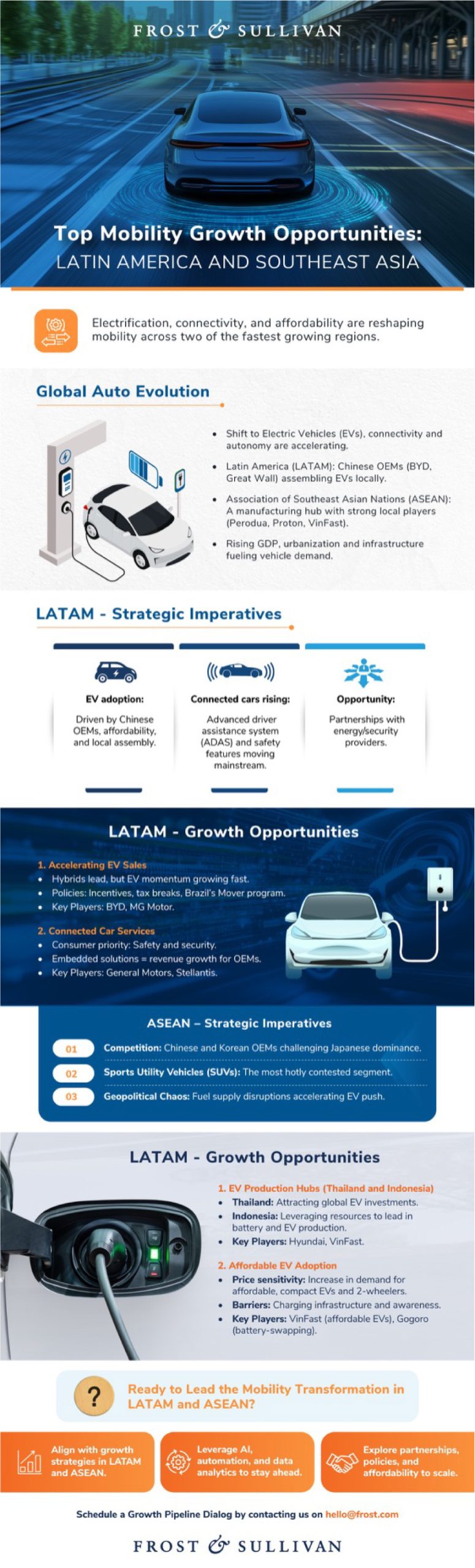
In recent years, there has been a notable shift toward electric and hybrid vehicles in the region, and this trend is expected to accelerate further. Chinese OEMs, such as BYD and Great Wall Motors, are at the forefront of this transformation, driving EV adoption through competitive pricing and local production. This is leading to a reduction in vehicle costs and the establishment of vital charging infrastructure.
Accelerating EV Sales
The transition to EVs is gaining momentum, fueled by government incentives and infrastructure development. Countries like Brazil have launched initiatives such as the “Mover” program to encourage the adoption of electric mobility. OEMs are expanding their EV portfolios, offering a wide range of options across various price segments, making EVs more accessible to local consumers.
Companies to Action:
- BYD is expanding its presence in this region with models like the Dolphin and Yuan Plus, making affordable EVs through local production.
- Morris Garages (MG) is increasing its footprint by offering competitive EV options like the MG4 Electric, targeting price-sensitive consumers.
Connected Vehicles and Safety
Another megatrend is the growing demand for connected vehicles, particularly those offering advanced driver assistance systems (ADAS) and safety features. As these technologies become more mainstream, automakers are looking to integrate them into both premium and entry-level vehicles to cater to the increasing demand for safety and security.
Key Companies to Action:
- General Motors (GM) is expanding its connected services, like OnStar, across the Latin territory to offer real-time safety and navigation.
- Stellantis is integrating embedded connectivity features such as emergency assistance and vehicle diagnostics across its portfolio.
What steps is your company taking to capture the growing demand for electrified and connected vehicles across this region?
READ MORE: Latin America’s Automotive Outlook for 2026 and Beyond
ASEAN: The Rise of EV Production Hubs
In countries like Thailand and Indonesia are positioning themselves as important EV production hubs. The region is becoming a key player in the global EV supply chain, driven by favorable government policies, investments in infrastructure, and the presence of both regional and international automakers. The shift towards electrification is being accelerated by local manufacturing, which helps reduce costs and improve vehicle accessibility.
EV Production and Local Partnerships
Thailand’s favorable EV production incentives and Indonesia’s focus on battery manufacturing are shaping the region’s future as a global EV powerhouse. With the right partnerships, Southeast Asian countries are well on their way to becoming major players in the electric mobility landscape.
Companies to Action
- Hyundai Motor Group is strengthening the region’s EV ecosystem through joint ventures, focusing on local production of vehicles and batteries.
- VinFast is expanding its presence in this region by opening new production facilities and offering affordable EVs tailored to regional needs.
READ MORE: Achieving carbon neutrality in battery electric vehicles (BEVs)
Driving EV Adoption Through Affordability
Affordability remains a key barrier to EV adoption. However, governments in countries like Vietnam, Malaysia, and the Philippines are introducing policies and incentives to make EVs more accessible. By focusing on affordable models such as electric two-wheelers and compact passenger cars, automakers can help accelerate the transition to electric mobility.
Companies to Action
- VinFast is expanding its offerings with affordable EV models, including electric two-wheelers and compact sport utility vehicles (SUVs), which cater to price-sensitive consumers.
- Gogoro is pioneering battery-swapping networks for electric two-wheelers, providing a cost-effective and scalable solution to overcome charging infrastructure gaps.
Strategic Imperatives for Success
Competitive Intensity
In both LATAM and ASEAN, local production can significantly reduce costs and improve accessibility. Offering affordable EV models tailored to the needs of regional consumers will be key to driving adoption and gaining a competitive edge.
Innovative Business Models
Building strong partnerships with local governments and energy providers will help expand EV infrastructure and create a sustainable mobility ecosystem. Governments in both regions are already offering various incentives to support the growth of electric mobility.
Disruptive Technologies
As consumers demand smarter, safer vehicles, integrating technological advancements, like connected car services and ADAS, into a wider range of vehicles will differentiate companies and attract more customers.
Are you adapting to these strategic imperatives to drive growth and innovation??
These regions represent two of the most promising growth areas in the global automotive industry. With the ongoing push for electrification, evolving consumer preferences, and the rise of local and Chinese manufacturers, the next phase of automotive innovation is unfolding in these regions. Companies that act strategically, focusing on local production, affordable EV offerings, and innovative technologies, will be well-positioned to lead the way in the mobility revolution.
Want to dive deeper? Click here to connect with Ming Lih Chan, Ingrid Schumann, and other mobility growth experts to discover how these insights can help accelerate your growth strategy.
You can also connect with us at [email protected].