This blog is based on Frost & Sullivan’s analyses, “Agricultural Robots, Growth Opportunities, 2024–2029, and “Growth Opportunities for Robotics in the Food and Beverage Industry,” authored by Ram Ravi and Soniya Shrivas from the Industrial and TechVision Practice Areas respectively.
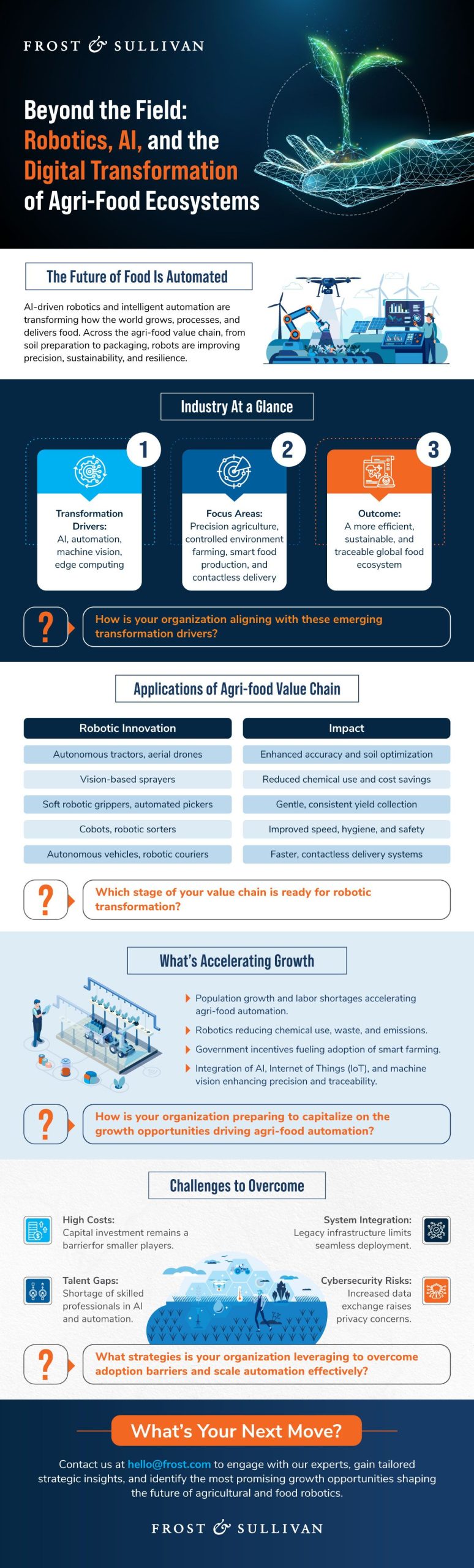
For decades, agriculture and food production have relied on tradition, manual labor, and complex logistics. Today, digital transformation is driving a profound shift. AI-powered robots, intelligent analytics, and connected automation in agriculture are redefining how the world grows, processes, and consumes food.
From autonomous tractors and crop-monitoring drones to robotic inspection systems and contactless food delivery, automation is redefining productivity across every link of the agri-food value chain. What was once labor-intensive and fragmented is now becoming data-driven, precise, and integrated.
Discover how robotics in food and agricultural industry are unlocking new growth opportunities, driving innovation, and shaping a sustainable global food ecosystem.
Frost & Sullivan’s latest whitepaper provides an in-depth analysis on how digital transformation, robotics, and smart manufacturing are reshaping sustainable food systems.
How is your organization preparing to capitalize on the robotic growth opportunities shaping the future of agriculture and food production?
Why Agri-food Robotics Matters Now
The global food supply chain is under pressure, from labor shortages and resource constraints to climate unpredictability. In this context, precision agriculture robotics is becoming a necessity.
- Autonomous robotics in agriculture is reducing dependency on manual labor and enhances traceability.
- Smart robotics in food industry are enhancing packaging, inspection, and delivery.
- AI and edge computing are enabling real-time decision-making based on sensor data and predictive models.
How is your organization preparing to align with the intelligent automation era in agri-food?
Access our exclusive analysis on growth opportunities in agricultural and food robotics
Key Strategic Imperatives Shaping Agri-food Robotics
Innovative Business Models
- Robotics firms are transitioning from equipment sales to automation-as-a-service models, improving scalability and affordability.
- AI platforms and cloud analytics are becoming integral to decision-making, predictive maintenance, and process optimization.
- Food & beverage (F&B) producers are integrating robotics into digital twins and smart factories, enabling continuous improvement and real-time insights.
Industry Convergence
- Collaboration among AgriTech, robotics, and food automation providers is creating end-to-end smart ecosystems.
- Integration with Internet of Things (IoT), sensors, and vision systems enhances transparency from farm to fork.
- Strategic partnerships between robotics startups and established F&B companies are accelerating innovation cycles.
Transformative Megatrends
- Global food demand and sustainability regulations are driving investment in clean, resource-efficient automation.
- Controlled Environment Agriculture (CEA) and vertical farming are emerging as key solutions for urban food security.
- Robotic farming innovation supports net-zero agriculture, reducing waste, energy consumption, and chemical inputs.
How is your organization planning to lead the transformation toward intelligent, and connected agri-food ecosystems?
Emerging Growth Opportunities in Agri-food Robotics
Growth Opportunity 1: Robotics for Controlled Environment Agriculture (CEA)
CEA and vertical robotic farming are redefining food production by bringing crops closer to consumers and reducing environmental impact. Robotics in seeding, pollination, and harvesting ensures high efficiency and year-round productivity.
Download the Full Analysis to Explore More Growth Opportunities
Building Intelligent and Sustainable Food Systems for the Future
Organizations that embrace AI, robotics, and analytics will lead in productivity, resilience, and environmental performance. By investing in connected automation, companies can turn food security challenges into growth opportunities, enabling a future where farms, factories, and food systems operate as one intelligent network.
Is your organization ready to lead the next wave of intelligent agri-food transformation?
Next Steps
Connect with our experts at [email protected] or schedule a Growth Pipeline Dialog to explore how Frost & Sullivan can help you accelerate your automation roadmap and capture new value in the agri-food ecosystem.