This blog is based on Frost & Sullivan’s analyses, “Industrial Hybrid AI Market, Global, 2024–2029” and “Growth Opportunities in the Industrial AI Market,” authored by Sankara Narayanan and Karthik Sundaram, from the Industrial Practice Area.
Industrial automation is entering its most transformative decade in more than fifty years. Global industries, from manufacturing and energy to chemicals, mining, and life sciences, are experiencing a fundamental shift as traditional automation reaches its limits. The pace, scale, and complexity of modern industrial operations now demand intelligence that is adaptive, explainable, and capable of autonomous decision-making.
Discover the full spectrum of hybrid AI in industry
This industry-wide transformation is being accelerated by the rise of hybrid AI, industrial AI, autonomous agents, digital twins, and edge intelligence. Together, they are enabling a new era of industrial growth driven by intelligent systems that are increasingly self-optimizing, interconnected, and continuously learning.
Frost & Sullivan’s latest whitepaper provides in-depth analysis on how hybrid intelligence, autonomous systems, and software-defined automation are redefining industrial performance.
How is your organization preparing to capitalize on the AI-driven growth opportunities shaping the future of manufacturing and process industries?
Listen to Our Podcast Episode on Industrial Hybrid AI Market
Why Hybrid AI Matters Now
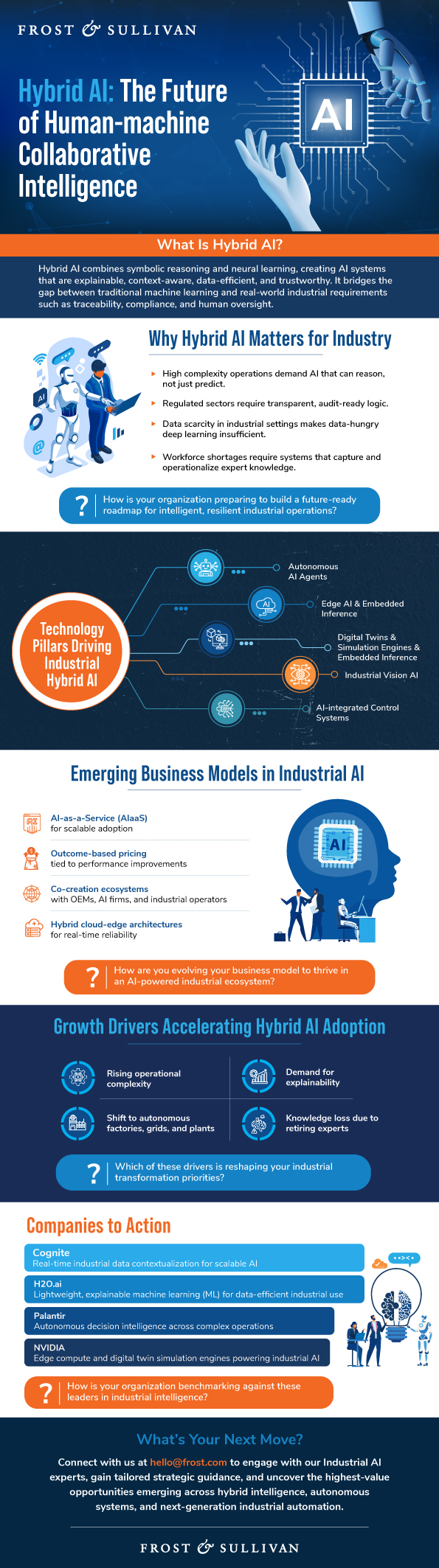
Hybrid AI blends the pattern-recognition strengths of neural networks with the logical reasoning of symbolic AI. Unlike traditional AI, which often “predicts without understanding,” hybrid systems can justify their decisions, incorporate domain constraints, and adapt to novel conditions.
This shift is especially important for industries where mistakes are costly, regulations are strict, and real-time responsiveness is non-negotiable.
The technology’s value comes from three major capabilities:
- Trustworthy, Explainable Intelligence: Operators need to understand why an AI system makes a decision. Hybrid AI provides transparent reasoning pathways, critical for safety, audits, and regulatory acceptance.
- Adaptability in Complex Scenarios: Energy grids fluctuating with renewable inputs, chemical plants reacting to feedstock changes, and supply chains disrupted by global uncertainties, all require AI that can reason beyond historical data.
- Data-efficient Performance: Hybrid AI can operate effectively even when labeled data is limited. By incorporating rules, expert knowledge, and causal logic, it reduces dependency on massive datasets.
How is your organization aligning with the era of hybrid, intelligent industrial automation?
Contact us at [email protected] or access our exclusive analysis on growth opportunities in industrial AI and hybrid AI
Key Strategic Imperatives Shaping Industrial AI
- Innovative Business Models
- Vendors are shifting from traditional software licenses to Artificial Intelligence-as-a-Service (AIaaS) and outcome-based models, reducing adoption barriers.
- Vision AI, autonomous agents, and scheduling tools are increasingly delivered via cloud and hybrid architectures.
- Manufacturers are scaling digital twins, simulation-driven decisions, and closed-loop optimization to strengthen resilience and agility.
- Industry Convergence
- Integration of OT (Operational Technology), IT (Information Technology), and ET (Engineering Technology) is forming unified intelligence layers.
- Partnerships among AI startups, automation vendors, hyperscalers, and semiconductor providers are accelerating solution maturity.
- Converged ecosystems are now combining Internet of Things (IoT) sensors, edge computing, robotics, data fabric platforms, and AI copilots for seamless optimization.
- Transformative Megatrends
- Sustainability and efficiency mandates are driving AI adoption for energy optimization and emissions reduction.
- Retiring expert workforces are pushing organizations to embed domain knowledge into AI-driven decision systems.
- Distributed energy systems and electrification require hybrid AI for contextual, explainable operational decisions.
How is your organization aligning with these strategic imperatives to accelerate its Industrial AI roadmap?
Growth Opportunities in Hybrid AI and Industrial AI
Growth Opportunity 1: Hybrid AI for Power & Utilities
Power and renewable energy networks are becoming increasingly distributed and volatile, making traditional AI insufficient for managing fluctuating loads, weather-dependent generation, and strict regulatory requirements. Hybrid AI is enabling smarter, more reliable operations by supporting real-time grid optimization, accurate load forecasting, improved renewable asset performance, and transparent, compliant decision traceability.
Download the whitepaper to explore more growth opportunities in hybrid AI.
Building Intelligent and Autonomous Industrial Systems for the Future
Organizations that embrace hybrid reasoning, autonomous agents, and real-time analytics will lead in operational excellence, sustainability, and competitive advantage. By investing in AI-driven automation, companies can transform structural challenges, such as workforce shortages, volatile markets, and aging infrastructure into long-term growth opportunities.
Is your organization ready to lead the next wave of industrial AI transformation?
Next Steps
Connect with our experts at [email protected] or schedule a Growth Pipeline Dialog to explore how Frost & Sullivan can help accelerate your automation roadmap, enhance decision-making, and capture new value across the industrial ecosystem