The Homes and Buildings Ecosystem Is Evolving Faster than Ever
Today, rising expectations for efficiency, sustainability, and occupant experience are prompting organizations to rethink how homes and buildings are designed, operated, and experienced. Outdated, siloed systems and reactive facility operations are giving way to integrated platforms, data-driven services, and intelligent environments, powered by rapid advances in AI, Internet of Things (IoT), analytics, and automation.
Explore how innovative business models and disruptive technologies are reshaping the Homes & Buildings sector.
As we move into 2026, organizations that can translate these shifts into scalable, technology-enabled solutions will be best positioned to lead. To support strategic decision-making, this blog highlights where innovation, investment, and partnerships will drive measurable impact across construction, operations, and occupant-centric services.
How will your organization capitalize on the forces reshaping the homes and buildings sector in 2026?
What’s Changing Across the Homes & Buildings Sector in 2026?
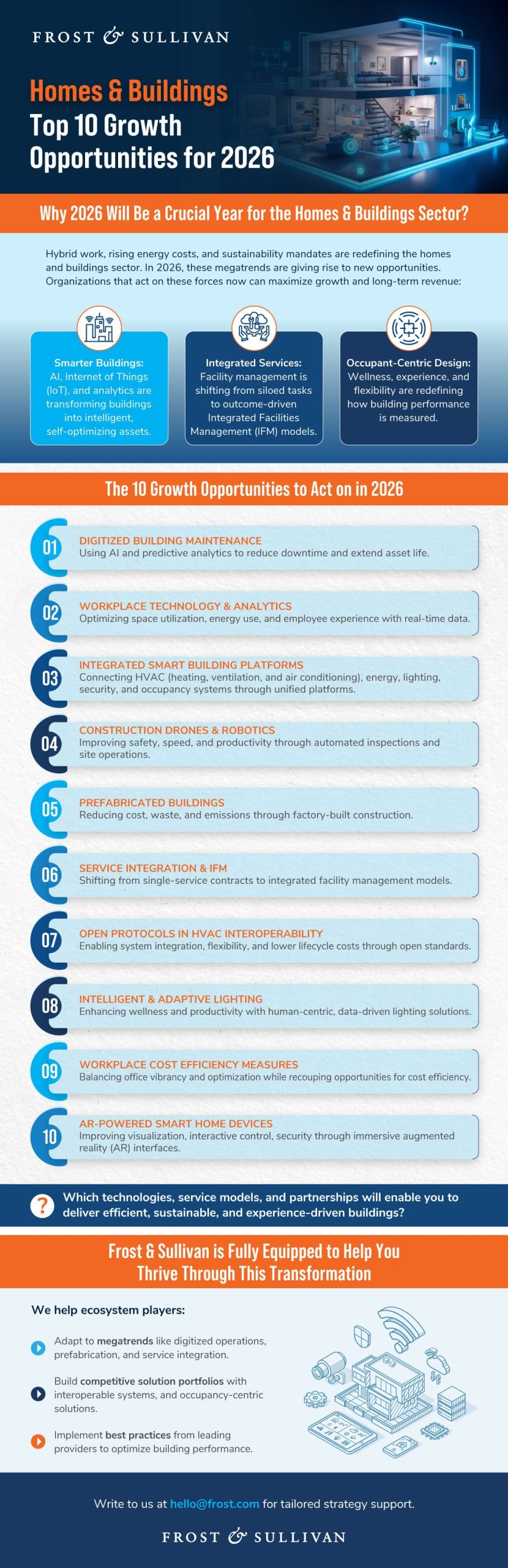
Key Forces Transforming the Homes & Buildings Ecosystem
These forces are redefining conventional business and technology approaches in the built environment:
- Innovative Business Models: Rising costs and evolving customer expectations are driving subscription and outcome-based models that increase revenue and customer loyalty.
- Industry Convergence: The value propositions of construction firms, technology companies, and service providers overlap, making collaboration, interoperability, and open standards essential for seamless solutions
- Disruptive Technologies: AI, IoT, augmented reality (AR)/virtual reality (VR), robotics, and cloud platforms are improving efficiency, safety, and occupant experience while giving providers a competitive edge.
Are you implementing best practices to thrive amid these transformative forces?
Homes & Buildings Growth Opportunities for 2026
- Construction Drones and Robotics
Labor shortages, tightening safety regulations, and the growing complexity of modern construction projects are forcing firms to rethink how work gets done on site. As a result, drones and robotics are becoming essential enablers of productivity, safety, and precision, creating tangible growth opportunities like:
- Drone-based Monitoring and Surveillance: Deploying HD cameras and LiDAR to generate 3D site models that enable real-time tracking and progress visibility.
- Construction Tool Advancements: Using robotic arms and 3D printing systems for bricklaying and complex geometries with minimal material waste.
- Humanoid Robots: Integrating AI-enabled humanoids with advanced sensors to support interior construction tasks such as drywall installation.
Companies to Action
- DroneDeploy: Using AI to spot site hazards.
- JDrone: Supporting logistics with heavy-lift cargo drones.
- ABB Robotics: Deploying microfactories to enable sustainable construction.
- Workplace Technology and Analytics
Hybrid work models, rising operating costs, and evolving employee expectations are pushing facility managers to rethink how workplace space is used and managed. In response, workplace technology and analytics are enabling more data-driven decisions, creating actionable ways to optimize workplace performance, including:
- Analytics-enabled Service Models: Embedding real-time workplace analytics to improve space efficiency, cost performance, and employee experience.
- Strategic Technology Partnerships: Collaborating with software providers to accelerate technology adoption and ensure interoperability across workplace systems.
- Industry-tailored Solutions: Developing sector-specific analytics offerings that convert data into measurable operational gains.
Companies to Action
- JLL: Leveraging AI to automate workplace planning.
- SPIE: Advancing energy and circular economy innovations.
- Planon: Delivering analytics-driven solutions for space and energy efficiency.
- Digitized Building Maintenance Capabilities
Digitized building maintenance is gaining momentum as smart buildings increasingly rely on command center-based remote services to improve reliability and performance. These capabilities are unlocking new ways to drive efficiency and value across maintenance operations, like:
- Proactive Asset Management: Using intelligent monitoring and predictive workflows to minimize downtime and extend equipment life.
- AI-powered Decision-making Tools: Equipping technicians with actionable insights to speed issue resolution and reduce skill gaps.
- Data Monetization Models: Leveraging analytics-derived insights to create new revenue streams and deliver higher-value advisory services.
Companies to Action
- Johnson Controls: Using WELL certification to deliver high-performance buildings.
- Honeywell: Delivering solutions to improve air quality, safety, and resilience.
- Carrier: Offering healthy buildings programs for productive indoor environments.
- Integrated Smart Building Platforms
As buildings become smarter, organizations are increasingly adopting integrated platforms that connect energy, HVAC (heating, ventilation, and air conditioning), lighting, security, and occupancy systems into a single operating layer. This shift is creating new opportunities for providers to deliver greater efficiency, intelligence, and value across building operations:
- Energy Optimization and Emissions Management: Deploying AI-enabled platforms to reduce energy consumption, meet efficiency targets, and lower operating costs.
- Indoor Air Quality and Wellness Analytics: Implementing predictive ventilation and air quality monitoring to improve occupant health, comfort, and productivity.
- Intelligent Safety and Access Solutions: Expanding touchless access, automated threat detection, and guided emergency response to enable safer, smarter spaces.
Companies to Action
- Siemens: Advancing AI-driven platforms for occupant comfort.
- Honeywell: Leveraging AI, analytics, and IoT to optimize performance and energy use.
- Johnson Controls: Enabling secure, adaptive, intelligent buildings.
- Prefabricated Buildings
Prefabricated buildings are enabling residential, non-residential, and emergency structures to be delivered faster, at lower cost, with improved quality and reduced material waste and emissions. This shift is unlocking high-impact opportunities across construction delivery models:
- Modular Construction with BIM: Reducing build time by up to 50% through factory-built modules and Building Information Modeling (BIM)-led design coordination.
- 3D Printing in Prefabrication: Accelerating component production, lowering labor intensity, and enabling flexible, cost-efficient designs.
- Green Prefabrication: Scaling eco-friendly materials, energy-efficient systems, and low-waste manufacturing to meet sustainability targets.
Companies to Action
- Prefabulous: Integrating solar glazing and cladding into net-zero modular housing.
- Mighty Buildings: Producing customizable 3D printed, prefabricated building kits.
- Dwellii: Delivering premium modular homes assembled onsite within a single day.
How will you prepare your organization to capitalize on these growth opportunities in homes & buildings?
Next Steps on Your Homes & Buildings Growth Journey
The homes and buildings sector in 2026 will be more connected and efficient, driven by advancements in smart home devices, workplace technologies, and digitized building maintenance. As organizations address aging infrastructure, rising costs, and shifting occupant expectations, acting on these growth opportunities will be critical to building a recurring revenue pipeline.
Frequently Asked Questions (FAQs)
What is smart building and home automation, and how is it used in 2026?
Smart building and home automation uses connected technologies to manage energy, HVAC, lighting, security, and occupancy from one platform. In 2026, it helps reduce costs, improve efficiency, and enhance occupant comfort.
What is a prefabricated building?
A prefabricated building is made from factory-built components assembled on-site. This method shortens construction timelines, reduces labor needs, lowers material waste, and improves build quality and sustainability.
What is smart home and intelligent building control?
Smart home and intelligent building control automates lighting, climate, security, and energy use through digital systems. Smart homes serve individual residences, while intelligent building control optimizes performance across large commercial buildings.
Ready to Lead the Transformation?
- Book a Growth Strategy Session: Align your growth roadmap with Frost & Sullivan’s visionary Growth Pipeline™ Dialog.
- Engage with Growth Experts: Co-design AI-enabled, data-driven operating models that scale industry-specific and commercial impact.
- Share Your Transformation Story: Position your organization as a transformation leader through Frost & Sullivan’s Transformational Growth Leadership platform.
- Join the Growth Council: Collaborate with industry leaders shaping the future of your ecosystem.
- Nominate for the Best Practices Recognition: Be recognized for excellence in growth strategy, execution, and customer impact.
- Demonstrate Industry Positioning on the Frost Radar™: Benchmark your growth performance and innovation strength against industry competitors.
- Activate Brand & Demand Growth: Accelerate awareness, engagement, and revenue growth through integrated brand and demand generation strategies.