This blog is based on Frost & Sullivan’s latest analysis, “US Customs and Border Protection Industry Growth Opportunities,” authored by Shreya Khakurel from the Aerospace & Defense Practice Area.
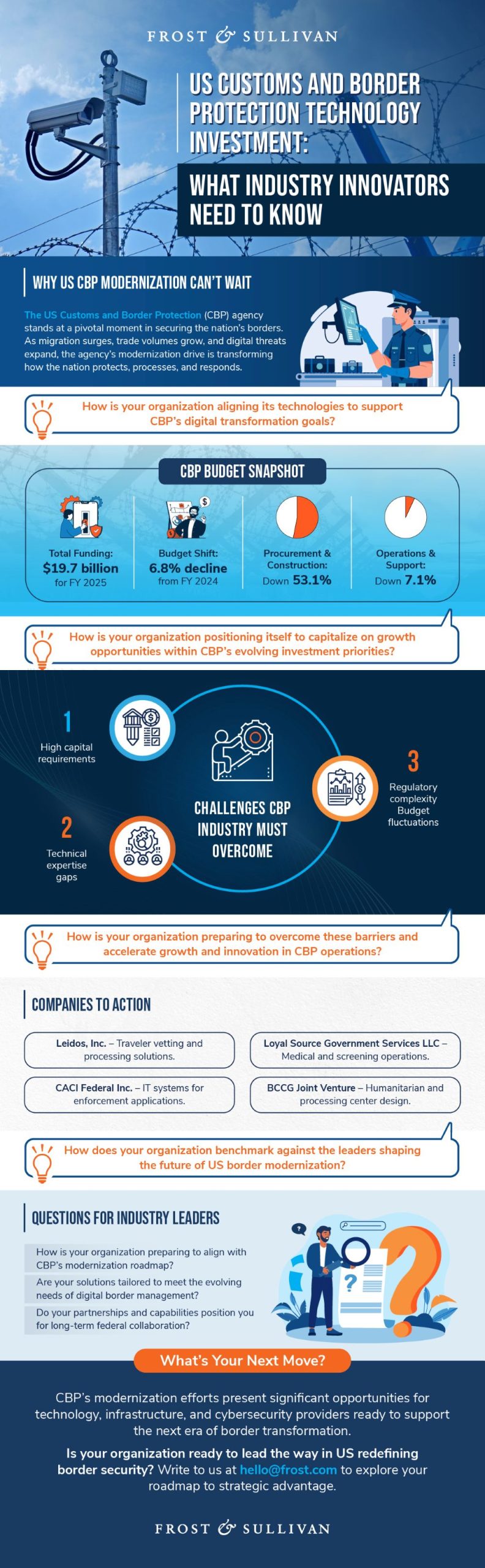
The US customs and border protection (CBP) stands at the forefront of homeland security, safeguarding national borders while facilitating lawful trade and travel. In an era defined by rising migration, growing trade volumes, and increasingly complex global supply chains, CBP faces unprecedented operational challenges. To meet these demands, the agency is implementing a comprehensive modernization strategy powered by digital transformation, data integration, and advanced technologies.
How is your organization preparing to capitalize on CBP’s technology investments?
Contact us at [email protected] or download the full analysis to explore the technology and investment roadmap.
The Urgency Behind Border Security Transformation
- Rising Migration Pressures: Escalating humanitarian inflows are straining existing border infrastructure and processing capabilities.
- Expanding Global Trade: Growth in eCommerce and cargo volumes is increasing the need for faster, more secure inspection and clearance systems.
- Evolving Threat Landscape: Drug trafficking, cyberattacks, and transnational crime are demanding real-time intelligence and rapid response.
- Aging Infrastructure: Legacy systems and manual workflows limit efficiency, scalability, and cross-agency collaboration.
- Technology Imperative: AI, cloud computing, and advanced analytics are now essential for predictive risk assessment, automation, and operational interoperability.
Is your organization ready to deliver the technologies CBP needs to overcome these challenges?
Access the full analysis to uncover CBP’s strategic priorities, technology roadmap, and budget outlook.
Strategic Imperatives Reshaping CBP Operations
- Geopolitical Chaos
Escalating regional and global instability continues to increase migration and trade pressures. In response, US customs and border protection is investing in intelligence and surveillance systems designed to enhance situational awareness and humanitarian response. This includes secure communication networks, biometric identification, and AI-based analytics to improve real-time information sharing across agencies.
- Disruptive Technologies
Digital transformation is at the centre of CBP’s future strategy. The integration of AI and machine learning (ML) is improving data processing, threat identification, and resource allocation, while predictive risk models are becoming central to cargo and passenger screening.
- Industry Convergence
US customs and border protection are embracing public-private partnership to accelerate innovation through programs such as the Reimbursable Services Program (RSP) and the Donations Acceptance Program (DAP). These initiatives foster co-development of inspection technologies, infrastructure upgrades, and non-intrusive detection systems.
What’s your organization’s strategy for driving innovation in CBP operations?
Growth Restraints and Operational Challenges
While modernization presents vast opportunity, several factors could temper the pace of adoption:
- High Capital Requirements: Integration of AI, ML, and biometric systems demands significant RDT&E (Research, Development, Test, and Evaluation) investment.
- Technical Expertise Gaps: New systems require advanced training and specialized skills among personnel.
- Regulatory Complexity: Federal cybersecurity and procurement regulations create entry barriers for smaller contractors.
- Budgetary Fluctuations: FY 2025 funding saw a 6.8% decline from FY 2024, reflecting shifting national priorities.
How is your organization overcoming these barriers to seize growth opportunities in CBP modernization?
Growth Opportunities Transforming CBP Landscape
- Cloud Computing and Services
Vendors offering Infrastructure-as-a-Service (IaaS), AI-driven analytics, and secure data-sharing architectures are well-positioned to support US customs and border protection’s full-scale cloud migration and zero-trust adoption.
- Supply Resilience
Companies specializing in digital twin modeling, predictive logistics, and automated inspection tools can contribute to more resilient and efficient port operations.
Want to explore the full range of growth opportunities driving CBP modernization? Click here to download.
The Next Chapter of US Border Security
The modernization of US CBP represents a transformational shift in homeland security, from reactive enforcement to predictive, data-driven decision-making. By advancing capabilities in cloud infrastructure, AI, surveillance, and immersive training, CBP is building a future-ready border ecosystem.
Whether in cloud infrastructure, cybersecurity, or immersive simulation, companies that align their strategies with CBP’s modernization roadmap will play a defining role in shaping the future of US border security.
How is your organization aligning its strategy to capitalize on CBP’s modernization journey?
Next Steps
Contact us at [email protected] or schedule a Growth Pipeline Dialog with our Aerospace & Defense experts to accelerate your growth strategy.