This blog is based on Frost & Sullivan’s recent analysis, “Main Battle Tank (MBT) Market, Global, 2024–2027.”
Global Main Battle Tank (MBT) spending is expected to surpass $10.9 billion by 2027, reflecting a steady acceleration in armored investment worldwide. Behind this growth lies a deeper strategic recalibration: nations are reinforcing land power to address high-intensity conflict risks and evolving multi-domain threats.
For senior defense executives, modernization priorities are extending beyond fleet replacement. Integrating AI-enabled targeting, active protection systems (APS), digital command networks, and hybrid propulsion into existing force structures requires disciplined capital planning, industrial alignment, and long-term technology roadmaps. In parallel, procurement decisions are increasingly tied to localization, interoperability, and lifecycle sustainment commitments.
Main Battle Tank Landscape:
1. Investment Priorities
2. Growth Opportunities
3. Revenue Forecasts
4. Competitive Benchmarking
Is your MBT modernization strategy structured to deliver both operational readiness and sustained competitive advantage over the next decade?
Listen to Our Growth Podcast Episode on the Global Main Battle Tank Landscape
Strategic Imperatives Reshaping the Global MBT Industry
- Geopolitical Chaos
Escalating conflicts are accelerating armored vehicle procurement and replenishment cycles. North Atlantic Treaty Organization (NATO) inventory gaps, following the transfer of over 700 MBTs to Ukraine, are driving modernization programs, while Europe, Asia-Pacific, and the Middle East strengthen deterrence capabilities. - Disruptive Technologies
MBTs are becoming digitally integrated combat systems. AI-enabled fire control, APS, and Manned-Unmanned Teaming (MUM-T) are redefining multi-domain operations, alongside R&D in hybrid propulsion and advanced armor. - Competitive Intensity
OEMs are facing growing pressure from export-focused and locally aligned companies. Procurement decisions are prioritizing industrial participation, technology transfer, and long-term sustainment models.
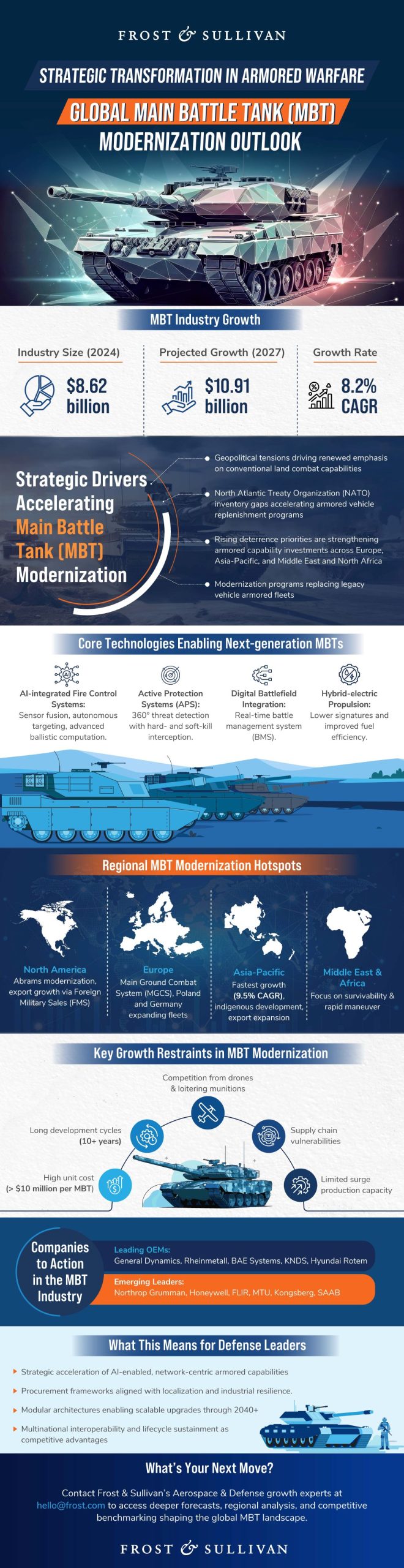
The Strategic Transformation: From Platform to Integrated Combat Ecosystem
The global MBT landscape is transitioning from platform-centric competition to ecosystem-driven value creation. Competitive advantage is extending beyond thicker armor and greater firepower to encompass connectivity, intelligence, and system-level integration.
Modern MBTs are evolving into digitally enabled command hubs, linking seamlessly with unmanned aerial vehicles (UAVs), intelligence, surveillance, and reconnaissance (ISR) platforms, artillery systems, and joint-force networks within a fully integrated, multi-domain battlespace.
This evolution is reshaping how value is created across the industry:
- Subsystem-led Differentiation: APS, battle management systems (BMS), AI-enabled targeting, next-generation propulsion, and advanced sensor suites are emerging as decisive performance multipliers.
- Lifecycle-driven Revenue Models: Maintenance, repair, and overhaul (MRO) services, software-defined upgrades, and digital retrofits are extending platform relevance while generating sustained revenue beyond initial acquisition.
- Industrial Ecosystem Alignment: Localization requirements, technology transfer frameworks, and resilient supply chains are shaping procurement outcomes and long-term strategic positioning.
Growth Opportunities Driving Transformation Across the MBT Industry
- Procurement Mapping and Early Engagement
OEMs and subsystem providers that align with 2030–2040 fleet replacement cycles are better positioned to secure prime contracts. High-demand areas include APS, AI-based targeting systems, hybrid propulsion, and thermal optics.
- R&D in Modular and Digital Architectures
Flexible, open-system architectures enabling rapid subsystem upgrades are emerging as a key differentiator. Investments in hybrid-electric mobility, autonomous navigation, and embedded AI are shaping next-generation MBTs.
- Multinational Collaboration and Industrial Partnerships
Collaborative programs such as Europe’s Main Ground Combat System (MGCS) and expanded Foreign Military Sales (FMS) pathways are reinforcing joint development models. Industrial participation clauses, localized assembly, and long-term MRO hubs are influencing procurement decisions.
Access the full analysis to explore all the growth opportunities in the Main Battle Tank industry.
Regional Momentum: Where Investment Is Accelerating
- Europe: Rapid modernization and collaborative next-generation development.
- Asia-Pacific: Fastest growth driven by indigenous programs and export expansion.
- Middle East: Stable modernization driven by regional security imperatives.
- North America: Sustained upgrade cycles and export-led expansion.
Companies to Action in the Global MBT Landscape
- General Dynamics: Leading Abrams modernization and export programs.
- Rheinmetall AG: Driving Leopard upgrades and next-generation platform initiatives.
- BAE Systems: Advancing Challenger modernization and hybrid technologies.
- KNDS: Franco-German collaboration shaping European armored evolution.
Armored capability is becoming a defining pillar of modern defense strategy. Beyond platform upgrades, the MBT industry is reflecting a broader shift toward digitally integrated, interoperable, and sustainment-driven ecosystems.
Organizations that synchronize technology investment, industrial collaboration, and lifecycle value creation will have an advantage to secure long-term competitive positioning in the global defense landscape.
FAQs: Global Main Battle Tank Industry
- What is a Main Battle Tank?
A Main Battle Tank (MBT) is a heavily armored, tracked combat vehicle that serves as the primary ground warfare platform of an army. It combines powerful firepower, strong protection, and high mobility to engage enemy forces and operate effectively in high-intensity combat environments.
- What are the main uses of MBTs?
Main Battle Tanks are primarily used for frontline combat, armored assaults, defensive operations, and deterrence. They provide heavy firepower, strong protection, and high mobility to engage enemy forces, support infantry, hold key terrain, and operate within integrated, multi-domain battlefield environments.
- Why are MBTs regaining strategic importance?
Recent conflicts have reaffirmed the need for survivable, mobile ground forces capable of operating in contested environments. Digital integration and advanced protection systems are reinforcing their relevance.
- What is driving growth in the MBT industry?
Fleet modernization cycles, North Atlantic Treaty Organization (NATO) replenishment demand, AI-enabled battlefield integration, and increased defense budgets across Europe and Asia-Pacific.
- How are procurement models evolving?
Governments are combining indigenous manufacturing with global OEM partnerships, emphasizing technology transfer and lifecycle support.
- Where are the strongest future opportunities in MBTs?
Asia-Pacific modernization programs, APS integration, hybrid propulsion R&D, and mid-life upgrade contracts represent high-growth opportunity areas.
Ready to Lead the Transformation?
- Book a Growth Strategy Session: Align your growth roadmap with Frost & Sullivan’s visionary Growth Pipeline™ Dialog.
- Engage with Growth Experts: Co-design AI-enabled, data-driven operating models that scale industry-specific and commercial impact.
- Share Your Transformation Story: Position your organization as a transformation leader through Frost & Sullivan’s Transformational Growth Leadership platform.
- Join the Growth Council: Collaborate with industry leaders shaping the future of your ecosystem.
- Nominate for the Best Practices Recognition: Be recognized for excellence in growth strategy, execution, and customer impact.
- Demonstrate Industry Positioning on the Frost Radar™: Benchmark your growth performance and innovation strength against industry competitors.
- Activate Brand & Demand Growth: Accelerate awareness, engagement, and revenue growth through integrated brand and demand generation strategies.