This blog is based on our analysis – IoT-based HVAC Services Enabling Sustainability of Buildings, Global, 2025–2030 and Smart Homes Market, Global, 2024–2030, authored by Frost & Sullivan’s Growth Expert, Melvin Leong and Anirudh Bhaskaran, from the Homes & Buildings team
The homes and buildings industry is undergoing rapid transformation, driven by AI, the Internet of Things (IoT), and outcome-based service models. In commercial environments, IoT-enabled heating, ventilation, and air conditioning (HVAC) systems are revolutionizing building operations through predictive maintenance and data insights.
Meanwhile, the global smart homes market is expected to reach $405.94 billion by 2030 as consumers increasingly prioritize convenience, security, and comfort. This momentum is accelerating the adoption of energy-efficient devices like washing machines, air conditioners, and home energy monitors.
Explore the innovative business models, disruptive technologies, and cross-industry opportunities in the homes and buildings industry.
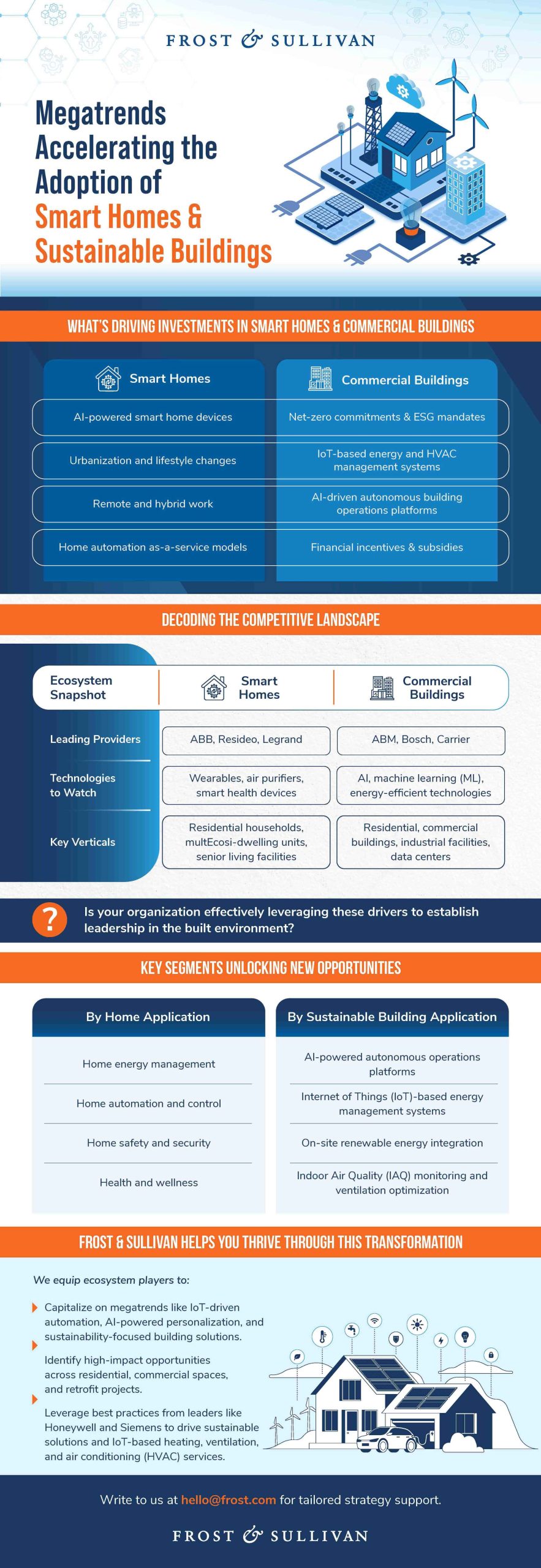
While commercial buildings focus on operational efficiency, sustainability, and occupant well-being, smart homes prioritize personalization, lifestyle convenience, and intuitive automation. Together, these megatrends are opening a billion-dollar opportunity across the built environment, and solution providers that act now can capitalize on the emerging opportunities across the ecosystem.
Is your organization harnessing smart technologies to maximize efficiency and comfort?
Tune in to our latest podcast for smart, sustainable building strategies.
Strategic Imperatives Catalyzing Growth in Smart Homes and Commercial Buildings
Smart Homes
The following imperatives are driving mass adoption and elevating living experiences:
- Innovative Business Model: Smart home-as-a-service and device-based subscriptions provide personalized experiences while lowering the barrier to adoption.
- Disruptive Technologies: AI, IoT, virtual batteries, and smart wellness devices are transforming operations, boosting energy efficiency, in-home health, and connected experiences.
Commercial Buildings
The following forces are redefining building operations and accelerating sustainability-led transformation:
- Customer Value Chain Compression: IoT-based HVAC services are witnessing faster deployment, direct access to user data, while reducing costs and accelerating innovation cycle.
- Industry Convergence: The integration of HVAC, energy, IT, access control, and building management system (BMS) platforms is enabling real-time insights, predictive maintenance, and Environmental, Social, and Governance (ESG)-ready operations.
Are you adopting the right growth strategies to thrive amid these transformative forces?
The Rise of Smart Homes & Sustainable Buildings
What’s Slowing the Adoption of Smart Homes and Sustainable Buildings?
Smart Homes
Residential adoption faces its own set of challenges:
- Complex Ecosystem: Making integration of smart home devices difficult due to multiple vendors, diverse devices, and non-interoperable communication standards.
- Ambiguous Economic Conditions: Affecting investment and adoption of smart home solutions amid an uncertain financial environment.
Commercial Buildings
Despite rapid innovation, these growth barriers are limiting growth in commercial environments:
- High Capital Requirements: Limiting adoption of IoT-enabled HVAC and sustainable solutions due to large upfront costs and long payback periods.
- Cybersecurity and Privacy Risks: Slowing adoption of connected building automation over data security and privacy concerns.
Are you implementing best practices to overcome these growth barriers?
Companies to Action
Accelerating Smart Homes and Energy-efficient Building Solutions
These trailblazers are transforming commercial and residential environments with data-driven and climate-smart solutions:
Smart Homes
- ABB: Offering smart home automation solutions across residential, commercial, and industrial sectors, integrating energy and asset management into a single cloud-based dashboard.
- Resideo: Delivering comfort, energy, safety, and security solutions to 150 million homes globally through its Honeywell Home, First Alert, and Resideo brands that are backed by a global distribution network.
Commercial Buildings
- ABM Industries: Enabling sustainable operations via Energy Performance Contracting (EPC), delivering HVAC, lighting, and automation upgrades with guaranteed energy savings and no upfront costs.
- Bosch Building Technologies: Building energy-efficient, climate-neutral infrastructure through the NEXOSPACE IoT platform, enabling real-time management of HVAC, lighting, and security systems.
Do you have the right tools to benchmark performance and collaborate with next-gen building automation leaders?
Growth Opportunities Shaping Smart Homes and Commercial Buildings
The following growth opportunities are set to define the next decade of innovation, servitization, and efficiency in homes and buildings:
Smart Homes
- Smart Home-as-a-Service: The shift from a hardware-focused model to a subscription-driven ecosystem is making connected living more accessible and dynamic. To capture this opportunity, companies are delivering subscription-based smart home solutions that emphasize interoperability, intuitive support, and ongoing upgrades.
- Intelligent Home Energy Management Systems: The integration of AI into home energy management systems (HEMS) is reshaping energy consumption, storage, and optimization in homes. This is pushing providers to develop AI-enabled HEMS that prioritize interoperability, intuitive design, and scalable performance to deliver smarter, more efficient homes.
Commercial Buildings
- Retrofit Solutions for Aging Building Stock: Many global buildings are over 30 years old, operating with inefficient systems, limited connectivity, and minimal indoor air quality (IAQ) monitoring. Providers are modernizing these assets by integrating retrofits with existing BMS via open protocols (e.g., BACnet, Modbus) to enable seamless, scalable upgrades.
- IAQ-as-a-Service (IAQaaS) & HVAC-as-a-Service (HVACaaS): Outcome-based HVAC and IAQ service models are set to redefine building operations, particularly in commercial, hospitality, and healthcare spaces. Companies are creating IAQaaS and HVACaaS bundles that combine smart equipment, remote dashboards, and automated diagnostics to drive efficiency and occupant well-being.
How will you prepare your organization to capitalize on these emerging growth opportunities?
Are You Ready to Future-proof Your Homes and Buildings Strategy?
The rise of smart technologies, cross-industry collaboration, and innovative business models is transforming homes and commercial buildings into intelligent ecosystems. Companies that embrace interoperable platforms, invest in retrofit solutions, and adopt outcome-based service models will not only overcome current growth barriers but also secure a competitive edge in a rapidly evolving built environment.
What strategies will you implement today to lead the transformation toward intelligent, sustainable spaces?
Frequently Asked Questions (FAQs)
What is the concept of a smart home?
A smart home is a residence equipped with internet-connected devices that automate and control systems like lighting, heating, security, and appliances. These devices can be managed remotely via smartphones or voice assistants, improving convenience, safety, and energy efficiency while enabling a more personalized living experience.
What are smart home technologies?
Smart home technologies are IoT-enabled devices and systems that automate household functions. These include smart thermostats, lighting, security cameras, smart locks, and voice assistants. By using AI and data connectivity, they enhance home security, optimize energy use, and provide greater control and convenience for homeowners.
What is sustainable building?
Sustainable building refers to the design, construction, and operation of buildings that minimize environmental impact. It focuses on energy efficiency, water conservation, reduced carbon emissions, and the use of eco-friendly materials, while improving occupant comfort and supporting long-term environmental and economic sustainability.
What is the difference between smart homes and smart buildings?
Smart homes are designed for individual residences, focusing on comfort, convenience, and security through connected devices. Smart buildings, in contrast, manage larger facilities like offices or hospitals, using advanced automation systems to optimize energy use, operations, and occupant experience at a broader, more complex scale.
Ready to Lead the Transformation?
- Book a Growth Strategy Session: Align your growth roadmap with Frost & Sullivan’s visionary Growth Pipeline™ Dialog.
- Engage with Growth Experts: Co-design AI-enabled, data-driven operating models that scale industry-specific and commercial impact.
- Share Your Transformation Story: Position your organization as a transformation leader through Frost & Sullivan’s Transformational Growth Leadership platform.
- Join the Growth Council: Collaborate with industry leaders shaping the future of your ecosystem.
- Nominate for the Best Practices Recognition: Be recognized for excellence in growth strategy, execution, and customer impact.
- Demonstrate Industry Positioning on the Frost Radar™: Benchmark your growth performance and innovation strength against industry competitors.
- Brand & Demand: Accelerate awareness, engagement, and revenue growth through integrated brand and demand generation strategies.