This blog is based on our analysis — Facility Management Industry, Southeast Asia, 2025–2030, authored by Frost & Sullivan’s Growth Experts, Janice Wung, from the Homes & Buildings team.
Facility management (FM) across Southeast Asia is experiencing significant transformation, fueled by expanding asset bases, evolving customer expectations, and a shift towards outsourcing. Many organizations still rely on in-house teams, and inconsistent regulations often create uneven service quality. Heavy reliance on manual labor further limits efficiency and stifles innovation.
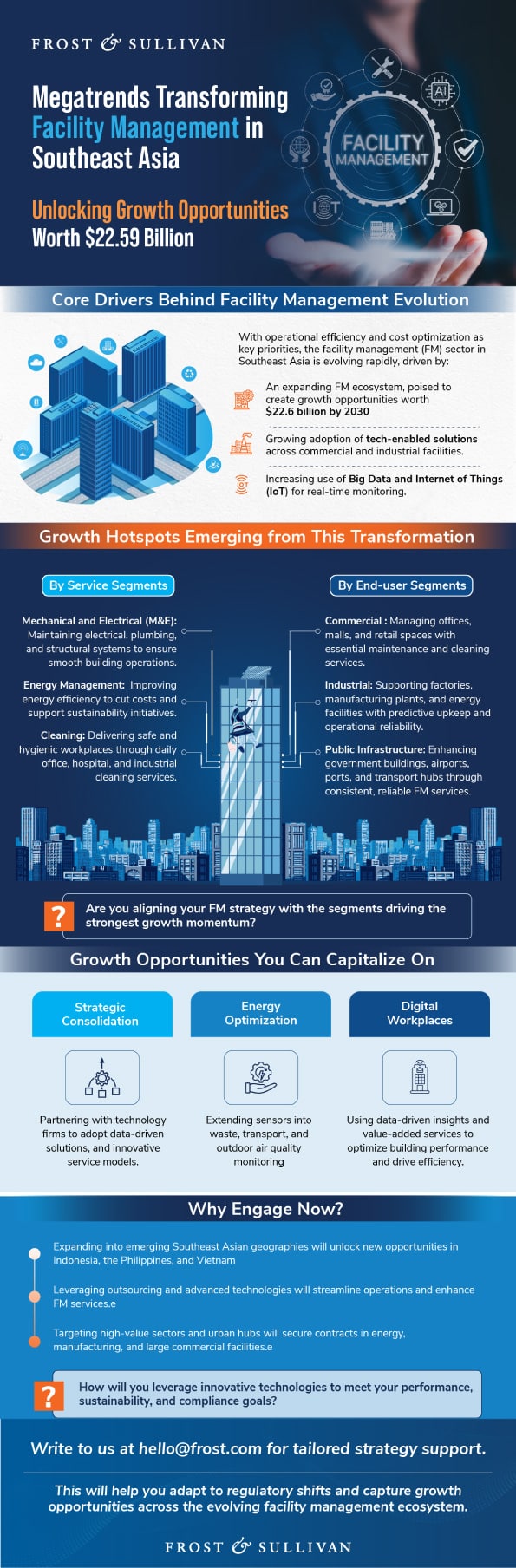
Despite these challenges, the demand for facility management services, such as energy efficiency, digital platforms, and eco-friendly solutions, is opening new growth opportunities. Over the next five years, these forces will reshape facility management companies in Southeast Asia, enabling them to optimize performance and elevate service capabilities through integrated facilities management solutions.
The transformation is clear. Which strategies will you adopt to lead the facility management landscape?
Discover how to capitalize on emerging shifts in facility management.
Growth Avenues in Facility Management for 2025 and Beyond
Explore the strategies for redefining facility management in Southeast Asia.
What’s Revolutionizing Facility Management in Southeast Asia?
These imperatives are pushing businesses to completely rethink operational approaches and service delivery in facilities management services:
- Internal Challenges: Domestic firms are hesitant to adopt innovative technologies due to end-user resistance and cost concerns. This conservative approach commoditizes services, increases price, and slows progress, even in advanced hubs like Singapore.
- Competitive Intensity: Larger facility management companies are consolidating businesses, acquiring smaller firms to expand specialization, geographic reach, and self-delivery capabilities. Simultaneously, the push to digitize and adopt advanced solutions is intensifying as organizations seek differentiation.
- Transformative Megatrends: Sustainability is reshaping operations, with governments and corporations accelerating green, smart, and energy-efficient practices. Emerging policies and corporate programs are guiding the long-term evolution of integrated facilities management strategies across the region.
How will your organization adapt to these strategic forces redefining FM across the region?
Megatrends Reshaping the Facility Management Industry
These emerging megatrends are transforming how facility management providers operate, compete, and deliver value across the region:
- Decarbonization and Net Zero: Embedding low-carbon solutions to meet regulatory requirements and sustainability objectives.
- Digital Transformation and AI: Using smart building technology and predictive analytics to improve operational efficiency and enable optimized facility management systems.
- Service Integration and IFM: Streamlining supplier management, increasing margins, and delivering seamless integrated facilities management services to clients.
- Healthy and Sustainable Buildings: Implementing green, wellness-focused, and energy-efficient designs as the new standard in post-pandemic workplaces.
- Environmental, Social, and Governance (ESG) Initiatives: Integrating ESG practices to gain a competitive edge and create long-term value.
Which partnerships and collaborations will help you turn these growth drivers into strategic advantages?
Where the Most Lucrative Growth Opportunities Lie
These high impact opportunities are set to unlock major returns for facility management providers:
- FM Consolidation
Companies can accelerate growth and expand reach through strategic partnerships and mergers & acquisitions (M&As). As a result, providers are:
- Pursuing localized acquisitions to strengthen presence in underserved regions.
- Partnering with technology firms to adopt facility management systems, data-driven solutions, and innovative service models.
- Combining internal strengths with external capabilities to build resilient business models that navigate intensified competition.
Are you implementing the right best practices to strengthen your facility management services footprint?
- Sustainability Focus and Regulatory Compliance
Rising sustainability expectations and stricter regulations are creating new avenues for facility management companies across Southeast Asia. This shift is prompting companies towards:
- Gaining expertise in green cleaning, energy management, and waste management while collaborating with suitable partners.
- Offering holistic ESG-focused solutions, positioning companies as strategic allies in achieving sustainability objectives.
- Ensuring compliance with evolving regulations and building standards to reinforce integrated facilities management practices.
Is your organization equipped with the right tools to meet evolving ESG and regulatory requirements?
- Tech-enabled FM Solutions
The transition to digital workplaces and smart buildings is driving demand for advanced facilities management services. Companies are adapting by:
- Developing in-house expertise to provide automation and smart services that reduce dependency on on-site workforce.
- Shifting to outcome-based service models that prioritize efficiency, innovation, and measurable results.
- Managing advanced building systems while integrating Internet of Things (IoT) robotics, and digital platforms to meet growing demand for tech-enabled facilities.
Are you implementing sustainability concepts and innovative technologies in existing facility management systems?
Unlock High-impact Growth Opportunities for Facility Management.
Leading the Future of Facility Management in Southeast Asia
Facility management across Southeast Asia is evolving at varying speeds. Singapore represents a mature setup, Malaysia and Thailand are progressing rapidly, while Indonesia, the Philippines, and Vietnam are still emerging.
By leveraging strategic partnerships, sustainability, and technology-driven approaches, facility management companies can unlock new value, streamline operations, and enhance service delivery. Those who act decisively today will not only maintain pace but also set new benchmarks for efficiency, innovation, and sustainable operations in the region.
What bold moves will your business make to lead the future of facility management?
Looking to prioritize the right investments, explore regional opportunities, or benchmark your approach against sustainable facility management services?
Get in touch with our Homes & Buildings Growth Experts to know more.