This blog is based on our analysis – VRF System Growth Opportunities, Global, 2025–2030, authored by Frost & Sullivan’s Growth Expert, Dennis Marcell Victor, from the Homes & Buildings team.
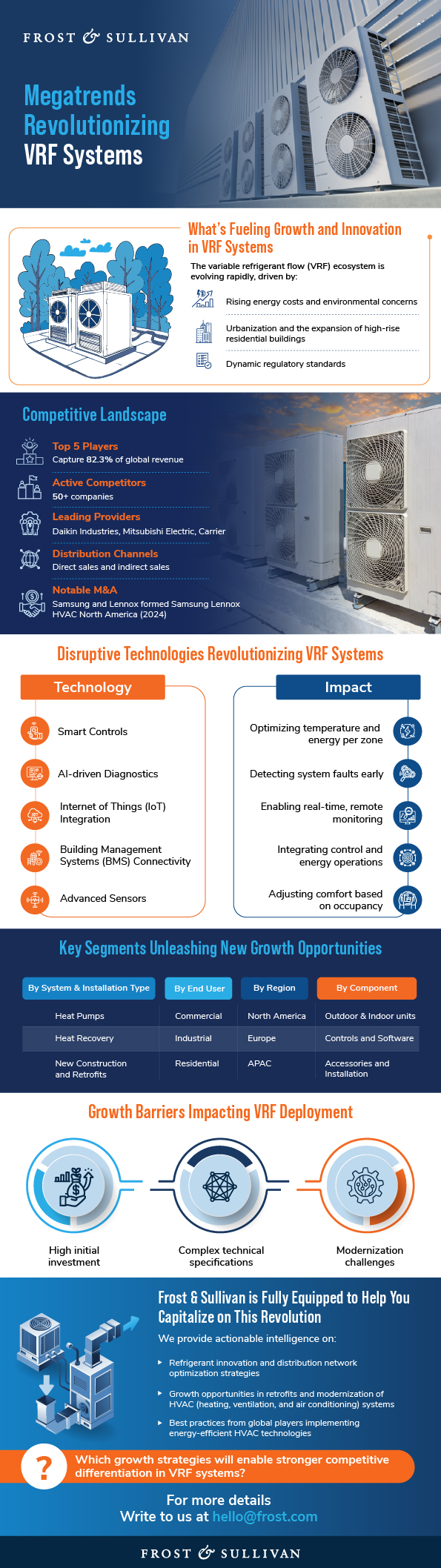
The variable refrigerant flow (VRF) industry is evolving rapidly and is projected to reach $30.07 billion by 2030 at a CAGR of 8.7%. Its growth is fueled by the rising demand for energy-efficient HVAC solutions and the shift toward smart building integration and connected environments. To stay competitive, manufacturers are responding by innovating new products and expanding distribution networks.
Explore how competitive intensity, disruptive technologies, and industry convergence are reshaping the global VRF system ecosystem.
At the same time, increasing competition and budget constraints are pushing providers to deliver predictive maintenance, localized support, and guaranteed energy performance. To lead this transformation, VRF system manufacturers are leveraging artificial intelligence (AI), Internet of Things (IoT)-enabled monitoring, and cloud-based diagnostics, while forming alliances with technology partners to enhance service delivery and innovation.
How will your organization leverage emerging technologies to stay ahead in the evolving VRF landscape?
Explore growth strategies to thrive in the evolving VRF systems industry.
Inside the Global VRF Transformation: Growth Drivers and Competitive Dynamics
Access the full analysis to identify growth areas and innovation hotspots.
Top Strategic Imperatives Catalyzing the Evolution of VRF Systems
These forces are redefining conventional HVAC (heating, ventilation, and air conditioning) norms and shaping how manufacturers and operators deliver energy-efficient HVAC solutions:
- Rising Competitive Intensity: Global players are competing aggressively on pricing, product innovation, energy efficiency, and regional expansion, squeezing margins and accelerating product lifecycles.
- Disruptive Technologies: Smart controls, AI-driven diagnostics, and IoT-enabled building management systems (BMS) are reshaping customer expectations, compelling OEMs to integrate predictive maintenance, demand-response readiness, and cloud connectivity.
- Industry Convergence: The HVAC industry is merging with energy management, building automation, and property technology, pushing VRF systems to integrate seamlessly into smart building ecosystems and challenging traditional business models.
Are you implementing best practices to thrive amid these transformative forces?
VRF System Pricing Megatrends Across Regions
Backed by Frost & Sullivan’s deep expertise and data-driven insights, understanding regional pricing dynamics becomes a powerful tool for distributors to make smarter investment decisions.
|
Region |
Pricing ($/ton) |
Factors Impacting Pricing |
|
North America |
600–1,200 |
Import tariffs, strict energy regulations, premium feature demand |
|
Europe |
700–1,300 |
F-Gas rules, high-efficiency heat pump technology demand |
|
Asia-Pacific (APAC) |
300–900 |
Strong local manufacturing, high competition |
|
Rest of the World |
450–1,100 |
Harsh climates, low local production, import taxes |
Regional policies, manufacturing capacity, and climate conditions significantly define pricing strategies across the global VRF systems industry.
How will you capitalize on regional pricing megatrends to maximize ROI and performance?
Explore region-specific strategies for green building solutions.
Companies to Action: Leading VRF System Providers Steering Global Growth
These key players are redefining the VRF ecosystem through innovation, expansion, and advanced technologies:
- Daikin (31.7% market share): Leveraging early-mover advantage with VRV (Variable Refrigerant Volume) technology, R&D capabilities, and global supply chains. Focusing on refrigerant innovation and region-specific strategies to sustain market leadership.
- Mitsubishi Electric (19.6% market share): Expanding footprint across Asia and Europe, delivering energy-efficient HVAC solutions for urban environments, and maintaining top-tier status globally.
- Carrier (11.1% market share): Capitalizing on legacy brand strength in North America and Europe, investing in inverter compressor technologies, and enhancing system performance.
Do you have the right tools to benchmark performance and collaborate with leading HVAC innovators?
Growth Opportunities Shaping the Future of VRF Systems
These high-impact opportunities are enabling manufacturers and operators to unlock efficiency, compliance, and competitive advantage:
- VRF Supporting Electrification and Decarbonization
The push toward net-zero buildings are transforming heating and cooling, making energy-efficient, flexible, and smart VRF systems essential. To capitalize on this shift, manufacturers are:
- Developing all-electric VRF systems that efficiently replace fossil fuel systems, even in cold climates.
- Integrating with renewable energy like solar panels and storage to enable low-carbon infrastructure.
- Adopting low-global warming potential (GWP) refrigerants to meet environmental regulations.
- Retrofit and Modernization of HVAC Systems
Aging infrastructure and outdated HVAC systems are enabling demand for VRF system retrofits. To capture this potential, building operators are:
- Positioning VRF system as the core of energy-efficient retrofits with smart building integration.
- Leveraging incentives and financing programs to lower upfront costs and boost adoption.
- Partnering with ESCOs and financial institutions to offer performance-based energy savings models.
- Integration of VRF and Smart Building Solutions
As buildings become more connected, VRF systems must integrate seamlessly with smart building platforms. This is pushing providers towards:
- Supporting open protocols (BACnet, Modbus, KNX) for smooth BMS and IoT integration.
- Embedding sensors and smart analytics to track energy, comfort, and system health in real time.
- Enabling automated benchmarking and carbon reporting to comply with sustainability standards.
How will you prepare your organization to capitalize on these emerging growth opportunities?
Are You Ready to Capitalize on VRF Transformation?
The global VRF systems ecosystem is at a pivotal moment, shaped by sustainability mandates, smart building integration, and customer expectations for high-performance solutions. Companies that invest in digital innovation, predictive maintenance, and strategic collaboration will lead this transformation, setting new benchmarks for comfort, efficiency, and sustainability.
What steps will your organization take today to lead the transformation toward smart, energy-efficient VRF systems?
Get in touch with our Homes & Buildings Experts to identify high-impact opportunities and align your water strategy with regional leaders.
Alternatively, you can also write to us at [email protected]