This blog is based on our analysis – Building Construction Market, Global, 2025–2030, authored by Frost & Sullivan’s Growth Expert, Melvin Leong, from the Homes & Buildings team.
The building construction industry is undergoing a major transformation and is projected to reach $11,456.5 billion by 2030. This shift is driven by sustainable construction initiatives, digital technologies, and geopolitical headwinds—reshaping how buildings are designed, constructed, and operated.
At the same time, geopolitical tensions are disrupting supply chains, driving up costs, and delaying project timelines. To address these challenges, start-ups and solution providers are leveraging smart building solutions that help streamline operations, optimize resources, and reduce carbon footprints. By integrating these innovations with sustainable construction practices, organizations can minimize environmental impact while keeping pace with rapid urban growth.
Discover how transformative megatrends, global disruptions, and intensifying competition are redefining the building construction industry.
Is your construction strategy equipped to balance efficiency, sustainability, and resilience while navigating rising costs and geopolitical uncertainties?
Explore strategies to thrive in the evolving building construction industry
Growth Avenues in the Building Construction Industry
How is your organization adapting to megatrends shaping built environments?
What’s Driving Transformation in Building Construction?
These forces are redefining conventional construction norms across regions:
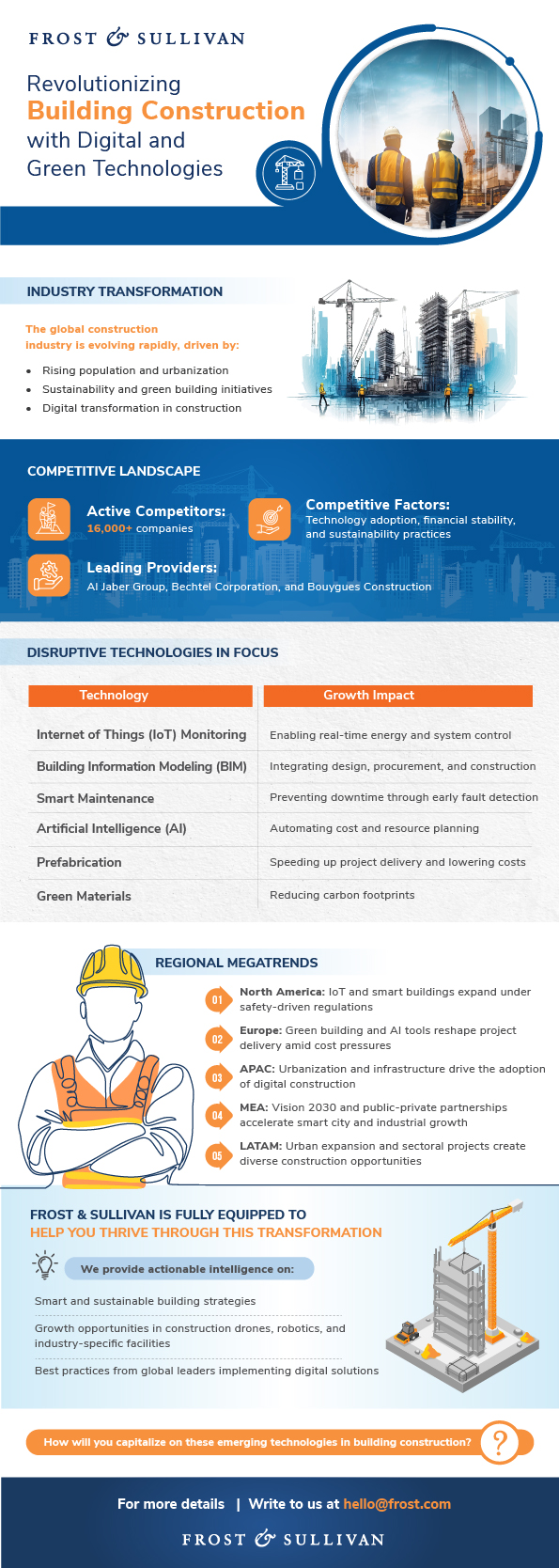
- Transformative Megatrends: Sustainable construction and green building materials like recycled steel and reclaimed wood are driving the adoption of eco-friendly designs and energy-efficient construction methods.
- Geopolitical Chaos: Trade disputes and political instability are disrupting supply chains and inflating the costs of materials and services.
- Competitive Intensity: Value chain compression is pushing companies to enhance efficiency and sustainability in project execution and delivery.
Are you equipped with the right tools and technologies to thrive amid these transformative forces?
Key Segments Fueling Growth in Building Construction
The industry spans multiple growth segments based on the following:
- Building Type: Residential, non-residential
- Technology: Drones, robotics, AI-enabled project management, Building Information Modeling (BIM), and smart sensors
- End User: Real estate developers, government agencies, healthcare facilities, data centers, and industrial clients
- Region: North America leads in technology adoption; APAC increases investments in digital construction technologies; Europe prioritizes green building design; MEA focuses on smart cities; LATAM expands through urban infrastructure.
Are you investing in the right segments to stay competitive in the evolving construction landscape?
Access the full analysis to identify growth areas and innovation hotspots
What’s Slowing Progress in the Building Construction Industry
Despite emerging growth opportunities, the industry still faces several challenges that hinder progress, such as:
- Resource Constraints: Limited material availability and skilled labor shortages are driving up costs and delaying project timelines.
- Economic Volatility: Inflation and interest rate fluctuations are disrupting investment flows and slowing construction activity.
- Green Cost Burden: High costs of eco-friendly materials and energy-efficient systems make sustainable construction challenging for smaller firms.
Companies that adopt digital efficiency and circular design principles will be better positioned to navigate these headwinds and maintain a competitive edge.
Are you implementing best practices to overcome these growth barriers and keep your projects on track?
Best Practices in Building Construction
To consistently outperform their competitors, the most successful construction companies focus on the following key strategic areas:
- Technology Adoption: Leveraging digital tools to enhance site safety, optimize workflows, and control costs.
- Project Expertise: Integrating technically skilled teams with multi-country project experience to ensure high-quality execution.
- Financial Strength: Maintaining strong cash flow and capital resilience to support large-scale developments.
- Sustainability Practices: Applying eco-friendly construction methods and sustainable design principles to minimize environmental impact.
- Partnerships and Certifications: Forming strategic alliances across the value chain and meeting rigorous accreditation standards.
Do you have the right tools to benchmark performance and collaborate with providers driving construction innovation?
Discover how top construction firms are driving innovation and efficiency
Growth Opportunities: Where to Act Now
As the construction industry evolves, new growth opportunities are emerging through digital technologies, infrastructure, and urban development. Key areas gaining momentum include:
- Construction Drones and Robotics
Emerging technologies like drones and robotics are transforming how construction projects are planned and executed, delivering significant gains in efficiency, accuracy, and safety through applications such as:
- Deploying drones with HD cameras and LiDAR for precise aerial surveys and real-time 3D modeling.
- Integrating robotic arms for faster brickwork and efficient 3D printing with reduced material waste.
- Adopting humanoid robots with AI-enabled sensors to perform complex tasks and improve on-site safety.
- Industry-specific Facilities
Demand for data centers and smart healthcare facilities is surging with the expansion of cloud, AI, and digital healthcare ecosystems. In response, construction efforts are increasingly prioritizing sustainability, efficiency, and adaptability through:
- Implementing sustainable design in data centers with renewable energy, efficient cooling, and water management systems.
- Constructing next-generation hospitals using eco-friendly materials, smart technologies, and AI-enabled telemedicine services.
- Designing patient-centric hospital spaces that enhance comfort through natural lighting, greenery, noise reduction, and private areas.
- Development of Smart Cities
Smart city initiatives are driving a new era of urban development by embedding sustainability and intelligence into core infrastructure and services. Key focus areas include:
- Implementing smart energy systems such as renewable-integrated grids, consumption forecasting, and grid-edge technologies.
- Adopting green urban planning with energy-efficient buildings, sustainable infrastructure, and biodiversity-friendly spaces.
- Exploring smart mobility solutions that use digital technologies to reduce congestion, improve safety, and lower emissions.
How will you prepare your organization to capitalize on these growth opportunities?
Are You Ready to Build the Future of Sustainable Construction?
The convergence of sustainability and digitalization will define the next decade of global building construction. Organizations that embrace automation, circular design, and green innovation will lead the transformation toward smarter, safer, and more sustainable buildings.
What concrete actions will your organization take today to lead the transformation toward smart and sustainable building construction?
Looking to prioritize investments, explore new opportunities, and benchmark your strategy against leaders in construction ecosystem?
Get in touch with our Homes & Buildings Experts to know more