This blog is based on our analysis, Impact of President Trump’s Administration on the Energy Industry, United States, 2024–2030 authored by Frost & Sullivan’s Growth Expert, Lucrecia Gomez, from the Power & Energy team.
The return of Donald Trump has brought significant changes to the U.S. energy ecosystem. Many of the climate and energy policies from the previous administration are being rolled back, creating both new risks and fresh opportunities for stakeholders across the energy value chain.
While fossil fuels are regaining political support, investments in clean energy continue to grow, driven by state-level incentives, corporate sustainability commitments, and the Inflation Reduction Act. The solar industry remains resilient, but offshore wind projects have stalled. Meanwhile, tariffs, uncertainty around tax credits, and environmental rollbacks are making it harder to forecast returns on investment in solar, wind, and battery storage.
How are you adjusting your strategy to capitalize on the lucrative-growth opportunities emerging from this transition?
Strategic Imperatives Shaping the U.S. Energy Shift
The energy transition in the U.S. isn’t just about technology, it’s influenced by a variety of factors that will shape future investments, policies, and business strategies:
- Disruptive Technologies: AI, Internet of Things (IoT), and predictive analytics are revolutionizing how power plants enhance efficiency, keep track of assets, and manage grid balance in real time.
- Geopolitical Pressures: Tariffs and international tensions (particularly with China) are necessitating a shift in manufacturing strategies, forcing companies to localize clean tech production.
- Innovative Business Models: Power-as-a-Service models like Energy-as-a-Service (EaaS) and Power Plant-as-a-Service (PPaaS) are allowing companies to monetize infrastructure, manage risk, and scale faster across distributed assets.
How are you aligning growth strategies with the key imperatives redefining the energy ecosystem?
Megatrends Transforming the U.S. Energy Ecosystem
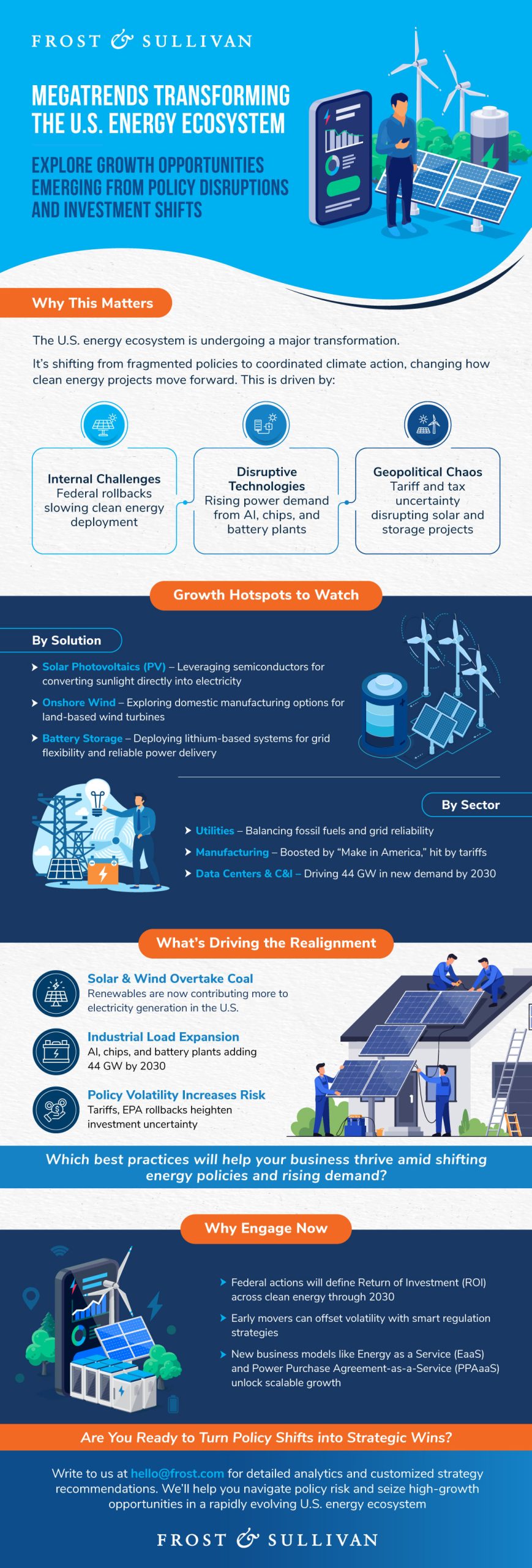
Are you equipped to lead through shifts in policy, demand, and innovation?
Access the full guide to identify growth areas and innovation hotspots.
What’s Driving the Demand
Even with some policy uncertainty hanging in the air, three key areas are holding their ground in unique ways:
Onshore Wind
Onshore wind continues to deliver value despite rising costs and federal barriers:
- Growth is driven by state-level policies and private investment, especially in Texas and Iowa.
- Turbine costs have increased by 7%, triggered by new tariffs (25% on Mexico/Canada, 10% on China).
- Developers are shifting to domestic manufacturing to cut costs and secure project pipelines.
Hydrogen
The momentum for clean hydrogen is hitting a bit of a snag due to unexpected funding cuts, but red states are stepping in:
- The administration is backing blue hydrogen (from natural gas + carbon capture), not green.
- $7 billion in federal funding for clean hydrogen hubs has been paused under executive review
- States like Texas and Louisiana are advancing hydrogen projects to fill the federal funding gap.
Battery Energy Storage Systems (BESS)
The U.S. BESS industry faces short-term challenges, but long-term growth remains strong:
- Growth is fueled by grid modernization, commercial and industrial (C&I) demand, and electric vehicle (EV) adoption.
- Heavy reliance on China’s lithium iron phosphate (LFP) batteries is prompting developers to seek new sourcing from Japan and Korea.
- A temporary 90-day tariff suspension offers limited relief, but risks remain.
Which technologies in your portfolio are best positioned to grow under evolving federal priorities?
Where the Biggest Growth Opportunities Are Emerging
As the strategies evolve with new leadership, companies that move quickly will discover opportunities to grow, minimize risks, and create lasting value. The next wave of momentum will be fueled by these three key areas of strategic growth:
Integrated Decarbonization Services
- Combining solar photovoltaics (PV), battery storage, and EV infrastructure to create seamless solutions for small and medium-sized enterprises (SMEs) and commercial users.
- Covering the entire lifecycle, from getting permits and designing systems to optimizing performance and monitoring results.
- Helping businesses meet sustainability goals by simplifying project execution and accessing incentives.
Energy-as-a-Service (EaaS) and Everything as a Service (XaaS) Models
- Delivering bundled energy solutions with predictive maintenance, remote monitoring, and flexible payment terms.
- Partnering with cloud and IoT providers to improve performance, security, and customer experience.
- Lowering capital risk for clients through outcome-based models that accelerate clean energy adoption.
OEM Innovation and Risk-sharing Models
- Accelerating product launches through acquisitions and strategic collaborations.
- Using gain-share financing to help customers overcome upfront investment barriers.
- Supporting prosumers with distributed energy resources (DER) systems and energy management tools optimized for evolving policies.
What’s your next move to unlock long-term value in power and energy?
Get the full guide for actionable strategies and investment priorities.
Next Steps: Turn Uncertainty into Growth Opportunities
To sum it all up, while federal rollbacks and the ever-changing policies are changing the energy investment scene, exciting new growth opportunities are emerging in solar, storage, and onshore wind.
Smart businesses will adapt by localizing manufacturing, diversifying their sourcing, and rethinking their project strategies to remain competitive all the way through 2030.
What bold steps will your organization take today to lead tomorrow’s energy ecosystem?
Want to dive deeper into grid-ready solutions, explore regional opportunities, or benchmark against competitors?
Get in touch with our Power and Energy Growth Experts to know more.