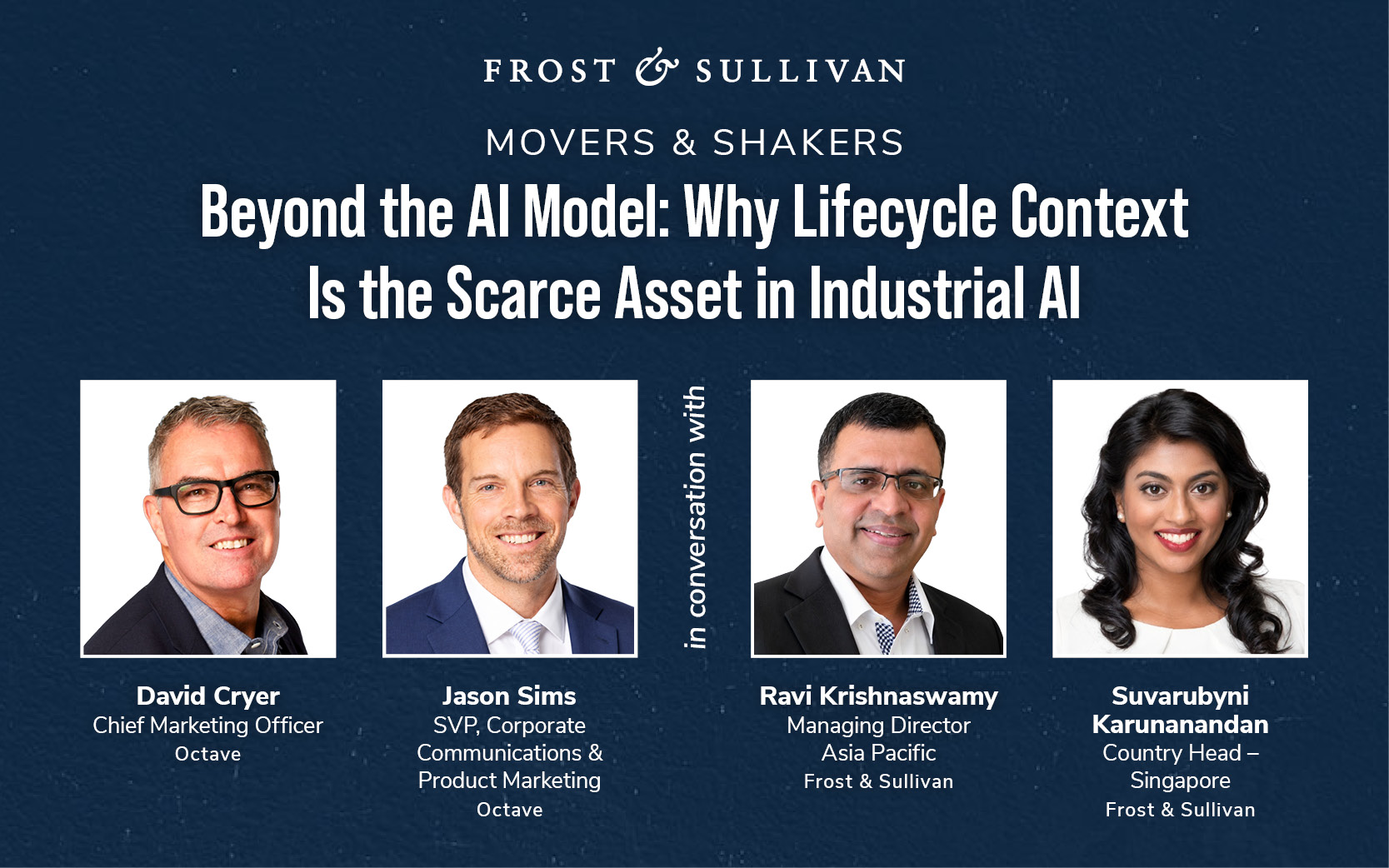
David Cryer, Chief Marketing Officer, Octave, and Jason Sims, SVP, Corporate Communications & Product Marketing, Octave, in conversation with Ravi Krishnaswamy, Managing Director, Frost & Sullivan, APAC, and Suvarubyni Karunanandan, Country Head–Singapore, Frost & Sullivan
Industrial organizations are managing increasingly complex assets and operations across decades-long lifecycles. Refineries, rail networks, transportation systems, and other critical facilities generate vast amounts of information across design, construction, operations, maintenance, and protection. Yet having more data does not necessarily make decision-making easier. Much of the challenge lies in connecting that information and preserving the context around how an asset was designed, built, modified, and operated over time.
Octave is focused on addressing this challenge by connecting information across the asset lifecycle and helping customers turn fragmented data into usable context. Rather than competing primarily on individual features or artificial intelligence (AI) capabilities, the company is focused on continuity across design, build, operate, and protect. Its long-standing relationships with customers, knowledge of complex industrial environments, and understanding of physical assets form an important part of this approach.
In this Movers & Shakers discussion, Ravi Krishnaswamy, Managing Director, APAC, and Suvarubyni Karunanandan, Senior Director, Customer Engagement, Frost & Sullivan, speak with David Cryer, Chief Marketing Officer, and Jason Sims, Senior Vice President, Corporate Communications & Product Marketing, Octave, about building ecosystems beyond individual products, creating continuity across the asset lifecycle, navigating partnerships and emerging competition, helping organizations move beyond fragmented digital transformation, and why Octave believes lifecycle context, not the AI model itself, will become increasingly important in industrial AI.
“The model is the commodity, and the lifecycle context is the scarce asset.”
— David Cryer, Chief Marketing Officer, Octave
Moving Beyond Features to Long-term Customer Value
Ravi Krishnaswamy: A lot of technology companies compete on features and capabilities. How is Octave building an ecosystem of customers, partners, and stakeholders that creates sustainable growth beyond the products themselves?
David Cryer: Features and capabilities can become an arms race, particularly in industries where customers operate facilities with lifespans of decades. Refineries, metro networks, and other industrial facilities are not looking for a short-term fix.
What compounds beyond the product and the features is context. Over the life of these assets, customers build an enormous amount of context around how they operate. That context becomes valuable, particularly across the gaps and handoffs between different stages of the asset lifecycle.
We are also seeing enterprises consolidate the number of vendors they work with rather than expanding it. They are looking to get more value from fewer strategic relationships, particularly when a provider can help carry value across the lifecycle of an asset.
Large projects also naturally create ecosystems. Design, build, operate, and protect are often handled by different companies, and a major project can bring together a whole range of partners. Our role is to help facilitate the continuity of project data and information across those relationships.
Why Brownfield Environments Create a Strong Need for Collaboration
Ravi Krishnaswamy: Between brownfield and greenfield environments, is there a greater need for partnership in brownfield projects?
David Cryer: Yes, and we have seen that to a certain extent, particularly around plant expansions, updates, and renovations of existing facilities.
A lot of work is happening in existing infrastructure because organizations want to get more value from the assets they already have. There hasn’t always been a huge appetite, whether from a capital or broader environment standpoint, to build entirely new facilities.
That makes partnerships particularly important when you are working with existing systems, existing data, existing infrastructure, and the history that comes with those assets.
Building Credibility Across Complex Industrial Environments
Ravi Krishnaswamy: What is distinctive about Octave’s approach when you look at the complexity of these industries?
Jason Sims: We have long-term relationships with customers involved in some of the most complex, expensive, and important projects in the world.
There are common capabilities that apply across industries. Asset management is one example. Location is another. So, we have horizontal technologies that can pull different industries together, but we also understand the importance of these critical projects because we have been doing this work for a long time.
That experience matters even more as AI becomes more widespread. There is a lot of scepticism around AI, and customers need to know that the technology is grounded in credible data and real-world experience.
We have the AI on top of that credibility, but the data is the foundation. We have those long-standing relationships, and we understand the design-to-operate-and-protect lifecycle. We see how all of those pieces are connected, and we see the potential to continue growing those capabilities.
And that credibility becomes particularly important when someone comes into an industry knowing one or two problems and uses AI to address them, compared with a company that has already solved a much broader range of challenges. The ability to bring that experience and context to the table becomes an important differentiator.
From Competitors to Partners in an AI-enabled Ecosystem
Ravi Krishnaswamy: As AI makes data and knowledge more accessible, could traditional technology providers and system integrators begin building or acquiring capabilities in this space?
David Cryer: We partner with a lot of those organizations already, and that is where the partnership angle becomes important. Traditional technology providers are also figuring out how to connect all of these systems together. I think that is fantastic because it can make things much easier for enterprises and create opportunities for us as well. But there is an important distinction. A system might collect data from a pump, a valve, or a dispatch system and make that information visible. The question is: Do you know what that number means in relation to the rest of the plant?
Do you understand how the plant was designed, how it was built, what changed when it was renovated three years ago, and how those changes affect the asset today?
So, again, it comes back to context.
From Technology Provider to Continuity Partner
Ravi Krishnaswamy: As organizations become overwhelmed by data, the competitive advantage increasingly depends on turning information into decisions and action. How do you see Octave’s role evolving from a technology platform toward becoming a transformation partner?
Jason Sims: I see it extending. I don’t necessarily see it changing. We already see these large customers as partners. We have strategic steering boards, advisory councils, and collaborative initiatives where we are working alongside them.
It is not just a transaction. These are organizations that are changing the world every day, and they are important enough for us to invest the time, energy, and effort into. The question is: How do we continue to grow with you? How do we innovate with you?
That is what initiatives such as our collaborative programs are about—how do we go down that journey together?
David Cryer: And I think there is an important distinction here. I would not position us as a conventional transformation partner. I would describe us more as a continuity partner for data.
A lot of these customers do not have a data shortage. In fact, they have too much data. Many went through a digital transformation journey where the goal was essentially to take everything that was not digital and make it digital. But that can actually create more silos of digital information. So, the problem becomes a continuity problem. Across the design, build, operate, and protect lifecycle, we can help create that continuity. The more continuous, connected, and record-based that information becomes within a platform, the more useful AI can be on top of it. And to be honest, it does not necessarily matter which AI model you use.
Helping Customers Move Beyond Fragmented Digital Transformation
Suvarubyni Karunanandan: How does Octave work differently with organizations building a new digital foundation versus those managing years of accumulated systems, data, and complexity?
David Cryer: It depends on the customer and the industry. At a foundational level, we can provide a framework for organizations that are starting from scratch. But in the majority of cases, when we are working with customers, it is more about looking at the existing environment and asking: Can you help us clean up this mess?
A lot of the work we have done, even going back to our Intergraph heritage, has involved data contextualization, smartification of documents, and managing engineering information.
In industries such as energy, a lot of information is actually contained in documents. So how do you get those documents into the system? How do you contextualize them? How do you manage that engineering information?
That is also what made smart computer-aided design (CAD) valuable. The system did not simply contain digital information. It understood the plant. It understood the engineering context behind that information.
We have a lot of that context built into the knowledge of the company, and that gives customers a foundation they can build on, whether they are starting something new or dealing with complexity that has accumulated over time.
Connecting the Entire Lifecycle
Suvarubyni Karunanandan: How does that broader lifecycle view translate into opportunities for customers?
Jason Sims: It becomes particularly powerful when you look at the entire environment holistically. Transportation is a great example. In rail, you have public safety agencies, video management, asset maintenance, infrastructure, and many other connected elements. You are looking at the tracks, maintaining the assets, managing video, and dealing with the build itself. So, you can look at the design piece and the visualization of what needs to happen, but you can also connect that to everything else. That is what is unique. The world is not two-dimensional. There is so much more that you can and should do across all of these spaces when you look at them together.
David Cryer: And there are many industries that have their own version of this. Formula One is a great example. They design, build, operate, and protect, just like some of these other environments. They simply do it over a very different timeframe, sometimes over decades, sometimes in weeks, sometimes in seconds. It is a microcosm of the same lifecycle.
The Bold Belief: The Model Is the Commodity
Ravi Krishnaswamy: What is the boldest belief Octave holds about the future that is not yet widely recognized?
David Cryer: I think that in industrial AI, the model is the commodity. The lifecycle context is the scarce asset. Everybody is betting on who has the best model or who has the most data. I think that is actually the wrong way around. We are already seeing model providers reducing prices. There is an arms race around the models, but we believe the winners in industrial AI will be the organizations that hold trusted contextual data that is connected to the physical asset or the physical world. There is also a perception that this context and information could somehow be scraped from the physical world or simply bought. Maybe some of it could be bought, but not quickly and not cheaply. That is why we believe lifecycle context is the scarce asset.
Preserving Industrial Knowledge as the Workforce Changes
Ravi Krishnaswamy: Is that lifecycle context also becoming more important as experienced people leave the workforce? And the context belongs to the customer?
David Cryer: Absolutely. There is so much tacit knowledge in industrial environments, and some of that knowledge exists with people who have spent decades working with these assets. As that workforce changes, there is a real challenge around preserving that knowledge. Yes. It is 100% our customers’ context. Our role is to help extract that context and make it usable.
Closing Reflection – The Future of Industrial AI Will Depend on Context
Industrial AI is often discussed in terms of models and data, but the discussion with Octave highlights something harder to recreate: the context surrounding an asset across its entire lifecycle.
As organizations connect design, build, operate, and protect, the value lies not simply in having more data, but in understanding what that data means within the physical environment. Octave’s experience across complex industrial environments provides a foundation for helping customers connect fragmented information and make decades of lifecycle knowledge more usable.
As AI models become increasingly accessible, trusted lifecycle context may become the scarcer asset, providing the foundation for applying AI more effectively across complex industrial environments.

About David Cryer
Chief Marketing Officer at Octave
David Cryer is Chief Marketing Officer at Octave, where he leads the company’s global marketing strategy and brand direction. He previously served as Senior Vice President and Chief Marketing Officer of Hexagon’s Asset Lifecycle Intelligence division. His earlier experience includes marketing leadership roles at Intergraph and Microsoft, as well as Alcatel and Newbridge Networks. David holds a Bachelor of Business Administration in Marketing from the University of Technology Sydney.
Jason Sims is Senior Vice President of Corporate Communications and Product Marketing at Octave. He brings extensive experience in marketing, communications, and technology, with a career spanning geospatial and industrial technology. His professional experience includes leadership roles associated with Hexagon and Intergraph, with a focus on translating complex technology into compelling customer and market narratives. His public profile also reflects long-standing experience in technical communications and marketing leadership.

Jason Sims
Senior Vice President of Corporate Communications and Product Marketing at Octave
About Ravi Krishnaswamy
Managing Director of Frost & Sullivan Asia Pacific
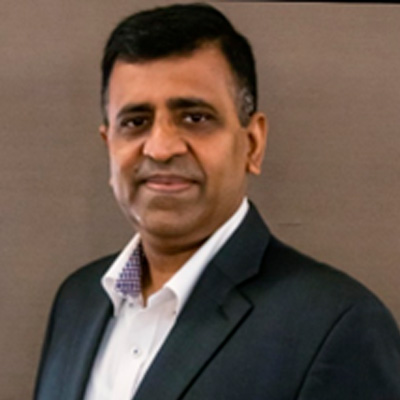
Ravi Krishnaswamy is the Managing Director of Frost & Sullivan Asia Pacific, where he leads the firm’s operations and strategic growth initiatives across the region. He brings more than 25 years of experience spanning energy transition, sustainability, smart infrastructure, industrial automation, and smart manufacturing, with extensive experience advising organizations on growth, strategy, and emerging technologies
Suvarubyni Karunanandan is Country Head–Singapore, at Frost & Sullivan. In this role, she works with organizations to strengthen customer engagement and support strategic growth initiatives. She brings experience in customer engagement and commercial collaboration within the technology and business advisory environment.

Sebastian Trolli
Research Director and Global Head of Research for Industrial Automation and Software at Frost & Sullivan
Ready to Lead the Transformation?
- Book a Growth Strategy Session: Align your growth roadmap with Frost & Sullivan’s visionary Growth Pipeline™ Dialog.
- Engage with Growth Experts: Co-design AI-enabled, data-driven operating models that scale industry-specific and commercial impact.
- Share Your Transformation Story: Position your organization as a transformation leader through Frost & Sullivan’s Transformational Growth Leadership platform.
- Join the Growth Council: Collaborate with industry leaders shaping the future of your ecosystem.
- Nominate for the Best Practices Recognition: Be recognized for excellence in growth strategy, execution, and customer impact.
- Demonstrate Industry Positioning on the Frost Radar™: Benchmark your growth performance and innovation strength against industry competitors.
- Activate Brand & Demand Growth: Accelerate awareness, engagement, and revenue growth through integrated brand and demand generation strategies.
APPENDIX: Connecting Industrial Data, Asset Lifecycle Context, and AI
Frost & Sullivan delivers actionable intelligence that helps industrial leaders, technology providers, and asset-intensive organizations identify emerging growth opportunities and accelerate transformational change across industrial operations. Our expertise spans industrial AI, asset lifecycle management, engineering data management, industrial connectivity, digital twins, automation, and data-driven services.
To learn more about the latest growth opportunities, strategic imperatives, companies to action, and best practices shaping connected and intelligent industrial environments, explore our portfolio of growth analyses:
- Frost Radar™: Industrial Connectivity Software, 2026
- Frost Radar™: AI Transformation in Industrial Design and Engineering, 2026
- Enterprise Metaverse: Building Digital Twins and Virtual Collaboration Platforms
- Growth Opportunities in Emerging Industrial AI Ecosystem, Global, 2025–2029
- Industrial Services Market, Global, 2025–2029
Together, these analyses reinforce the themes explored in this Movers & Shakers conversation: connected industrial data, lifecycle continuity, engineering context, asset lifecycle management, and the role of trusted contextual data in enabling more effective industrial AI.