Global industry is entering a new phase of competition as technology-led investments accelerate across AI, energy transition, and digital services. Markets such as edge AI (30%+ CAGR), hydrogen testing (over 40% year-on-year growth), industrial services (7% CAGR), and smart compressors ($28 billion+ by 2029) signal that growth is increasingly tied to intelligence, efficiency, and sustainability rather than capacity expansion alone
Download Now
Are your growth strategy, technology roadmap, and ecosystem partnerships aligned with where industrial investment and demand are scaling next?
Frost & Sullivan’s Top 10 Industrial Growth Opportunities in 2026 identifies where these forces converge to create sustained strategic and commercial impact across manufacturing, energy, and infrastructure
Listen to Our Podcast Episode on Industrial Growth Opportunities 2026
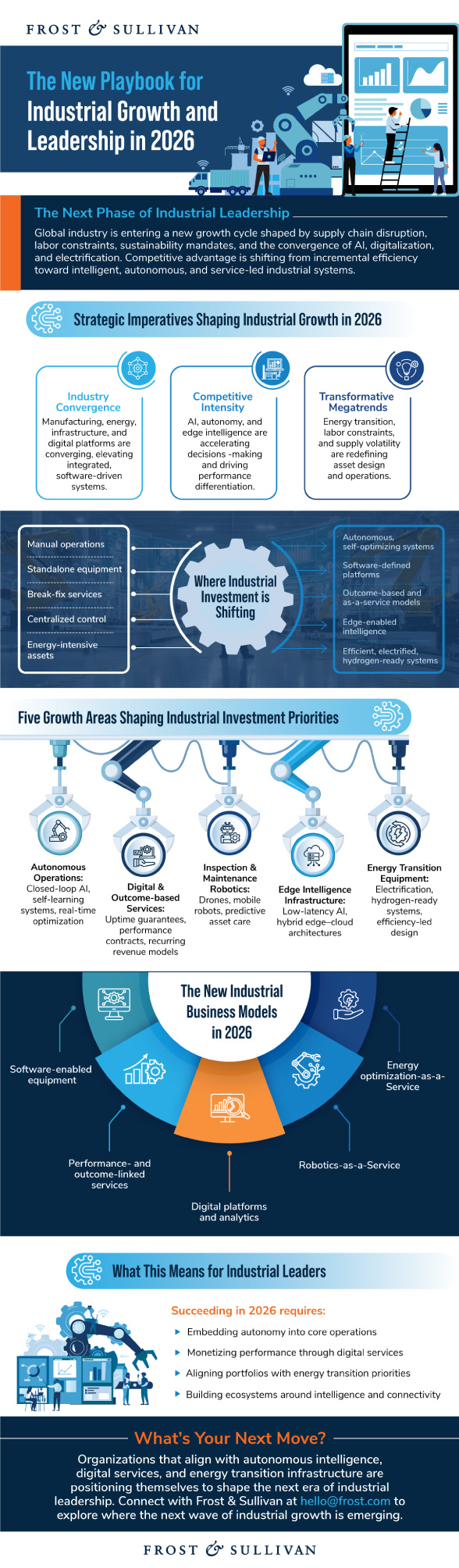
Where Industrial Capital Is Moving in 2026
Industrial investments in 2026 are concentrating around technologies and business models that support resilience, scalability, and recurring returns.
- Resilience-driven Investment: Downtime risk, labor shortages, and supply disruptions are accelerating demand for autonomous operations.
- Software-led Returns: Intelligence is shifting from hardware to software, enabling faster innovation and recurring revenue.
- Energy Transition Spending: Electrification and hydrogen adoption are driving multi-year equipment and infrastructure investments.
- Service-led Growth: Outcome-based services and digital platforms are improving margins and revenue predictability.
- Ecosystem Advantage: Scaled partnerships are enabling faster growth and stronger competitive positioning.
Growth Opportunity 1: Autonomous AI Is Becoming the Industrial Control Layer
Industrial AI is moving beyond analytics and dashboards into autonomous, closed-loop decision-making as organizations confront downtime, labor shortages, and operational volatility.
Evidence from Industry Adoption
- Autonomous industrial AI deployments are delivering 5–10× ROI within three years as systems evolve from rule-based automation to self-learning operations.
- Advances in edge AI, small language models, agentic AI, and federated learning are enabling sub-5ms response times and secure, distributed control in safety-critical environments.
Strategic Impact
Autonomy is shifting from a productivity enhancer to a foundational capability. Organizations embedding intelligence across operations gain measurable advantages in uptime, responsiveness, and capital efficiency.
Growth Opportunity 2: Digital and Outcome-based Services Are Rewriting Industrial Economics
Industrial services are shifting from reactive maintenance to digital, outcome-driven models as customers demand guaranteed uptime, performance transparency, and measurable results.
Evidence from Industry Adoption
- Digital and outcome-based industrial services are expanding at 7% CAGR through 2029, supported by analytics, Internet of Things (IoT) connectivity, and as-a-service delivery models.
- Remote-first service operations are scaling despite skilled labor shortages, enabled by AI, automation, and digital support tools.
Strategic Impact
Services are emerging as one of the most scalable and defensible growth engines in industry. Companies that invest early in digital platforms and outcome-based contracts improve margin stability, revenue visibility, and customer lifetime value.
Growth Opportunity 3: Inspection Robotics Is Shifting Maintenance from Reactive to Predictive
Industrial inspection is rapidly automating as safety requirements, asset complexity, and uptime expectations increase across energy, manufacturing, and infrastructure operations.
Evidence from Industry Adoption
- AI drones, quadrupeds, and mobile robots are expanding inspection coverage across hazardous, remote, and confined environments.
- Robotics-as-a-Service (RaaS) models are lowering adoption barriers while enabling continuous data capture and predictive maintenance at scale.
Strategic Impact
Inspection robots deliver immediate operational value by improving safety, reducing downtime, and extending asset life. Organizations deploying autonomous inspection at scale gain durable advantages in reliability, compliance, and maintenance efficiency.
Growth Opportunity 4: Smart, Energy-efficient, and Hydrogen-ready Compressors Are Becoming Transition Infrastructure
Industrial compressors are evolving from mechanical equipment into digitally enabled, energy-optimized, and hydrogen-compatible systems as decarbonization accelerates.
Evidence from Industry Adoption
- Hydrogen-ready and Carbon Capture, Utilization, and Storage (CCUS)-compatible compressors are supporting clean energy production, storage, and transport at scale.
- The global compressor opportunity exceeds $28 billion by 2029, with digital twins and predictive maintenance expanding aftermarket value.
Strategic Impact
OEMs that combine efficiency, hydrogen readiness, and service-led models create multi-cycle growth across both equipment and lifecycle services.
Companies to Action
- Siemens – Leading industrial AI, digital twins, and software-defined automation, enabling autonomous and resilient operations.
- Schneider Electric – Well positioned in digital services, electrification, and sustainability-driven industrial transformation.
- Rockwell Automation – Expanding AI-enabled automation and edge intelligence to support autonomous manufacturing.
- ABB – Strong across robotics, electrification, and service-led industrial growth.
- NVIDIA – A key enabler of industrial edge AI and real-time autonomous systems.
Where the Next Industrial Growth Will Be Won
Industrial growth in 2026 will be driven by structural transformation rather than incremental efficiency. Autonomous AI, digital services, inspection robotics, and edge intelligence are converging to redefine how value is created and scaled.
For C-suite leaders and strategy teams, growth will be won by those who prioritize the right opportunities, sequence investments with discipline, and build ecosystems that scale intelligence, resilience, and recurring value. Organizations that move will be better positioned to adapt to disruption and shape competitive benchmarks of the next industrial cycle.
Frost & Sullivan’s Top 10 Industrial Growth Opportunities in 2026 provides a clear lens on where to invest, how to compete, and which capabilities will shape industrial leadership in the years ahead.
FAQs: Industrial Growth Opportunities in 2026
- Why is 2026 critical for industrial markets?
Because AI, energy transition, and digital services are moving from pilots to large-scale deployment, fundamentally reshaping industrial economics. - Which technologies matter most for industrial growth in 2026?
Autonomous AI, edge intelligence, digital services platforms, inspection robotics, and energy-transition technologies. - What should industrial companies prioritize now?
Software-defined systems, service-led business models, ecosystem partnerships, and scalable digital platforms that deliver continuous value.
Connect with our industrial experts at [email protected] or schedule a Growth Pipeline Dialog to align your strategy with the next wave of industrial growth and value creation.