This blog is based on Frost & Sullivan’s analysis, “Global Heat Exchangers Market, 2024–2029,” authored by Krishnan Ramanathan, from the Industrial Practice Area.
The global industrial landscape is entering a new phase shaped by energy transition, digitalization, and sustainability. As industries electrify and decarbonize, heat exchangers are shifting from passive components to strategic assets that improve energy efficiency, process reliability, and carbon performance. This blog identifies where demand is growing, what technologies are disrupting the market, and which strategies will deliver the strongest returns through 2029.
Discover how advanced materials and smart systems can drive your organization for growth in the evolving heat exchangers landscape.
Modern applications expanding demand
Modern applications of heat exchangers now extend beyond traditional manufacturing and include:
- Hydrogen production – Supporting clean energy generation.
- Carbon capture – Enabling decarbonization efforts.
- Data centers – Managing high-density thermal loads efficiently.
- Electric vehicle (EV) battery systems – Ensuring optimal battery performance and longevity.
The rapid expansion of data infrastructure and electric mobility is driving demand for compact, high-efficiency exchangers, while renewable energy and hydrogen technologies rely on advanced designs for thermal optimization.
These developments are transforming heat exchangers from passive components into digitally connected, high-performance systems that enable cleaner, smarter, and more resilient industrial operations.
How is your organization aligning its heat exchanger strategy to capture this new wave of industrial growth?
Strategic Imperatives Driving Growth in the Global Heat Exchangers Landscape
- Competitive Intensity:
Regional industrial heat exchanger manufacturers are expanding capacity to serve growing domestic demand, especially in Asia and the Middle East. As governments push for localized supply chains, global OEMs face heightened competition from cost-efficient regional players. Success increasingly depends on technology differentiation, reliability, and after-sales performance, not just price.
- Transformative Megatrends:
The clean-energy transition is reshaping industrial heating and cooling requirements. Hydrogen production, carbon-capture initiatives, and renewable integration are creating new demand for durable, high-efficiency heat exchangers. Meanwhile, data centers, driven by cloud computing and AI, require advanced liquid-cooling systems to manage escalating thermal loads.
- Disruptive Technologies:
The integration of Internet of Things (IoT), AI, and digital twins is transforming heat exchangers into intelligent systems capable of predictive maintenance, performance optimization, and lifecycle cost reduction. Manufacturers are also developing compact, modular configurations suited to constrained spaces and renewable installations.
How is your organization adapting to these megatrends and advanced technologies to stay competitive in the heat exchangers market?
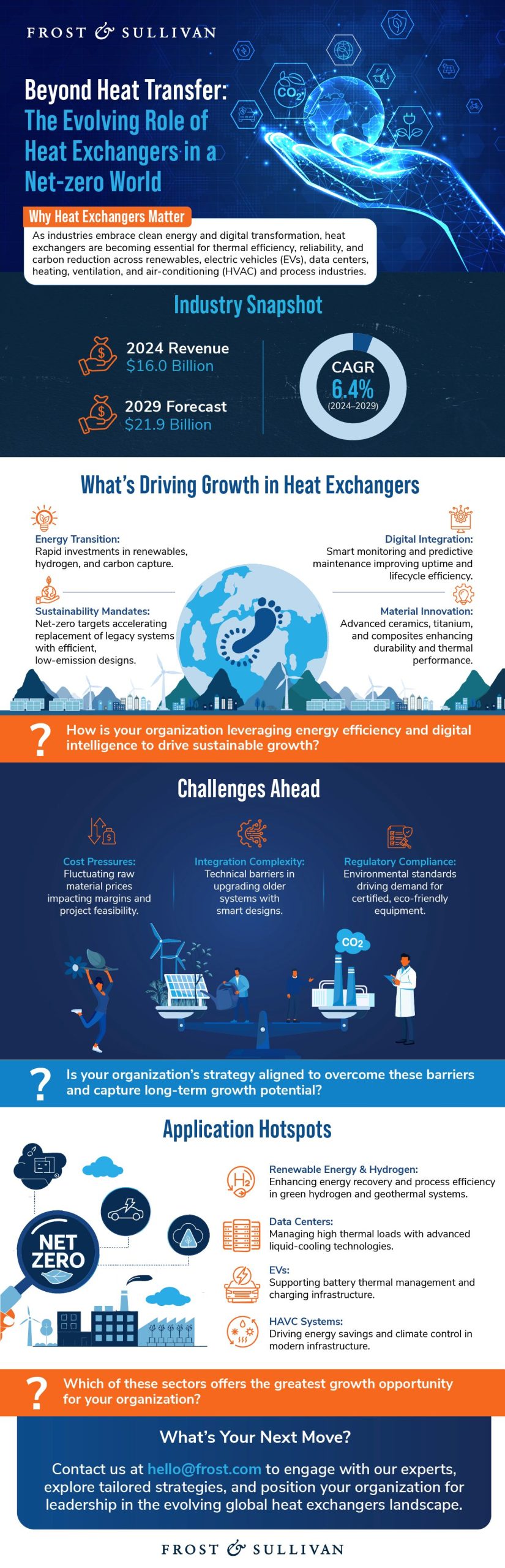
Access the full analysis to accelerate your heat exchangers growth strategy.
Emerging Technologies Redefining Heat Exchangers
- IoT and Predictive Maintenance: Smart sensors and digital twins enable real-time diagnostics, reducing lifecycle costs.
- Modular and Compact Systems: Scalable configurations support flexible deployment in renewables, hydrogen, and data centers.
- Advanced Materials: Ceramics, titanium, and composites enhance thermal performance and corrosion resistance.
- Additive Manufacturing: Customizable designs shorten production cycles and improve heat-transfer efficiency.
Which emerging technologies is your organization adopting to stay ahead of performance and sustainability demands?
Companies to Action
The global heat exchangers industry features over 300 active players, with the top companies accounting for nearly 30% of total market revenues. Recent strategic moves highlight how leading firms are strengthening capabilities and expanding market presence:
- Nexson Group – Acquired Thermowave GmbH to enhance its portfolio in smart heat transfer systems.
- Wieland – Acquired Onda S.p.A., broadening offerings in HVAC (heating, ventilation, and air conditioning) and energy-efficiency solutions.
- Kelvion – Partnered with industrial automation firms to advance digital integration for predictive service models.
How is your organization benchmarking itself against industry leaders to drive growth and innovation in heat exchangers?
Growth Opportunities in the Global Heat Exchangers Market
Growth Opportunity 1: Data Centers and the Automotive Sector to Become Major Sources of Revenue Generation
- The rapid expansion of data centers and EVs is driving strong demand for advanced heat exchangers.
- Liquid-cooling systems are becoming critical in data centers to manage thermal loads from AI, cloud, and cryptocurrency operations.
- China remains a key investment hub, offering significant opportunities in both automotive manufacturing and data center infrastructure.
Download the Full Analysis to Explore All Growth Opportunities in Global Heat Exchangers Industry
The Road Ahead
The convergence of clean energy, digital intelligence, and sustainable materials is redefining the competitive landscape.
To capture growth, companies should:
- Prioritize modular, serviceable designs to reduce time-to-deploy.
- Integrate sensors and analytics to move from reactive to predictive maintenance.
- Invest in advanced materials to win high-value, corrosive, or high-temperature niches.
- Build partnerships across the hydrogen, renewables, and data center ecosystems.
How is your organization transforming its heat management strategy to lead the next phase of industrial growth?
Next Steps
Let’s connect! Schedule a Growth Pipeline Dialog™ with Frost & Sullivan’s experts or write to [email protected].