This blog is based on the competitive analysis, Frost Radar™: Data Services Platforms, 2025, authored by Frost & Sullivan’s growth expert, Karyn Price from the AI and Cloud Business Solutions team.
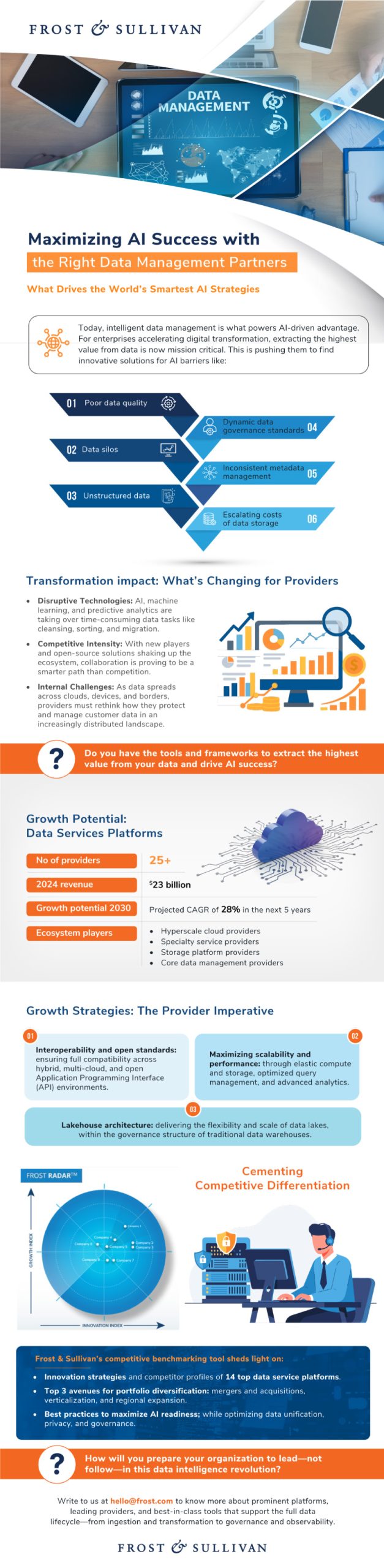
Enterprises are swimming in a sea of data, full of untapped potential. But simply having data isn’t enough; smart data management is the fuel that can turn AI from concept to competitive advantage. Moreover, as the volume of data continues to grow across hybrid, multi-cloud, and edge environments, it demands more than just basic storage. Consequently, for businesses that are implementing AI and pursuing digital transformation, the ability to effectively manage, unify, and extract value from this overlooked asset has become paramount.
Enter Data Services Platforms, which equip enterprises with seamless ingestion, real-time processing, governance, and intelligent analytics. These platforms are becoming the central engine for the success of AI, supercharging everything from workflow automation to predictive analysis and cybersecurity.
Our competitive benchmarking tool reveals tech strategies and innovation plans of 14 data services providers who can help you maximize the returns on your AI investments.
Click here for instant access to best practices that support the full data lifecycle—from ingestion and transformation to governance and observability.
- Increasing Data Complexity: Unstructured data across multiple devices and distributed storage locations (hybrid clouds, edge sites, Internet of Things [IoT] applications) is necessitating smarter, more agile data processing. Tomorrow’s data services must deliver seamless integration, cross-platform visibility, and the ability to unify data silos.
- AI and Machine Learning (ML) Require Cleaner Data: To get the most out of disruptive technologies, standardized data formats and consistent structuring is crucial. This is becoming a strategic priority among organizations looking to minimize the risks associated with model drift, bias, data leakage, and hallucinations.
- Governance and Compliance: Businesses are grappling to manage compliance with regional/ global standards, amid dynamic data sovereignty laws and privacy mandates. This draws attention to innovative services for automated policy enforcement, adaptive governance, and smart meta-data management.
- Growing Cyber Risks: Protecting the integrity and confidentiality of corporate data against breaches, ransomware, and insider threats is becoming paramount. This necessitates rapid developments in AI-first threat detection, zero-trust architecture, and encryption by default.
- Compression of Value Chains: From data ingestion to AI enablement, customers increasingly demand end-to-end solutions that streamline the entire data lifecycle. Providers are therefore under pressure to deliver integrated platforms that maximize interoperability, consolidate workflows, and drive quantifiable AI outcomes.
What’s your strategy for evaluating different data services and identifying the right partners to achieve your AI goals?
Why ‘Data First’ is the Smartest AI Move You’ll Make
AI-enablement Capabilities That Enterprises Are Looking For
To help customers use their data as an asset (for revenue generation, customer experience [CX] personalization, and AI implementation) platforms are becoming smarter and faster, bridging the gap between raw data and business-ready insights through:
- Data ingestion: that supports smoother data flow between structured, semi-structured, and unstructured formats.
- Data processing: workflow orchestration that delivers clean, enriched, and user-ready data.
- Data storage and access: through unified data lake-houses that support open formats, APIs, and query engines.
- Data governance: metadata management and cataloging that facilitates optimized access controls and policy enforcement.
- Data quality and observability: automated data profiling, validation, anomaly detection, and drift monitoring.
- Analytics and AI enablement: built-in analytics tools and integrations with business intelligence (BI) platforms.
AI Runs on Data: Best Practices to Make Sure Yours is Ready.
These 3 best practices play a critical role in shaping the effectiveness and reliability of tomorrow’s Data Services Platforms:
- Offering native support for AI workflows, including real-time data pipeline creation and observability for AI models. This will ensure smoother integration between data and AI teams.
- Prioritizing compatibility with open data formats, Application Programming Interfaces (APIs), and protocols, thereby bringing together data from disparate tools, platforms, and structures. This also simplifies data sharing and supports more scalable, flexible architectures.
- Embedding observability tools that track data freshness, accuracy, and pipeline health in real time. This guarantees that reliable data will serve as the foundation for AI models and downstream analytics.
Are you equipped to implement these best practices in your organization?
Enabling Tomorrow’s AI Applications: Three Growth Frontiers for Providers to Act Upon
The data services provider ecosystem is becoming increasingly crowded, with new players and open-source options changing the rules of competition. This implies that established players can’t afford to rely solely on standard features and capabilities to achieve their 2030 growth targets. Frost & Sullivan finds that these 3 growth opportunities can help providers stay relevant in the future:
Explore the Opportunity Universe in Other Segments of AI and Cloud Business Solutions:
- Edge-to-cloud Portability: Seamless data movement from edge to cloud (with unified metadata and access controls) is becoming a must-have for enterprise customers, but it’s something few providers have mastered so far. This real-time orchestration is key to enabling tomorrow’s AI and IoT applications.
- Context-aware Services: As data volume, variety, and use expands across organizations, platforms should evolve to better understand context—who the user is, what they need, and where they are. This will help providers deliver more intuitive, personalized, and simplified experiences, while minimizing data friction.
- Data Monetization: Most platforms today don’t offer embedded tools for customers to turn their data into revenue engines. By integrating licensing controls, secure marketplaces, and usage-based billing, providers could help organizations profit from their data assets, thereby sparking cross-industry collaboration.
When every other provider claims similar strengths, which tools will you use to calculate the ROI benefits of different solutions?
Want Better AI Outcomes? Start With Optimizing Data Management.
In conclusion, to achieve more meaningful AI outcomes, businesses must first optimize how they secure, process, and manage data. With advanced data services and automatic data processing, enterprises can eliminate silos, improve governance, and fuel reliable AI innovation. Put data first, and AI success naturally follows.
Talk to our AI and Cloud Business Solutions experts for strategic intelligence on evolving data standards, industry whitespaces, best practices, and emerging growth opportunities.
Alternatively, you can also write to us at [email protected].