This blog is based on our analysis, AI Orchestration in CX – Powering Innovation & Transformation authored by Frost & Sullivan’s growth expert, Bernardin Arnason from the Contact Center Solutions team.
From autonomous agents that think and act like humans, to predictive analytics that anticipate customer needs before they arise, AI is giving rise to smarter, faster, and more personalized customer engagement tools across industries.
Frost & Sullivan brings to you exclusive intelligence on AI applications, best practices, technology strategies, and growth opportunities from over 24 companies to action like Genesys, Zoom, Quiq, Sprinklr, NiCE and more!
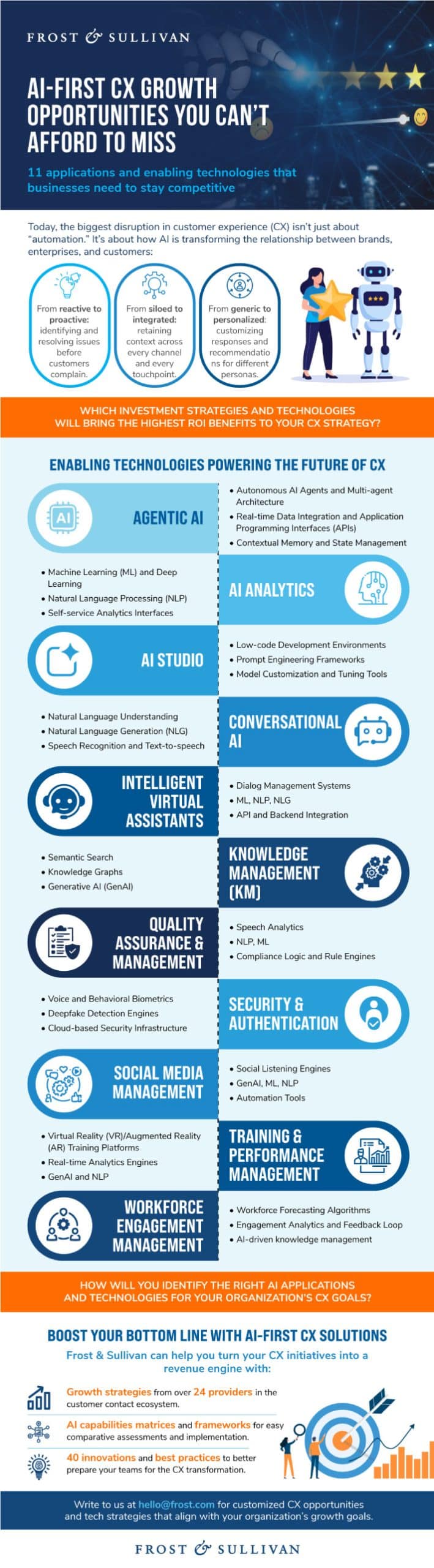
This brings to light the following AI applications with the potential to revolutionize the CX value chain:
- Agentic AI: Enabling AI agents to orchestrate CX outcomes with limited human intervention. These can use data from multiple channels for maximizing contextual awareness.
- AI Analytics: Facilitating intelligent processing of data across call transcripts, chat logs, email, and social media to deliver real-time, predictive, and prescriptive insights.
- AI Studios: Low-code/no-code platforms for designing, testing, and deploying new CX applications. These serve as centralized workspaces where customer contact teams can speedily manage prompts and customize AI models.
- Conversational AI: Powering context-aware, empathetic, and fluid communications across various channels through machine learning (ML) and natural language processing (NLP).
- Intelligent Virtual Assistants: Delivering autonomous, multi-modal customer support, especially for task-oriented functions. These can play the role of always-on frontline agents that minimize friction in service delivery.
- Knowledge Management (KM): Tools for organizing/accessing knowledge with semantic search, NLP, and predictive analytics. This brings timely information to employees and AI agents for delivering more proactive customer service.
- Quality Assurance & Management: Automating the analysis of customer interactions with AI-powered sentiment, tone, risk, and compliance checks, thereby reducing reliance on manual reviews.
- Security & Authentication: Safeguarding CX applications with voice biometrics, multi-layer security, adaptive verification, predictive risk scoring, behavioral analytics, and automated compliance.
- Social Media Management: Interpreting customer sentiment, detecting usage trends, and automating responses, thereby allowing proactive conflict resolution and personalized content across social platforms.
- Training & Performance Management: Customizing training programs and coaching content for agents and employees based on job functions. This enables adaptive learning and performance optimization.
- Workforce Engagement Management: Forecasting demand, automating scheduling, and personalizing employee development plans across all stages of the agent/employee lifecycle.
Going forward, as competition intensifies, mastering the use of AI in CX will not only help businesses differentiate themselves, but also build lasting customer trust, loyalty, brand recall, and generate higher ROI on tech investments.
How will you determine which part of your CX value chain would benefit most with AI and automation?
Your Guide to Winning the CX Race with the Power of AI
Click here to discover how AI can help your teams turn new CX initiatives into a growth engine.
From Autonomous Agents to Intelligent Virtual Agents (IVAs): Key Innovations to Watch
The pace of AI innovation is accelerating, and for CX leaders, the implications are profound. Industry incumbents must not only adapt but also anticipate the infrastructure changes these technologies will necessitate. Else, they risk falling behind their more agile competitors.
This brings to light the following:
- Multi-agent Orchestration: for triggering rule, prompt, and goal-oriented AI, while coordinating with other agents to solve complex customer issues. This also helps in proactively detecting (and remedying) potential service failures.
- Natural Language Querying: empowering non-technical users with data-driven answers and automated insights. Additionally, using advanced customer analytics to uncover patterns, anomalies, and root causes.
- Multimodal Support: to design more immersive, omnichannel experiences that seamlessly combine inputs from text, image, and voice sources.
- Human-like Conversations: harnessing generative AI (GenAI) and NLP to deliver more natural, empathetic, inclusive, and consistent interactions across web, mobile, messaging apps, and voice interfaces.
- Context-aware Virtual Assistants: better interpreting the nuances of conversational slang, intent, sentiment, and context with advanced language understanding and self-learning.
- Semantic Knowledge Engines: moving KM beyond keyword matching to include automated content curation, predictive support, and dynamic workflow management for agents.
In a crowded ecosystem of AI tools, CX platforms, and managed services, how do you know which investment strategies and growth processes will truly move the CX needle for your organization?
Access full analysis for detailed capability matrices and best practices in the CX ecosystem.
The ROI of AI Orchestration in CX: Measuring What Really Matters
AI promises to transform CX, but without calculating operational impact, even the most advanced tools risk becoming expensive experiments. Outcomes like efficiency, resolution rates, and customer satisfaction translate directly into ROI. By quantifying these gains, organizations can cut through the AI hype, prioritize the right use cases, and ensure that future investments drive both customer engagement and profitability.
Here are a few operational parameters that organizations can prioritize:
- First Contact Resolution in AI agents: addressing complex queries autonomously and reducing repeat interactions, thereby minimizing the need for live agent intervention.
- 24/7 Always-on Support: using intelligent automation to make sure that customers receive proactive help and responses any time they need, while also lowering wait times.
- Real-time Monitoring and Alerts: leveraging predictive analytics and behavioral insights to identify sentiment change or operational risks across various touchpoints.
- Accelerated AI Deployment: using low-code/no-code tools to enable intelligent self-service, that minimizes the time required to implement and scale AI in CX operations.
- Higher CX Service Coverage: using IVAs and automated bot coaching to scale CX, while maximizing operational efficiencies.
- Escalation Rates: equipping frontline teams with better knowledge and real-time insights, thereby lowering the need for handoffs and tiered support.
- Authentication Time: replacing legacy verification systems with passive and automated ones that detect (and address) fraudulent activities faster.
Which operational metrics will bring the highest ROI benefits to your CX strategy?
In conclusion, AI orchestration isn’t just about automating tasks; it’s about designing experiences that feel personalized, predictive, and seamless. Businesses that embrace these tools today can position themselves to set new standards of customer trust, loyalty, and brand recall tomorrow.
To explore customized opportunities, technology strategies, and best practices for your specific CX goals, get in touch with our Customer Contact experts today!
Alternatively, you can also write to us at [email protected].