This blog is based on the analyses titled, Top Strategic Imperatives in Distribution Infrastructure and Top 10 Growth Opportunities in Content Delivery, 2026 authored by Frost & Sullivan’s growth expert, Alaa Saayed from the Digital Content Services team.
Optimize Your Content Delivery Strategy
- Digital consumption today operates at a completely different scale, pushing delivery networks well beyond their original role as performance layers.
- Advancements in video streaming, real-time gaming, and agentic AI — combined with the rise of edge computing and increasingly sophisticated cyber threats — are necessitating change across the content value chain.
- Speed still matters, but resilience, trust, and control are now table stakes.
- Tomorrow’s platforms must orchestrate secure data flows across jurisdictions, enforce digital identity, and facilitate autonomous workloads, all while supporting applications like augmented reality (AR)/virtual reality (VR) and Internet of Things (IoT) connectivity.
Transformative Change in Content Distribution—Are You Ready?
These forces are accelerating the pace of this transformation:
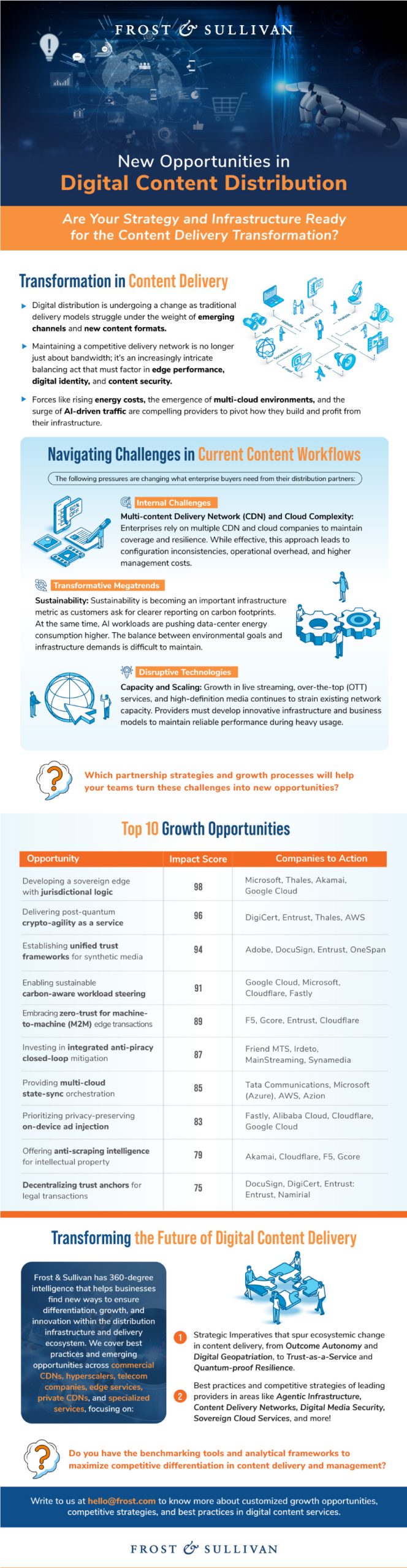
- Trust-as-a-Service: The explosion of synthetic and AI-generated content is beginning to erode trust across digital platforms, making it harder to determine where content originated and whether it has been altered. In response, infrastructure providers are embedding cryptographic signing, identity assurance, and tamper-evident metadata into delivery workflows to create verifiable content provenance.
- Outcome Autonomy and Agentic Systems: Managing distribution networks that stretch across thousands of edge nodes and hybrid-cloud environments has become too complex for manual oversight alone. Consequently, providers are transitioning from treating infrastructure as a utility, to deploying agentic systems where AI agents take on tasks like incident response, remediation, and software updates through shared semantic layers.
- Sovereign Identity Ecosystems: Digital identity management is moving away from fragmented platform-controlled logins toward user-controlled digital wallets that allow individuals and organizations to manage verified credentials securely. This requires providers to develop orchestration layers for identity management across over 27 national trust registries, thereby embracing privacy-by-design.
- Jurisdictional Routing: The idea of borderless internet clashes with stricter data sovereignty rules, pushing organizations to keep sensitive data and workloads within specific regional boundaries—particularly in regulated sectors like finance, healthcare, and government. As a result, operators must embed jurisdiction-aware routing into their infrastructure, enabling enterprises to distribute content globally while staying compliant with regional data laws.
- Quantum-proof Resilience: The rise of quantum computing is creating a new security challenge as adversaries adopt “harvest now, decrypt later” strategies. Going forth, providers feel the pressure of building crypto-agile infrastructure that can adapt to post-quantum cryptography (PQC) standards without requiring enterprises to redesign their underlying applications.
Is your content delivery strategy equipped to facilitate real-time, AI-driven, and trust-centric digital experiences?
Take Advantage of Next-Gen Distribution Technologies in Your Organization Today!
New Opportunities Revolutionizing the Future of Content Delivery Networks (CDNs)
Identifying the right growth opportunities is just as important as solving operational challenges. Providers that evaluate emerging opportunities through structured impact assessments can prioritize investments more effectively, differentiate their platforms, and unlock new revenue streams while adapting to regulatory, security, and infrastructure shifts in digital distribution.
Listen to Our Growth Podcast on Content Delivery Infrastructure Know More!
Best Practices and Growth Strategies for Competitive Differentiation
All of this means that running a global delivery platform has become more demanding. Traffic volumes keep rising, regulations are becoming stricter, and cyber-attacks are getting more sophisticated. In this environment, defendable best practices matter just as much as new technology. Providers that refine how they manage security, data movement, and transactions are better positioned to keep services stable and customers confident. But how exactly can they do this?
Start with these:
- Closed-loop anti-piracy enforcement at the edge: Moving detection and enforcement closer to the edge so that suspicious activity can be identified and blocked in real time. Techniques such as forensic watermarking, credential-abuse monitoring, and automated session termination help trace leaks quickly and prevent illegal streams from spreading across networks.
- Moving personalization and ad-matching logic closer to users: Processing recommendation and advertising decisions at the edge or on the device rather than in large centralized systems. This reduces how much personal data travels across networks while still allowing platforms to deliver relevant content and meet stricter privacy and consent requirements.
- Orchestrating state synchronization across multi-cloud environments: Allowing applications, streaming sessions, and security policies to move smoothly between hyperscalers, CDNs, and edge environments. Keeping session data synchronized across providers helps maintain service continuity during outages, congestion, or regional traffic shifts.
- Building verifiable trust mechanisms into transactions: Supporting cryptographic signing, immutable timestamps, and distributed verification records within delivery infrastructure. These capabilities allow organizations to prove when transactions occurred and who authorized them, creating stronger audit trails for contracts, digital documents, and other legally sensitive exchanges.
Looking For More Growth Opportunities?
Read on about emerging technologies, competitive strategies, and leading providers in digital content services:
· Growth Opportunities in Distribution Infrastructure and Delivery
· Growth Frontiers in Content Creation, Management, and Orchestration
Click Here to Start Implementing These Best Practices in Your Organization.
Ready to Lead the Transformation?
In conclusion, the real transformation isn’t just technological—it’s economic and experiential as well. Content delivery is becoming a strategic control layer for digital ecosystems, where ownership of trust, data flow, and user experience will define market leaders far more than speed ever did. The question then is, is your organization equipped to thrive through this transformation?
- Book a Growth Dialog:Align your content distribution strategy for 2026 and beyond with Frost & Sullivan’s Growth Pipeline™ Dialog.
- Engage with Growth Experts:Co-design AI-enabled, energy-efficient content delivery networks that scale commercial impact.
- Share Your Transformation Story: Position your organization as a transformation leader in content creation, management, orchestration, distribution, and delivery through Frost & Sullivan’s Transformational Growth Leadership program.
- Join the Growth Council:Collaborate with digital content services leaders shaping future ICT ecosystems.
- Nominate for Best Practices Recognition:Be recognized for excellence in digital infrastructure, hardware, software, integrated solutions, and customer impact.
- Demonstrate Industry Positioning on the Frost Radar™:Benchmark your content performance, delivery speed, and innovation focus against your top competitors.
- Activate Brand & Demand Growth:Accelerate awareness, engagement, and revenue growth through integrated brand and demand generation strategies.
Content Distribution, Delivery Infrastructure, and Network Services: Frequently Asked Questions (FAQs)
- How expensive is it to modernize content delivery architecture?
Costs vary widely, but the bigger factor is inefficiency. Many companies overspend on bandwidth, duplicate infrastructure, or downtime. Modernization often reduces those hidden costs, especially when automation and better traffic management start replacing manual intervention and overprovisioning. - What’s the difference between CDNs and edge computing in practice?
A content delivery network (CDN) mainly focuses on delivering cached content quickly, while edge computing actually processes data closer to the user. In reality, modern platforms blend both (delivery plus decision-making) so the line is blurring, especially for real-time applications. - What should companies look for when choosing a CDN provider in 2026 and beyond?
Beyond speed, things like security capabilities, regional compliance support, and integration with cloud or edge environments matter more now. Flexibility is key, especially how easily the provider adapts to new workloads, rather than just handling traffic spikes.
- What role does observability play in content delivery today?
It’s becoming essential. With so many moving parts — clouds, edges, networks — you need real-time visibility to understand what’s happening. Without it, troubleshooting becomes guesswork, especially when performance issues only affect certain regions or user segments.
🎧 Listen to Our Growth Podcast to Know What’s Next in Digital Content Delivery and Distribution!