This blog is based on our analyses, Growth Opportunities in the Tier I Mobile Device and Data Industry and Enterprise Mobility Solutions in Latin America, 2025-2030 authored by Frost & Sullivan’s growth experts, Vikrant Gandhi and Paula Fenoglio from the Enterprise Wireless Services team.
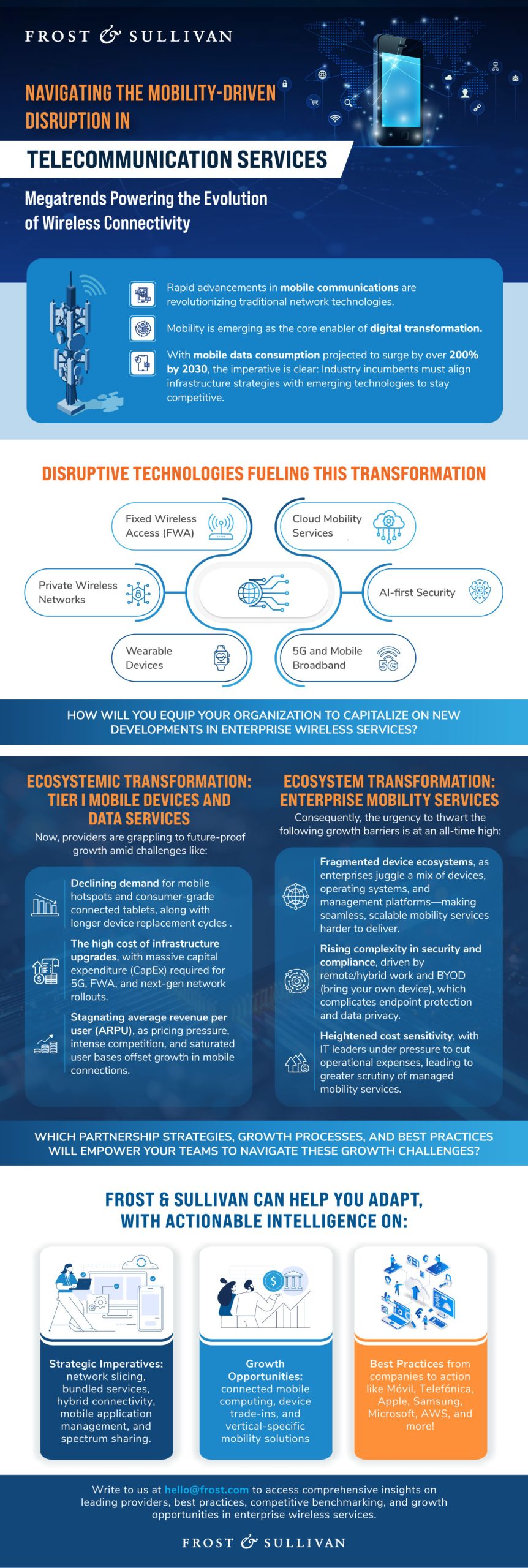
Today, advancements in mobile communications are redefining connectivity, network technologies, and wireless experiences. This implies that mobility isn’t just a channel for data exchange anymore, it is becoming the core enabler of digital transformation—driven by the convergence of devices, software, and networks that power a more connected economy.
This shift is unfolding differently across various regions. North America is witnessing exponential growth in Fixed Wireless Access (FWA), private networks, wearables, and other connected devices, while Latin American enterprises are rapidly adopting more cloud-first, mobile-based, and AI-powered operations.
Such developments signal that future growth potential will be determined by how well telecom providers and Communication Service Providers (CSPs) adapt to megatrends like:
- Private Wireless Networks: Delivering customized wireless connectivity with superior security and data services optimization.
- Adoption of Wearables: Cellular-enabled smartwatches, health trackers, and fitness devices prompting carriers to develop bundled pricing strategies and shared data pools.
- Cloud Mobility Services: Centralizing data management, security, and storage services through cloud-connected mobile apps, thereby enabling anywhere, anytime access, and location-agnostic workforce models.
- FWA: Gaining momentum due to its speed, affordability, rural accessibility, and ability to support Internet of Things (IoT) applications across consumer and enterprise segments.
- AI for Customization and Security: Helping CSPs personalize user experience, detect anomalies, and deliver more intelligent and adaptive network services.
- 5G Solutions and Mobile Broadband: Facilitating compute-intensive applications, like cloud gaming, AI, predictive analytics, and real-time collaboration on multi-functional mobile devices.
- Now is the time to re-align your organization’s wireless technologies and 5G solutions to support the mobility momentum.
- Start your transformation journey with Frost & Sullivan’s exclusive whitepaper on mobile communications.
The question is – Which infrastructure strategies will help you thrive amid this transformation?
Monetizing the Mobile Momentum and Unlocking New Growth Avenues
Best Practices in Mobile Devices and Data Services
Adopting new technologies alone is insufficient in the ever-changing world of mobile communications. This could leave providers susceptible to commoditization, eroding prices, shrinking margins, and declining customer loyalty. Going forward, the companies that are willing to experiment with new business models and partnership strategies, putting customer value at the center of every offering will thrive.
Here are three proven best practices to create long-term differentiation in wireless technologies:
- Leveraging network slicing to unlock premium services: By combining FWA with network slicing, providers can deliver dedicated, performance-optimized connections for vertical-specific customer needs—whether it’s ultra-low latency in real-time operations or high bandwidth for data-heavy workloads. Additionally, simplifying 5G deployment and monitoring so that customers can benefit from mobility without wrestling with technical complexity.
- Forging cross-industry alliances: By collaborating with hardware manufacturers, software developers, and cybersecurity vendors, providers can build holistic, industry-ready mobility solutions. These tailored solutions can open doors to highly regulated industries, whether it’s healthcare devices that meet data privacy standards or financial platforms with built-in security and compliance.
- Developing usage-based and Application Programming Interface (API)-driven pricing models: Moving beyond traditional bandwidth tiers and flat-rate plans, providers can create new revenue streams by charging based on IoT endpoint volumes, edge computing workloads, or quality-of-service guarantees. This flexible approach makes connectivity solutions more responsive to changing customer needs.
Which partnership strategies will help you turn your organization’s 5G infrastructure investments into high-margin revenue streams?
Best Practices in Enterprise Mobility
Going forward, these best practices will help industry incumbents’ future-proof investments and enhance end-to-end security in apps and functions like CRM (Customer Relationship Management), UC&C (Unified Communications and Collaboration), UEM (Unified Endpoint Management), MAM (Mobile Application Management), MDM (Mobile Device Management), and MCM (Mobile Content Management):
- Security integration: Providing safe and smooth mobile service integration with business operations, through encryption, remote wiping, secure authentication, and data loss prevention. This can be done in collaboration with cybersecurity providers.
- App configuration: Focusing on developing expertise in vertical-specific distribution protocols, client needs, and compatibility tests.
- Data security assessments: Supplementing data services with regular assessments and security upgrades to mitigate cyber risk and prevent data breaches.
- Employee training: Offering value-added training services to educate enterprises about the integration of mobile services, adherence to data security best practices, and protection of company data.
Which of these best practices would give your organization the strongest competitive edge in enterprise mobility?
Next Steps On Your Mobile Communications Journey
Moving forward, provider success hinges on converting advanced 5G capabilities—network slicing, Multi-access Edge Computing (MEC)-based delivery, and AI-optimized performance—into tangible customer value. Those who master vertical-specific customization, while bundling connectivity services with premium content, security, and enterprise-grade management tools stand to gain long-term advantages. Moreover, as device fleets and AI-first workloads multiply, operators and mobility vendors must move from selling access to delivering intelligent services that command customer loyalty and higher margins — What steps will you take to better prepare your organization for tomorrow’s era of mobile communications?
Get in touch with our Enterprise Wireless Services experts to explore customized opportunities, technology strategies, and best practices for your specific business goals.
Alternatively, you can also write to us at [email protected].