This blog is based on the recent analyses, “Strategic Analysis of the Global Medium- and Heavy-Duty Commercial Vehicle Aftermarket”, and “Opportunities in the Fleet Services Aftermarket for Passenger Cars and Light Commercial Vehicles, North America and Europe” authored by Frost & Sullivan’s Growth Experts Jagadeesh Chandran and Benson Augustine, respectively, from the Mobility team.
The global vehicle aftermarket is no longer just about selling replacement parts. Trade volatility, electrification mandates, and software-defined vehicles (SDVs) are converging to create a fundamentally different industry.
What’s changing:
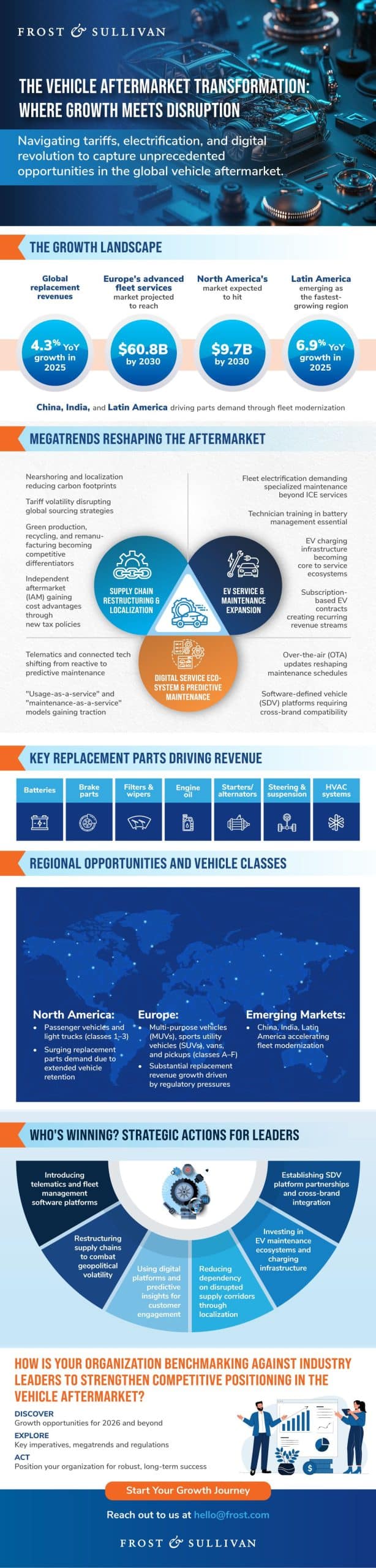
- Global replacement revenue is projected to grow 4.3% year-on-year (Y-o-Y) this year
- Latin America is emerging as the fastest-growing region (medium and heavy-duty vehicles) at 6.9% (Y-o-Y) growth through nearshoring trends and expanding auto exports
- Fleet electrification is eliminating entire service categories while creating new ones
- Companies are shifting from transactional relationships to outcome-based partnerships
Organizations acting decisively on supply chain restructuring, electric vehicle (EV) service expansion, and digital ecosystems are positioning themselves as ecosystem leaders.
Transformative Megatrends Reshaping Competitive Advantage
Driven by tariff volatility, sustainability mandates, and mounting geopolitical risks, organizations are dismantling centralized, globalized supply networks in favor of regionally diversified models that prioritize flexibility, compliance, and customer alignment. This fundamental restructuring is reshaping how aftermarket organizations compete, partner, and deliver value across key regions.
Where this is happening:
- North America: Nearshoring initiatives are redirecting supply chains to Mexico and Central America, reducing logistics costs and compliance complexity
- Asia: Companies are establishing localization partnerships in China and India to serve rapidly growing domestic regions while building multi-source supplier ecosystems
- Europe: Building domestic supplier networks and strengthening partnerships with Eastern European manufacturers to reduce geopolitical risk and supply disruptions
Why it matters:
- Localized supply chains reduce carbon footprints, enable faster fulfillment, and improve inventory management efficiency.
- Companies are investing in remanufactured component programs and circular economy practices that extend component lifecycles while reducing raw material dependency.
- Sustainable supply chains are becoming core competitive differentiators, not compliance checkboxes; fleet operators are increasingly prioritizing environmental credentials when selecting service providers.
- Multi-source, geographically distributed supplier networks provide operational flexibility to absorb tariff changes, currency fluctuations, and regional demand shifts.
Electric Vehicles Are Reshaping Service Categories
Fleet electrification is accelerating faster than anticipated, creating challenges and massive opportunities simultaneously.
The challenges:
- EV maintenance fundamentally differs from traditional internal combustion engines (ICE) servicing. No oil changes, regenerative braking systems operate under different wear mechanics, and high-voltage battery diagnostics require specialized expertise.
- Traditional mechanics trained on ICE systems lack the foundational knowledge needed for high-voltage electrical systems, battery management software, and thermal system management.
- Fleets transitioning to EV face a critical technician skills gap—service centers lack qualified personnel to diagnose battery issues or conduct software updates.
The opportunities:
- New parts categories are emerging, like battery thermal management systems, high-voltage electrical components, battery monitoring sensors, and software-enabled diagnostics platforms.
- Organizations are building EV maintenance expertise and training programs are attracting premium fleet contracts with higher service margins.
- Subscription-based EV maintenance models bundling battery diagnostics, software updates, and predictive servicing are creating predictable recurring revenue streams replacing volatile parts sales.
- Charging infrastructure integration with fleet management is becoming a high-value service enabling fleet operators to optimize vehicle utilization and reduce downtime.
The acceleration drivers:
Government electrification mandates are tightening across North America and Europe. Fleet operators seeking lower operational costs are adopting EVs faster than aftermarket service providers can scale expertise. This creates a window of opportunity for organizations investing in EV service training, certifications, and partnerships with EV manufacturers for access to proprietary diagnostic protocols.
Digital Platforms Are Enabling Predictive Maintenance
Telematics systems have fundamentally transformed how fleets manage vehicle health. Continuously monitoring engine performance, component wear patterns, thermal systems, and safety parameters, these platforms stream gigabytes of daily performance data that predictive algorithms analyze to enable maintenance scheduling before failures occur, reducing downtime, extending vehicle life, and improving safety outcomes.
Furthermore, this capability is amplified by over-the-air (OTA) updates, now standard practice for new commercial vehicles (CVs), allowing software patches and diagnostics to be deployed remotely without requiring facility visits. Organizations are shifting away from transactional parts sales toward “maintenance-as-a-service” and “vehicle uptime guarantees” structures, where revenue is derived from recurring performance-based fees rather than parts sold. This transition aligns provider incentives with fleet operator priorities, keeping vehicles operational and costs predictable.
How Aftermarket Leaders Will Win in the Aftermarket Industry
Fleet operators have made their priorities unmistakably clear. When evaluating vehicle purchases, they now prioritize predictive maintenance capabilities, recognizing that avoiding unexpected breakdowns directly impacts operational profitability. This shift in buyer behavior is reshaping supplier selection criteria across the industry.
Three structural forces are converging to reshape the entire industry:
- Supply chains are localizing to mitigate tariff and geopolitical risk.
- Electric vehicle maintenance expertise is transitioning from optional to essential.
- Digital platforms are enabling outcome-based service models that align provider incentives with fleet operator profitability.
Organizations acting decisively on these three pillars will capture the $60+ billion in advanced aftermarket services revenue expected through 2030. Those clinging to traditional parts sales will find themselves increasingly commoditized, competing on price alone in an industry that has fundamentally moved on.
Want to dive deeper? Click here to connect with Jagadeesh Chandran, Benson Augustine, and other growth experts to discover how these insights can help you achieve sustained growth or connect with us at [email protected].