M&A will enable rapid entry into new markets, customer diversification, and portfolio expansion, while AI is set to support reduced downtime and improved cost and operational efficiencies.
Macroeconomic pressures, including ongoing trade disputes and a cautious investment climate, are dampening the global connected truck telematics market. Nevertheless, technological innovation is continuing to boost adoption, with the market transitioning from traditional tracking systems to sophisticated, AI-powered, software-defined solutions that enhance efficiency, safety, and real-time decision-making.
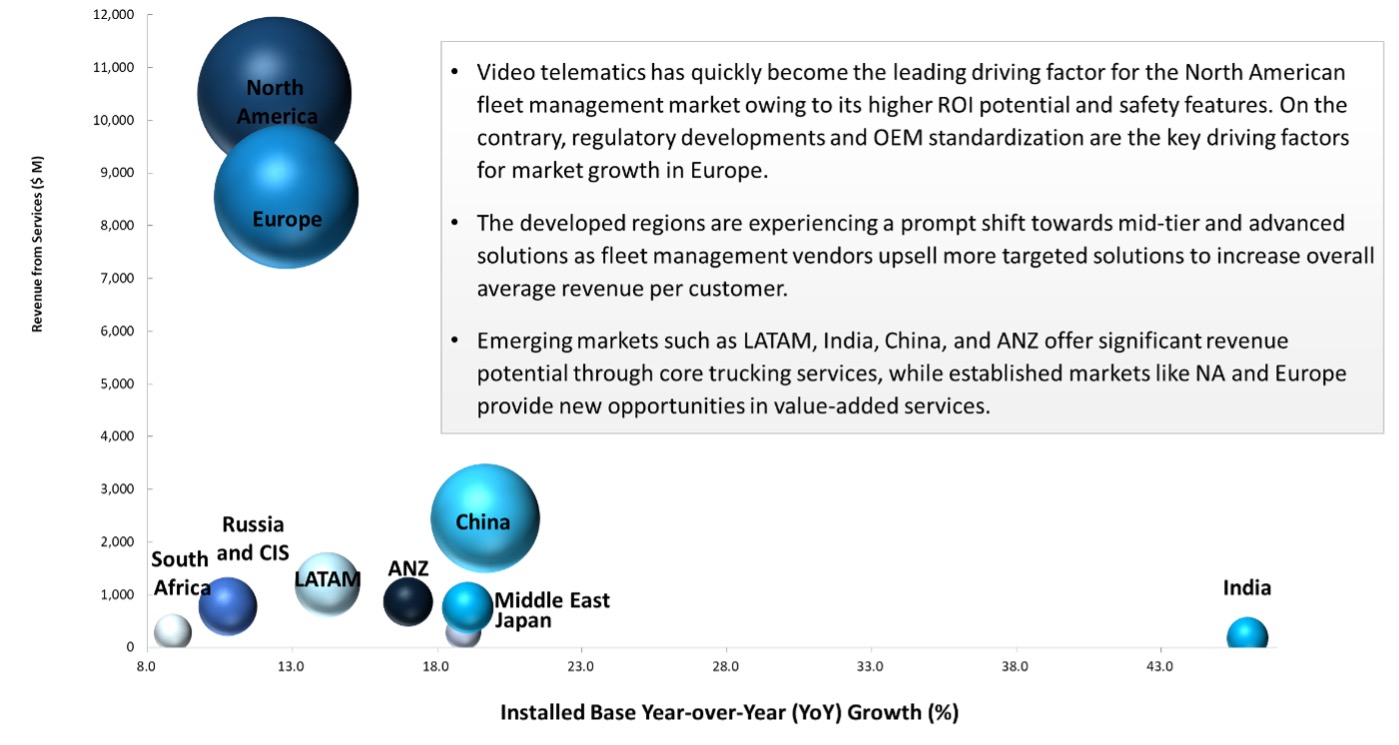
Developed markets like North America and Europe are at the forefront of this transition, spurred by regulatory mandates and OEM integration. Simultaneously, emerging markets like India, Latin America, and Southeast Asia offer promise for the uptake of core telematics services. Overall, fleet operators are increasing investments in solutions that offer actionable insights and align with electrification and sustainability goals.
As vehicle connectivity becomes standard, fleet telematics is emerging as a strategic enabler. With AI, predictive maintenance, and embedded intelligence becoming mainstream, market participants are poised to unlock new business models and value-added services in 2025.
To learn more, please see our upcoming Global Connected Truck Telematics Outlook, 2025, Global Connected Truck Telematics Outlook, 2024, Medium and Heavy-duty Commercial Vehicle (CV) Electronic Service Tools (EST) Market, North America, 2025–2030, Commercial Vehicle (CV) Predictive Maintenance Industry, North America, Europe, and India, 2024–2029, or contact [email protected] for information on a private briefing.
Market Consolidation and Technology Advances Define the Market in 2024
Frost & Sullivan’s outlook for 2024 identified key trends centered on increased merger and acquisition (M&A) activity, OEM engagement, and diagnostics and maintenance. These predictions were validated by significant developments in the market.
For instance, M&A activity surged as major telematics service providers (TSPs) such as Trimble, Platform Science, Mix Telematics, Fleet Complete, and Astrata expanded their capabilities through acquisitions. Clarience, Ranger Design, and Auto Integrate took the M&A route to strengthen telematics portfolios with advanced diagnostics and predictive maintenance solutions. The trailer telematics space also witnessed heightened activity with Phillips’ acquisition of Inland Trailer and Wabash’s takeover of TrailerHawk.ai.
OEMs doubled down on connected vehicle strategies, further underscoring Frost & Sullivan’s forecasts for 2024. For example, several automakers either launched or expanded partnerships with TSPs to embed telematics hardware, leverage AI, and unlock data-driven insights. A major event was the joint venture between the Volvo Group and Daimler Truck to develop a software-defined vehicle platform, highlighting the crucial role of digital infrastructure in vehicle design.
Meanwhile, strategic partnerships accelerated. Collaborations like Platform Science’s with Phillips Connect and TAT, Samsara’s with Esri, Hyundai’s with Waymo, and Fleetio’s with Razor Tracking, emphasized the market’s push toward integrated, end-to-end fleet management. Product innovation also flourished as seen in Samsara’s drowsiness detection feature and Geotab’s collision center.
AI took center stage in 2024. Applications of AI expanded across real-time alerts, video analytics, predictive diagnostics, and telematics-based insurance, particularly in mature markets. Geotab Ace, Samsara Intelligence, and Webfleet’s AI Assistant showcased how AI-powered tools have been transforming dashboards.
Connected Truck Telematics: Global Trends, 2025

Source: Frost & Sullivan, 2025
What to Expect in 2025
Frost & Sullivan’s outlook for 2025 reveals that AI adoption will pick up pace, with TSPs and OEMs progressively integrating AI-based, customer-oriented features into dashboard navigation, predictive maintenance, and generative conversational user interfaces. Frost & Sullivan anticipates that generative AI and machine learning will enable personalized fleet insights and improved decision-making.
M&A activity will continue to shape market dynamics. Large enterprise fleets and global TSPs are expected to acquire mid-sized firms to quickly enter new markets, expand their service range, and deliver one-stop solutions for diverse fleet needs. Consolidation will also help companies remain resilient and sustain growth amidst geopolitical and economic volatility.
Portfolio expansion will be a key focus area in 2025. TSPs will expand into adjacent areas like insurance and tolling. As more fleets transition to electric trucks, there will be high demand for enabling solutions like battery analytics and charge point mapping. Trailer solutions and fuel card integration will be among the areas set to witness innovation and bundling within larger telematics platforms.
Meanwhile, competitive dynamics will be disrupted by non-TSP players such as Tier-1 suppliers, tire manufacturers, and engine system vendors. These companies will increasingly enter the telematics ecosystem through software partnerships and digital product offerings. OEMs will also intensify their presence in the hardware segment by embedding telematics control units (TCUs) as standard factory fitments. This will set the foundation for over-the-air (OTA) software capabilities and real-time diagnostics.
Connected Truck Telematics: Service Revenue by Region, Global, 2025
Source: Frost & Sullivan, 2025
Our Perspective
The M&A wave is far from over. As companies push to scale globally and offer integrated, end-to-end solutions, M&As will be the go-to strategy for rapid geographic and customer expansion. For many TSPs, entering emerging markets and broadening portfolios through M&A will be essential to remaining competitive.
AI will continue to transform fleet management. It will enable real-time analytics, predictive diagnostics, route optimization, and personalized driver coaching. This, in turn, will support reduced downtime and improved cost and operational efficiencies. TSPs that can successfully integrate AI into their platforms and partner with AI specialists will be able to realize competitive differentiation.
Video safety solutions will come to the fore, particularly in North America and Europe, where larger fleets will invest in advanced systems to safeguard assets and improve risk management. Meanwhile, emerging markets and smaller fleets will embrace simpler, budget-friendly options. Collaborations between OEMs and video solution vendors will further standardize camera integration at the factory level.
With inputs from Amrita Shetty, Associate Director, Communications & Content – Mobility