A split-venue show that mirrors a split-second industry
IAA MOBILITY returned to Munich for its third edition from September 9–14 with the theme “It’s All About Mobility.” Germany’s premier mobility trade show retained its dual format: the B2B Summit at Messe München (September 9–12) and the Open Space in downtown Munich (September 9–14). Together, they created a clever bridge between industry strategy and citizen engagement. The event attracted more than half a million visitors, including German Chancellor Friedrich Merz. This year too, the Summit featured impressive numbers: 750 exhibitors from 37 countries, over 350 worldwide premieres, and over 69,000 trade visitors from 108 countries. Strong attendance and a program dominated by cloud and software companies underscored a clear message: software is no longer a cameo in mobility; it’s the star of the show.
Key Takeaways
With a ringside view of the event, these were our key takeaways that highlight how the industry is rapidly redefining its priorities:
1) Hybrids are (definitively) back
BMW, Mercedes-Benz, Volkswagen, and Porsche all paired BEV headlines with efficient hybrid propositions. Porsche’s 911 Turbo S T-Hybrid reinforced the performance-hybrid case, while Renault kept the Clio central to its value ladder with hybrid coverage across the broader portfolio. Tier-one signaling matched this shift: Schaeffler foregrounded electrified drivelines (e-axles, hybrid modules) following its Vitesco acquisition, while AISIN spotlighted hybrid transmissions alongside e-axles and integrated vehicle control—signaling suppliers’ read on customer demand and policy realism.
The near-term European fleet will be more HEV/PHEV-heavy than many forecast two years ago, as OEMs balance CO₂ compliance with affordability and uneven charging infrastructure. Hybrid content (power electronics, thermal) is expected to remain a resilient margin pool through 2028–2030. Range-extenders have re-entered supplier roadmaps (e.g., compact generator sets for specific duty cycles), primarily as a TCO lever in select LCV and long-distance use cases.
The Chinese market has demonstrated significant potential for large SUVs, sedans, and MPVs equipped with EREV powertrains. In Europe, EREVs can be positioned as a forward-looking alternative to PHEVs, appealing to consumers who seek extended electric driving range and advanced technology features. However, growth potential in Europe will remain limited compared to China, as approaching emissions deadlines, urban low-emission zones, high fuel prices, robust charging networks, and consumer preference for compact vehicles all reduce EREV competitiveness.
Frost & Sullivan analysis projects hybrids (PHEV, EREV, MHEV, FHEV) to account for 49.5% of total light vehicle sales in Europe by 2030, before gradually decreasing to 30.7% by 2035.
2) Affordable EVs go mainstream – across European and Chinese nameplates
IAA 2025 made “entry EV” tangible: the Volkswagen ID.Polo, CUPRA Raval, and the ID.CROSS concept signposted a €20,000–€30,000 band from 2026, while Škoda Vision O/Epiq pulled estate and small-SUV formats into the value discussion. Chinese brands pushed on value and tech:
- Leapmotor – Using the Stellantis JV to short-circuit the hard bits of Europe (homologation, logistics, aftersales), then slotting B05 hatch + B10 SUV into the €25–30k fight with ID.3/MG4. The play is cost + cadence: LFP batteries and fast OTA feature packs to undercut on price while feeling modern. Watch for selective EU assembly or finishing if tariffs tighten, and for how quickly Stellantis’ retail network converts test drives into orders.
- BYD – Broadens the compact line-up while reframing the bottleneck from battery range to charge time, using the 1,000 kW “flash-charging” demo to push co-investment in battery-buffered hubs with CPOs and fleets. Vertical integration (cell → pack → power electronics) is the margin weapon; DENZA acts as a premium halo to lift brand stretch. The risk is real-world duty cycles not matching the demo – track live site rollouts, partner CPOs, and queue times.
- TOGG – A region-first strategy: build density at home (product + charging Trugo + services Trumore), then step into DACH/Benelux with T10X/T10F as honest value cars rather than tech theatre. Differentiator is localisation and service coverage more than headline specs.
We expect A, B, and C-segments to be contested by localised, shared-platform EVs, compressing option packs and pushing software-led upselling of features, rather than factory fitted solutions as seen in the past.
3) Flash charging moves from lab demo to product roadmap
Two vectors stood out: 800-V architectures in volume models (e.g., BMW iX3’s sixth-gen eDrive) and ultra-fast “flash charging” claims led by BYD (demonstrated capability to add 400 km in 5 minutes under defined conditions). Early deployments will cluster at battery-buffered hubs that charge the site battery off-peak and discharge to dispensers at peak – the economics that make 800-V “flash” feasible without over-penalising the local grid. Charging is now a spec-sheet differentiator; grid-tied storage and site software become new revenue layers for utilities, CPOs, and OEM alliances.
4) Software becomes the car’s defining system (not a feature)
Software is now the central vehicle architecture: virtualised ECUs, cloud simulation, and hardware-agnostic deployments layered over zonal E/E and central compute.
- NVIDIA – Halos. A cloud-to-car, safety-assessed platform around DRIVE/DriveOS and validation pipelines; positioned for partner SOPs rather than a single model tie-in through OEMs.
- Qualcomm × BMW – Snapdragon Ride Pilot (iX3). Co-developed AD/ADAS stack, validated in 60+ countries with a pathway to regional feature releases via OTA; scope ranges from L2+ driving assist to hands-off, conditionally automated functions as regional regulations allow.
- Valeo × AWS – Virtualised Hardware Lab + anSWer. vECUs and sensor models accelerate integration, reduce physical mule dependence, and cut test cycles/costs; anSWer spans feature-to-ecosystem software, bridging sensing, HPC and zone controllers for SDV roadmaps.
- Elektrobit showed OTA/virtual IVI workflows on partners’ booths (HERE, Google, AWS, Sonatus), highlighting hardware-agnostic development.
What hardware-agnostic means: software components (e.g., park-assist, energy management) compiled and safety-assessed to run across different silicon and ECUs – closer to a licensing model in parts of the stack than the old one-ECU-per-feature approach.
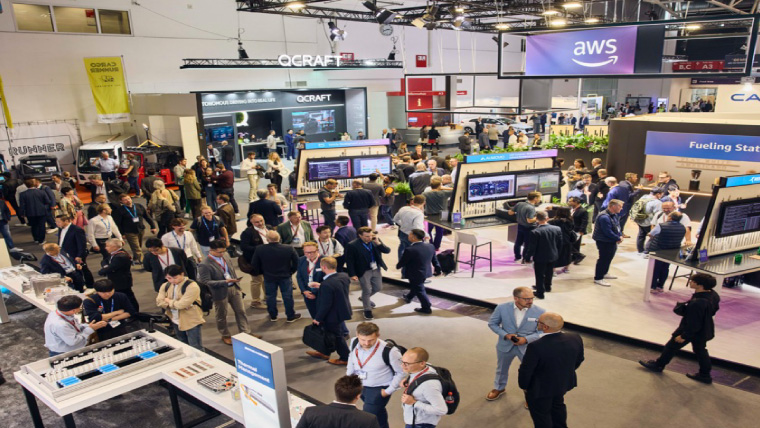
Photo credit: IAA Mobility 2025
5) High-performance computing (HPC) moves into series programs
Two clear proof points:
- Valeo HPC for Renault’s first SDV models as part of a 2023 strategic cooperation (HPC + zone controllers + ADAS components) now feeding into 2025–26 launches. (model names pending; aligns to Ampere-led architectures).
- BMW Neue Klasse highlighted four “superbrain” computers coordinating domains (ADAS, infotainment, power/energy, body) to enable long-term OTA evolution.
- WeRide × Lenovo (on NVIDIA DRIVE AGX Thor): WeRide’s HPC 3.0 platform – co-developed with Lenovo and powered by NVIDIA DRIVE AGX Thor – debuted on the Robotaxi GXR, billed as the first mass-produced L4 vehicle on Thor, with WeRide stating a ~50% cost reduction for the AD system to enable scale.
Implication: consolidation into 2–4 central computers will shrink bill of materials in wiring/ECUs but increase software and toolchain spend – shifting margins from hardware to lifecycle services.
6) Partnerships everywhere: SDV, ADAS, cloud, data
- Qualcomm × Valeo: expanding a global ADAS/AD portfolio to make safety-centric features scalable across tiers and regions.
- Valeo × AWS: cloud-native SDV development tools (vECUs, sensor models) heading to AWS Marketplace.
- Elektrobit × Foxconn: collaboration around SDV software and integration alongside Elektrobit’s OTA and virtualised development toolchains.
- Valeo × Momenta: co-operation on parking/ADAS feature stacks for EU programmes.
- Uber × Momenta: L4 robotaxi tests in Munich from 2026 – a strong China-Europe bridge play.
7) Life-on-Board: UX is the new spec race
The standout was BMW Panoramic iDrive / Panoramic Vision – a pillar-to-pillar projected HUD paired with an updated OS and optional 3D HUD – moving attention management and personalization to the glass. Audi concept work previewed calmer, layered UI; Mercedes-Benz MB.OS demos emphasised assistant-led journeys; CUPRA Tindaya carried a driver-centric, low-distraction layout. Expect experience packs (AR nav, wellness, gaming, concierge) to become the recurring-revenue front end. This competitive edge shifts to UX orchestration across displays, voice, and driver state, whilst being tied to ADAS handover design.
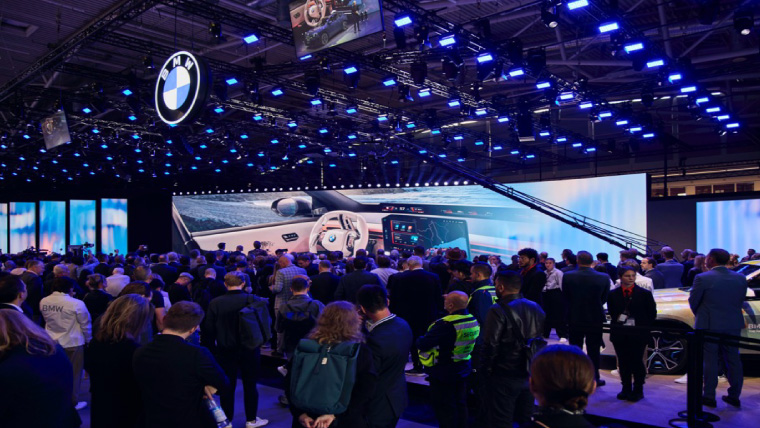
Photo credit: IAA Mobility 2025
If 2023 felt dominated by new Chinese entrants, 2025 was a European reset: BMW launched the iX3 (first Neue Klasse series model), Volkswagen previewed a family of small EVs (ID.Polo, ID.CROSS) and doubled down on value-for-money, Škoda pulled estates into the EV conversation, Porsche advanced hybrid performance (and inductive-charging tech demos), Opel showed Mokka GSe and Grandland Electric AWD, and Renault premiered Clio 6. Europe’s countermove is platform breadth and price discipline – with software and charging as the differentiators.
9) China’s ecosystem targets Europe – beyond OEMs
It’s not just cars. BYD brought fast-charge narratives; Momenta brought L4; and a wave of software/ADAS suppliers circled partnerships. With US tariffs constraining North America, Europe is the proving ground for Chinese scale, software cadence, and cost structure. Expect more Joint Venture / R&D hubs in Germany and tier-one collaborations to accelerate homologation and reduce political friction.
Names to watch:
- Horizon Robotics – showcased next-gen smart-driving stacks built on its Journey processors; its stand featured the European “Firefly” demo vehicle equipped with Horizon hardware for assisted driving.
- ECARX – unveiled a next-generation in-vehicle navigation system integrated with HERE’s platform and an updated Skyland New intelligent driving suite, including versions built on Black Sesame silicon.
- Black Sesame Technologies – introduced its Safety Intelligent Platform internationally and highlighted the C1296 cockpit-driving integration path with partners (e.g., Aptiv, Continental) and planned OEM adoptions.
- QCraft – signed a strategic cooperation with TÜV Rheinland at the show to advance European safety validation and announced a Europe-focused expansion programme around its autonomous stack.
10) Sustainability: quieter on stage, visible in booths
While the green storyline was less prominent on stage, suppliers like Valeo advanced remanufactured electronics/HV components and showcased circular design in lighting, thermal, and charging portfolios; Valeo emphasized remanufactured components like inverters and compressors, showing how lifecycle extension is becoming core to its strategy. A clear statement of how innovation and sustainability go hand in hand.
Recycled/biobased interiors, design-for-disassembly and reman-ready electronics were visible across stands. Lifecycle CO₂ and reman-ready design will be procurement requirements in RFPs by mid-decade; aftermarket reman becomes a cost-down lever in the EV TCO equation.
11) Sensing shifts inside the cabin (and grows up outside)
A notable push came from Magna on integrated interior sensing (child presence, driver attention, vital signs) alongside radar/camera fusion; AISIN flagged broader “Intelligence” themes. With EU GSR raising the bar (ISA, DMS, etc.), in-cabin sensing is moving from optional to expected. Occupant-aware HMI and ADAS handover quality will separate safe L2+ from fatigue-prone L2+ in the coming years.
12) Big Tech’s auto moment: cloud + silicon + partners
AWS anchored the conference; Qualcomm used IAA to push automated driving “for all” with a press-kit of partners; Google/HERE appeared in SDV workflows via partners like Elektrobit. The pattern: cloud for simulation, data, OTA, silicon for HPC/ADAS, and integrators stitching value across fleets. Vendor selection criteria now include cloud costs, data egress and toolchain lock-in. Mobileye/Intel remained visible through partner vehicles and ADAS features, underscoring the breadth of the ecosystem alongside NVIDIA/Qualcomm.
13) Automated driving: from hype to scoped deployments
HOLON updated its autonomous shuttle toward pilot operations on public roads, while MOIA showcased a turnkey AV mobility stack anchored on the ID. Buzz AD. The Uber × Momenta Munich program cements L4 pilots in Europe for 2026.
OPEX-sensitive operators will favour fixed-route shuttles and night-time logistics first; geo-fenced L4 robotaxi follows where regulatory environments mature.
14) ADAS is becoming a platform business
The platformisation of ADAS was visible in three layers:
- SoC + base software (NVIDIA/Qualcomm);
- Feature stacks (parking, L2+/L3) from Valeo, Mobileye, Momenta, Magna, and
- Toolchains + MLOps (AWS/Google/HERE ecosystems).
The winners create portable, safety-assured modules with clear commercial models (license + data services + support SLAs). Procurement shifts from “project scope” to multi-program platform deals with roadmap co-governance.
15) Charging & energy as a profit pool, not a cost centre
Ultra-fast hubs, inductive pilots, and V2G-ready OBCs point to an emerging site-level P&L: energy arbitrage + demand response + retail services. While consumer V2G/V2L sentiment remains mixed, the software control layer is here and bankable on fleets and depots. OEMs, utilities and CPOs that co-design sites (hardware + software + finance) will unlock durable EBITDA.
Frost & Sullivan Perspective
IAA MOBILITY 2025 marked a pragmatic “reset,” highlighting how the mobility industry is navigating costs and competition, partnerships and platform strategies. Hybrids staged a decisive comeback, while affordable EVs moved into the mainstream with a wave of €20,000–€30,000 entry-level unveilings from both European and Chinese automakers. 800V platforms and flash-charging systems advanced from lab concepts to product demonstrations, reflecting growing technological maturity and the push to meet mass-market expectations.
Amid intensifying Chinese competition and ecosystem strength, European majors regrouped around core brand attributes, leveraging software and charging as key differentiators. At the same time, Chinese mobility players pressed their advantage in Europe, offering everything from fast charging and Level 4 autonomy to software and ADAS, seeking new opportunities to counter tariffs limiting their U.S. ambitions.
Beneath the skin, the story was one of software-led vehicles becoming the norm. From HPC “superbrains” and SDV/ADAS partnerships to UX-driven cabin experiences, the industry has shifted from concept to execution. Charging infrastructure, too, was reframed not just as hardware rollout but as ecosystem value creation.
Ultimately, IAA MOBILITY 2025 underscored an “execution era” for global mobility, where platform choices and partnerships will determine the winners.