This blog is based on the recent analysis, Motorbike Taxi Market, Southeast Asia and India, 2024-2030, authored by Frost & Sullivan’s Growth Analyst, Chanchal Jetha, from the Mobility team.
Southeast Asia’s urban mobility landscape is evolving, with motorbike taxi platforms emerging as key tools for addressing critical issues like traffic congestion, affordability, and last-mile connectivity. Powered by converging forces such as regulatory momentum, electrification, platform innovation, and evolving driver behavior, the motorbike taxi ecosystem is rapidly reshaping how millions commute in cities across India, Indonesia, Vietnam, Thailand, and the Philippines.
The Urban Mobility Challenge and Strategies to Navigate It
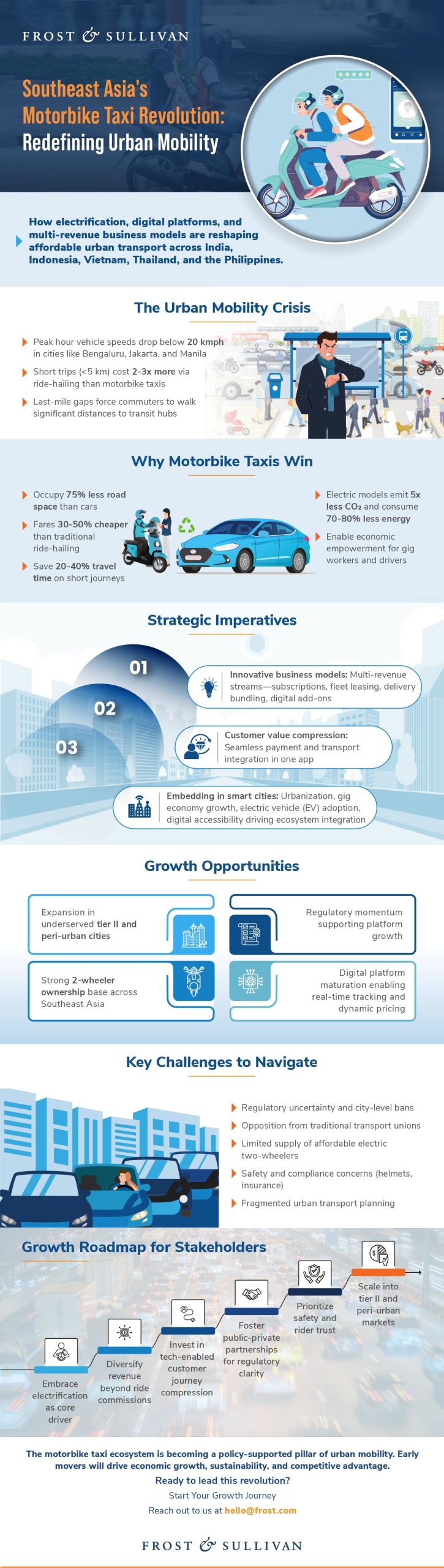
Cities like Bengaluru, Jakarta, and Manila rank among the world’s worst for traffic delays, with vehicle speeds during peak hours often dropping below 20 kmph. Affordability gaps make short trips (<5 km) prohibitively expensive via cabs or ride-hailing apps, where per-kilometer charges run two to three times higher than motorbike taxi fares. Furthermore, rapid public transit expansions are failing to fully solve first and last-mile connectivity, leaving commuters to walk considerable distances to metro or bus stations.
This complex urban mobility puzzle is fueling demand for agile, affordable, and hyperlocal transport solutions. Motorbike taxis—occupying just 25% of the road space needed by cars, offering fares 30-50% cheaper, and saving 20-40% in travel times on short trips fit this need perfectly. Electric motorbike taxis further reduce operating costs and emissions, positioning the industry as an indispensable component of Southeast Asia’s evolving urban mobility fabric.
How will your organization leverage these shifts to secure sustainable growth and a lasting competitive advantage?
Top Strategic Imperatives Shaping Industry Evolution
- Innovative Business Models: Shifting from single-revenue rides to multi-layered income streams like subscriptions, fleet leasing, delivery bundling, and digital add-ons.
- Customer Value Chain Compression: Streamlining journeys by integrating transport modes and payments into one seamless app, reducing commute friction.
- Transformative Megatrends: Urbanization, gig economy growth, EV adoption, and digital access are driving demand and embedding motorbike taxis in smart city mobility ecosystems.
Why Motorbike Taxis Are Winning
- Faster door-to-door commutes on short journeys, especially during peak hours
- Cost-effectiveness, with fares significantly lower than traditional motorized options
- Superior space efficiency reducing urban congestion
- Lower environmental impact, with electric models emitting up to five times less carbon dioxide (CO₂) and consuming 70%-80% less energy
- Economic empowerment by allowing drivers to monetize personal assets flexibly
What is your organization’s strategy to stay ahead of competition and lead this mobility revolution?
Industry Progress, Opportunities, and Challenges
The motorbike taxi industry in Southeast Asia is maturing at varying paces across countries. India, Indonesia, Vietnam, Thailand, and the Philippines demonstrate different levels of readiness, regulatory support, and platform penetration, each presenting unique opportunities and growth pathways.
Widespread 2-wheeler ownership combined with indigenous traffic issues and last-mile gaps make motorbike taxis the preferred hyperlocal mobility solution. Expansion into underserved tier II cities and peri-urban zones, where transit options are limited but demand for low-cost mobility is high, offers significant growth potential.
Nonetheless, challenges remain:
- Regulatory uncertainty and city-level bans
- Opposition from traditional transport unions
- Limited supply of affordable electric two-wheelers
- Safety and compliance concerns (helmet use, insurance, and others)
- Fragmented urban transport planning
The Role of Digital Platforms and Ecosystems
Digital platforms have been critical to scaling and optimizing motorbike taxi services. Features like real-time tracking, dynamic pricing, and driver onboarding apps streamline operations while enhancing safety and customer trust.
The ecosystem of motorbike taxis is evolving into a digitally enabled environment linking vehicle OEMs, fleet operators, financial institutions, regulators, and service platforms.
Environmental and Economic Impact
Transitioning to electric motorbike taxis can reduce operating costs by significantly lowering fuel expenses and maintenance. This aligns well with urban air quality improvement goals and climate commitments. Simultaneously, motorbike taxis provide vital economic opportunities for millions of urban youth and gig workers, bridging unemployment gaps and fostering inclusivity.
How will you lead in shaping a cleaner, more inclusive mobility ecosystem while driving sustained business growth?
Looking Ahead: Growth Strategies for Stakeholders
- Embracing electrification as a core growth driver
- Innovating and diversifying revenue streams beyond ride commissions
- Investing in technology to compress customer journeys and enable platform integration
- Fostering public-private partnerships for regulatory clarity and infrastructure support
- Prioritizing safety and rider trust to drive mass adoption
- Targeting tier II and peri-urban expansions to unlock new markets
Seizing these opportunities will cement motorbike taxis as a policy-supported mobility pillar driving urban economic growth and sustainability across Southeast Asia.
Is your organization ready to capitalize on these opportunities and lead the Southeast Asia’s Motorbike taxi industry?
Want to dive deeper? Click here to connect with Chanchal Jetha and other growth experts and discover how these insights can help you achieve sustained growth, or connect with us at [email protected].