This blog is based on the recent analysis “Global Connected Truck Telematics Outlook”, authored by Frost & Sullivan’s Growth Expert, Mugundhan Deenadayalan, from the Mobility team.
The connected truck telematics industry is transforming owing to latest AI innovations and changing regulatory mandates. With North America and Europe leading the charge, the adoption of advanced technologies is revolutionizing fleet management and the global connected vehicle industry. AI, edge computing, and data convergence are creating new opportunities for businesses to enhance efficiency and drive growth.
Discover the latest growth opportunities.
Embracing AI-driven Innovation
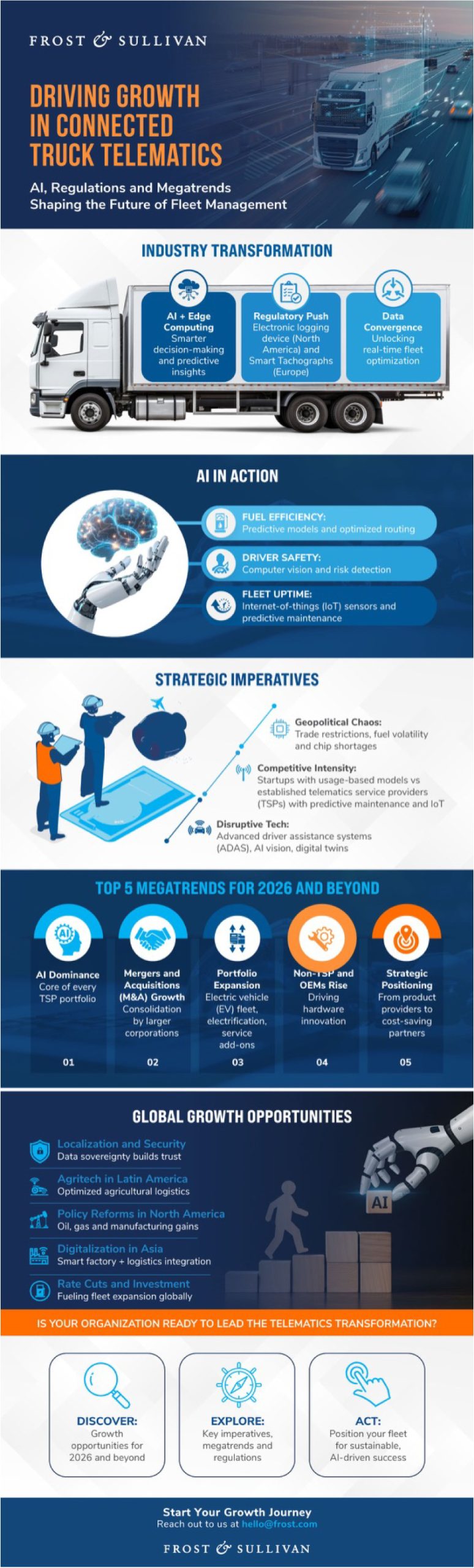
The integration of AI is reshaping how telematics systems operate, enabling smarter decision-making, real-time insights, and predictive maintenance. Powered by these technological advances, businesses are:
- Improving fuel efficiency and route planning through AI-based optimization, real-time traffic/weather analytics, and predictive fuel models.
- Enhancing driver safety with computer vision, driver monitoring, and AI-powered risk detection.
- Streamlining fleet management via predictive maintenance, Internet of Things (IoT) sensors, and anomaly detection.
By staying ahead of regulatory mandates like electronic logging device (ELD) requirements in North America and smart tachographs in Europe, companies can gain a competitive advantage, ensuring compliance while driving sustainability.
The Impact of Strategic Imperatives
Geopolitical Chaos
Global uncertainties are disrupting trucking supply chains through trade restrictions, fuel volatility, and chip shortages, pushing telematics providers to build resilient, regulation-ready systems.
Disruptive Technologies
Advanced Driver Assistance Systems (ADAS), AI-driven computer vision, and digital twins are transforming connected trucks by enabling driver monitoring, predictive routing, and virtual fleet simulations.
Competitive Intensity
Start-ups are competing with low-cost, usage-based models, while established players are leveraging predictive maintenance, OTA (over-the-air) updates, and IOT integration to stay ahead.
READ MORE: Global ADAS and Autonomous Driving Outlook and Growth Opportunities
Top 5 Megatrends for 2026 and Beyond
- AI will continue to dominate, with telematics service providers (TSPs) offering AI-powered solutions in their portfolios.
- Mergers and acquisitions will increase, as large corporations acquire small to midsize companies to scale quickly.
- Product portfolios will expand, integrating service and maintenance solutions, electric vehicle (EV) fleet management, and electrification technologies.
- Non-TSPs and OEMs will play a significant role in the telematics hardware industry, pushing new innovations.
- Strategic positioning is crucial, with TSPs becoming comprehensive, cost-saving solution providers.
How is your company leveraging these megatrends to drive growth and stay competitive in the evolving mobility industry?
Key Growth Opportunities
- Localization efforts and security-driven initiatives are opening opportunities for international partnerships. Companies investing in data sovereignty and cybersecurity are building trust with governments and unlocking access to restricted markets.
- Agritech growth in Argentina and Brazil is driving demand, alongside nearshoring in Uruguay and Costa Rica. Connected truck telematics are becoming vital for optimizing agricultural logistics, ensuring timely delivery, and reducing waste across long supply chains.
- Policy reforms in North America are benefiting manufacturing sub-segments and the oil and gas industry. Telematics providers are gaining new opportunities to support compliance, efficiency, and cross-border trade in these regulated sectors.
- Digitalization in Asia is boosting productivity, with China’s high-tech manufacturing spurring innovation. Connected truck solutions are increasingly integrated into smart factory ecosystems, linking production hubs directly with logistics networks.
- Rate cuts across industries such as automotive, banking, and real estate are fueling demand and investment. Lower financing costs are enabling fleet expansions and accelerating adoption of next-gen telematics platforms.
Are you ready to capitalize on the latest growth opportunities emerging in 2026 and beyond?
As the connected truck telematics industry evolves, embracing AI innovations, regulatory compliance, and strategic industry positioning will be crucial for success. With geopolitical tensions, disruptive technologies, and emerging megatrends shaping the future, businesses must stay agile and forward-thinking.
Want to dive deeper? Click here to connect with Mugundhan Deenadayalan and other mobility growth experts to discover how these insights can help accelerate your growth strategy.
You can also connect with us at [email protected].