This blog is based on the detailed analysis, “Emerging AI Trends in the Renewable Energy Industry,” conducted by Frost & Sullivan’s growth experts, Heena Juneja & Bhavesh Prasad, from the TechVision Information and Communication Technology team.
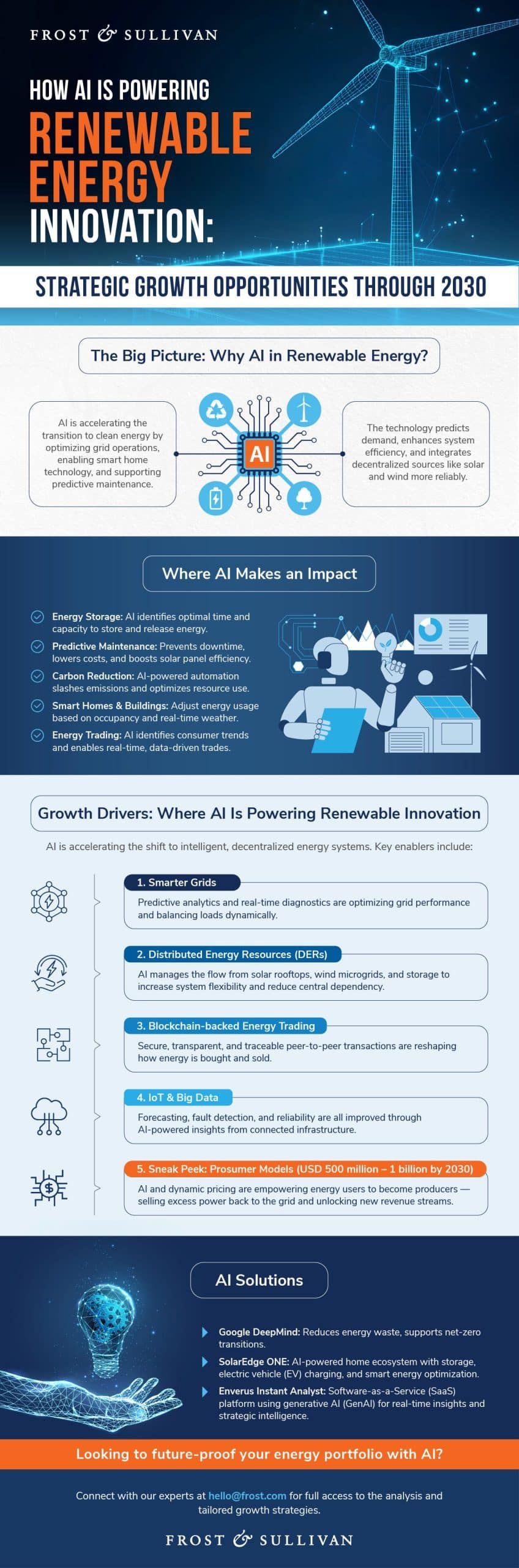
Artificial intelligence (AI) is playing a central role in accelerating the transition to a low-carbon, sustainable energy future. As organizations prioritize decarbonization and climate resilience, AI has emerged as a critical enabler for optimizing energy production, usage, storage, and management. From dynamic load balancing to smart forecasting, AI applications are transforming renewable infrastructure at scale.
Want to know how AI can power your next big energy move? [Download the sample] or write to us at [email protected] for tailored insights.
Strategic Imperatives Driving AI Adoption in Renewable Energy
Three powerful forces are reshaping the renewable energy landscape:
- Transformative Megatrends: AI, big data, and the Internet of Things (IoT) are enabling cleaner, more efficient, and highly adaptive energy ecosystems.
- Internal Challenges: Legacy infrastructure poses barriers. Modernization via AI-integrated solutions is key to future-proofing operations.
- Geopolitical Chaos: Global policy shifts, energy access equity, and net-zero mandates are accelerating innovation.
Is your strategy aligned with the forces driving change? [download the study] for region-specific and segment-level insights.
Emerging Trends at the AI-energy Nexus
AI is ushering in a new era of intelligent energy management. Four key trends are transforming how renewable energy is generated, distributed, and optimized:
- Microgrid Development: AI is enabling the development of decentralized microgrids that can manage energy flows more efficiently, improve load balancing, and support the seamless integration of renewable sources. These smart systems enhance local energy reliability and promote decarbonization strategies.
- Smart Electric Vehicle (EV) Management: The convergence of AI with EV infrastructure is reshaping energy use patterns through smart charging and vehicle-to-grid (V2G) systems. These technologies enhance grid responsiveness, optimize energy consumption, and align with broader electrification efforts.
- Predictive Maintenance: AI and machine learning (ML) are being leveraged to forecast system failures, reduce unplanned downtimes, and optimize maintenance schedules. These capabilities allow energy operators to make data-driven decisions based on variables such as topography, weather patterns, and historical performance.
- Sustainable Data Practices: AI-driven data frameworks are increasingly used to monitor the energy lifecycle, minimize resource waste, and align operations with Environmental, Social, and Governance (ESG) requirements. These practices are helping organizations improve reporting transparency and enhance their positioning as responsible energy stakeholders.
For a comprehensive analysis of these trends and their long-term impact on clean energy transformation, [download the full study] or reach out to [email protected].
Growth Opportunity Highlight: The Prosumer Model
Prosumers—energy users who also generate electricity—are transforming the grid into a decentralized, flexible ecosystem. With support from solar rooftops, EV batteries, and AI-led optimization, prosumers can sell surplus power back to the grid, supporting resilience and reducing dependence on central plants.
Is your business ready to tap into this $500 million – $1 billion opportunity? [Connect with us at [email protected]] for regional demand forecasts and strategic recommendations.
| Long-term Impact: A Roadmap to 2030 and Beyond |
|---|
Between 2024 and 2030, AI will enable a phased evolution in renewable energy:
|
|
Download the complete analysis to access use cases, technology evaluations, and growth pathways tailored to your sector.
Or schedule a Growth Dialog™ to explore how Edge AI can align with your transformation goals.