This blog is based on Frost & Sullivan’s analysis At-home Diagnostics: Innovations and Growth Opportunities by Frost & Sullivan’s growth experts, Neeraj Nitin Jadhav and Swati Mishra from the TechVision Medical Device & Imaging team.
Healthcare delivery is shifting closer to the patient. The pandemic, coupled with rapid advances in artificial intelligence (AI), edge computing, and smartphone integration, has made at-home diagnostics one of the fastest-evolving sectors in global healthcare. From self-testing kits and biosensors to wearable analytics and telehealth-linked applications, technology is transforming the home into an intelligent, data-driven health environment.
By 2032, at-home diagnostics will play a central role in achieving accessible, preventive, and decentralized healthcare across developed and emerging economies.
How is your organization aligning with the technologies driving this transition?
Download Frost & Sullivan’s sample to explore strategic innovation pathways.
Growth Drivers: Innovation Accelerators in Connected Diagnostics
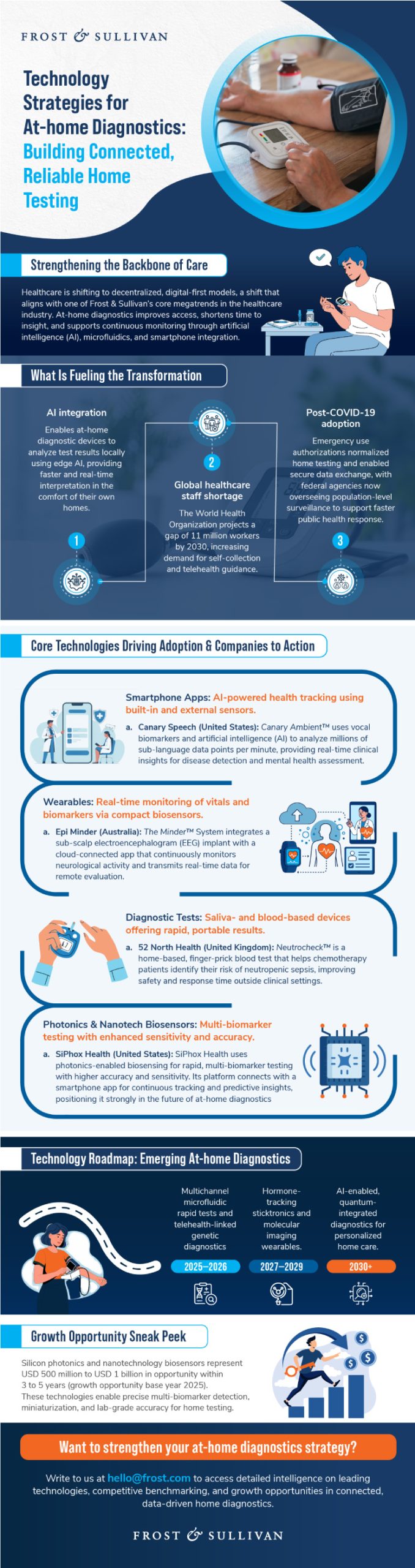
- AI Integration: AI is enabling clinicians and patients to access faster, more reliable, and connected diagnostic insights. The adoption of edge AI allows real-time analytics within compact, user-friendly devices. These intelligent platforms interpret test results instantly, reducing reliance on centralized laboratories and expanding access to continuous monitoring and early intervention.
- Global Healthcare Workforce Shortage: With the World Health Organization (WHO) forecasting a shortage of 11 million healthcare workers by 2030, at-home diagnostics is stepping in to relieve pressure. Automated, self-guided testing and telehealth-supported decision systems improve efficiency and enable clinicians to manage more patients remotely.
- COVID-19’s Lasting Impact: The pandemic catalyzed regulatory support for at-home tests, changing how people view self-care and disease monitoring. Decentralized distribution of test devices now helps governments track health data securely, improving preparedness for future medical crises.
Is your strategy designed to capitalize on these enduring drivers of healthcare innovation?
Strategic Imperatives Reshaping At-home Diagnostics
- Transformative Megatrends: Point-of-care testing, AI, and edge computing are driving decentralized healthcare. Technologies such as large language models (LLMs), digital twins, and quantum simulations are enhancing diagnostic precision and reliability at home.
- Industry Convergence: Medicine, engineering, and data science are converging to create integrated diagnostic ecosystems. Partnerships across medtech, device, and software sectors are enabling multimodal platforms that detect multiple biomarkers within a single device.
- Competitive Intensity: Innovation is shifting toward connected, patient-friendly diagnostics. Smartphone-linked kits, microneedle patches, and wearable biosensors are expanding clinical accuracy beyond labs, supported by rising patent activity in AI and microfluidics.
| Growth Spotlight: Funding and Partnership Trends
|
| Learn more by downloading the sample. |
Emerging Technologies Powering At-home Diagnostics
- Smartphone- and Tablet-based Applications: Modern apps harness intrinsic sensors and connected peripherals to track, record, and interpret physiological data.
- Company to Action: Canary Speech (United States): Canary Ambient™ uses vocal biomarkers to detect mental and physical health changes in real time, analyzing more than 15 million data points per minute.
- Wearable Devices: Miniaturized sensors now make continuous monitoring possible outside clinical settings.
- Company to Action: Epi Minder (Australia): The Minder™ System combines a sub-scalp EEG implant with an app that uploads brain data for cloud-based AI analysis.
- Diagnostic Tests: Portable and non-invasive tests are redefining preventive care.
- Company to Action: 52 North Health (United Kingdom): Neutrocheck™ enables chemotherapy patients to detect risk of neutropenic sepsis at home.
Which technologies align with your roadmap for smarter, patient-centric diagnostics
Growth Opportunity: Silicon Photonics and Nanotechnology Biosensors in At-home Diagnostics
The convergence of silicon photonics and nanotechnology biosensors is redefining diagnostic precision at the consumer level. These technologies enable miniaturized, multimodal testing devices capable of measuring multiple biomarkers in a single interaction. With enhanced optical sensitivity and faster data capture, they bridge the accuracy gap between laboratory-grade and at-home diagnostics.
Growth Indicators
- Opportunity Size (5 Years): Over USD 500 million – USD 1 billion
- Timeline for Action: 1–3 years
- Base Year: 2025
- Relevant End-user Industries: Manufacturing | Chemicals & Materials | Information & Communication Technologies | Electronics & Semiconductors | Healthcare & Lifesciences | Consumer
- Applicable Regions: Central & Eastern Europe | South Asia | Western Europe | CIS | North America | Latin America | Africa | Middle East | Asia-Pacific
Outlook:
With photonic biosensors achieving real-time, high-resolution detection and nanotech devices enabling single-drop analysis, the integration of these technologies supports more accurate, connected, and scalable home-based diagnostics. Their development aligns with Frost & Sullivan’s 2025 megatrend of digital-first healthcare models, which prioritize predictive analytics and decentralized care.
Which industries are best positioned to commercialize these high-growth diagnostic technologies?
Want to dive deeper?
Connect with us to explore how these insights can help strengthen your organization’s diagnostics innovation strategy. Schedule a complimentary Growth Pipeline Dialog™ with Frost & Sullivan’s experts to identify tailored opportunities for advancing connected, data-driven healthcare and accelerating success in the at-home diagnostics market.
[Access the Full Analysis] | [Download a Sample] | [Connect with us at [email protected]]