This blog is based on the analysis, “Top Growth Opportunities in Cybersecurity Innovation,” developed by Frost & Sullivan’s growth expert Heena Juneja from the TechVision Information and Communication Technologies team. The content draws from seven Technology Opportunity Engine (TOE) analyses published since 2025.
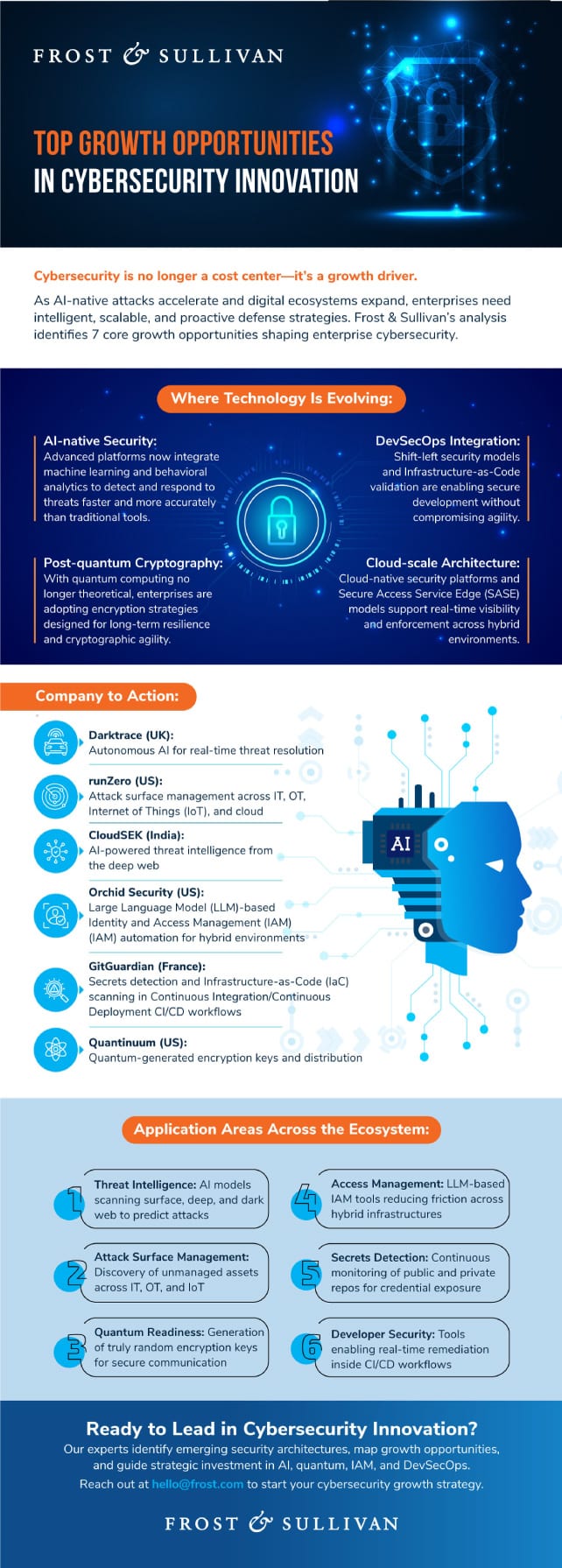
Enterprises today face rising threats from AI-driven attacks, identity-based exploits, and fast-evolving vulnerabilities across hybrid networks. Cybersecurity is a core enabler of digital transformation. Frost & Sullivan’s latest analysis identifies seven growth-rich domains transforming enterprise cybersecurity strategy and performance, from predictive encryption and asset visibility to zero trust and developer-centric controls.
[Access the full whitepaper] or write to us at [email protected] to chart a cybersecurity innovation roadmap tailored to your priorities
Technology Shifts Driving the Cybersecurity Evolution
- AI-native Detection: AI and behavior analytics are now central to real-time detection and response. Tools like Vectra AI’s Attack Signal Intelligence and Darktrace’s autonomous Antigena platform offer rapid containment without manual intervention.
- Quantum-ready Encryption: Quantum computing is no longer abstract. Companies like Quantinuum are already delivering encryption key generation based on quantum randomness to prepare for future decryption risks.
- Cloud-native Security Architecture: From runZero’s asset visibility across cloud and OT to SASE (Secure Access Service Edge) deployments, organizations are strengthening control across distributed ecosystems.
- DevSecOps Integration: GitGuardian and other innovators are embedding security into continuous integration (CI), continuous deployment (CD) workflows with secrets detection, Infrastructure-as-Code (IaC) scanning, and automated remediation tools ensuring speed doesn’t compromise security.
How is your organization embedding security into cloud, code, and architecture workflows?
Strategic Imperatives Reshaping Enterprise Cybersecurity
Disruptive Technologies: AI-native platforms are accelerating detection and response by embedding intelligence into security workflows. These systems enable predictive insights, reduce dwell time, and deliver autonomous threat mitigation across digital ecosystems.
Transformative Megatrends: Quantum computing has evolved from a theoretical risk into a near-term concern. Enterprises are now assessing cryptographic agility and implementing post-quantum encryption to maintain long-term digital trust.
Innovative Business Models: Cybersecurity is shifting from a defensive cost center to a strategic business enabler. Integrated platforms, identity-first frameworks, and scalable architectures are now core to digital transformation and competitive resilience.
Is your security strategy aligned to the shifts redefining enterprise value and risk?
Growth Opportunity Snapshot: Identity-First Security
Identity is becoming the frontline. Tools like Orchid Security’s Large Language Model (LLM)-driven IAM (Identity and Access Management) and no-code Multi-Factor Authentication (MFA) / Role-Based Access Control (RBAC) are closing gaps across hybrid cloud systems. The shift to least-privilege access and identity-aware defense models is enabling security at scale.
Use Cases: Cloud IAM, developer access, hybrid identity governance
Industries: ICT, BFSI, Manufacturing, Healthcare
Regions: Global
Is your organization investing in identity-first frameworks to scale zero trust?
[Access the full cybersecurity series] or schedule a Growth Pipeline Dialog™ with our domain specialists.