This blog is based on Frost & Sullivan’s analysis, “Growth Opportunities in Computational Quantum Chemistry for Accelerated Material Discovery,” authored by Abhishek Paul Choudhury from the TechVision Practice Area.
The global push for sustainability and high-performance materials is redefining how industries design, test, and commercialize new compounds. As traditional trial-and-error methods reach their limits, computational quantum chemistry is emerging as a key enabler of next-generation material innovation.
By simulating matter at the electron level through quantum computing, this discipline is enabling highly accurate predictions of molecular behavior, ushering in a new paradigm for designing advanced materials across industries. From green catalysts and high-performance polymers to next-generation batteries and corrosion-resistant alloys, the use of AI in material science is reshaping how scientists and engineers approach material discovery.
Listen to Our Growth Podcast on Computational Quantum Chemistry
Strategic Imperatives Driving Growth in Computational Quantum Chemistry
- Disruptive Technologies
The fusion of quantum computing and AI is revolutionizing molecular simulations, improving predictive accuracy, and speeding up the discovery of advanced materials. To stay competitive, companies need invest in quantum simulation capabilities and partner with tech innovators and research leaders. - Transformative Megatrends
Sustainability goals are reshaping material R&D. Industries now are seeking recyclable, low-carbon, and energy-efficient materials that support clean energy and circular economy targets. Integrating quantum chemistry into these initiatives are paving way for new funding, compliance, and innovation advantages. - Industry Convergence
The merging of materials science, quantum computing, and AI is enabling virtual prototyping of complex materials, like self-assembling nanostructures and quantum devices, before physical synthesis. Collaboration across disciplines is key to accelerating innovation.
How is your organization leveraging the convergence of quantum technology, AI, and sustainability imperatives to lead the next frontier in materials R&D?
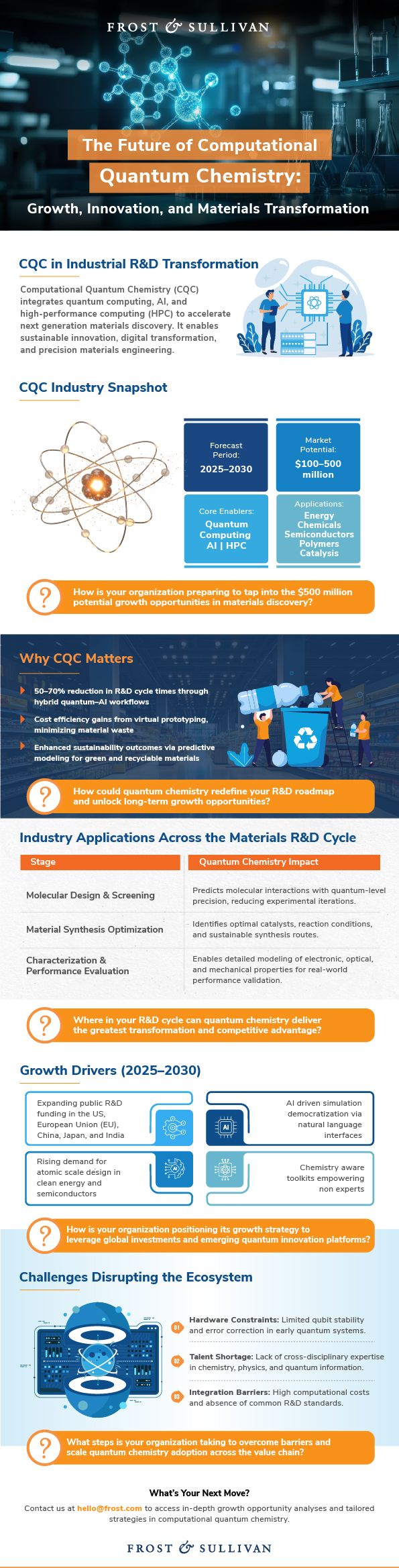
Want your organization to stay ahead by integrating quantum-AI workflows, partnering across ecosystems, and scaling R&D through digital platforms?
Download the full analysis to explore more growth opportunities.
Emerging Technologies Redefining Materials R&D
- Quantum-AI Synergy: Advanced algorithms are enhancing precision in modeling reaction mechanisms and potential energy surfaces.
- Cloud-native Platforms: “Computational Quantum Chemistry Platform as a Service (CQCPaaS)” models are providing scalable access to simulation Application Programming Interfaces (APIs) and hybrid environments, powered by high-performance computing.
- Chemistry-aware Toolkits: New toolkits allow scientists to design green solvents, recyclable polymers, and catalysts without deep quantum expertise.
- AI-driven Agents: Natural language interfaces democratize access to quantum simulations, bridging the gap between education and industry.
Companies to Action
The computational quantum chemistry ecosystem is expanding rapidly, led by innovative collaborations across software, hardware, and research institutions:
- Microsoft & Oak Ridge National Laboratory (USA) – Demonstrating hybrid high-performance computing (HPC)-quantum simulations for catalytic processes and electron transport.
- Xanadu & Applied Materials (Canada/USA) – Partnering to model advanced semiconductor materials using photonic quantum computing hardware.
- Ai.Qimia (Switzerland) – Offering Software as a Service (SaaS) solutions combining physics-based AI with quantum chemistry for sustainable chemical synthesis.
How is your organization benchmarking against these leaders to advance computational innovation in materials R&D?
Growth Opportunities in Computational Quantum Chemistry
Growth Opportunity 1: Cloud-native Quantum Chemistry Platforms for Scalable R&D
The rise of CQCPaaS is democratizing access to advanced simulation environments. These platforms are allowing R&D teams to explore quantum-accurate molecular modeling without owning quantum hardware, unlocking scalable, pay-as-you-go innovation models.
Download the Full Analysis to Explore All Growth Opportunities in Computational Quantum Chemistry
Shaping the Future of Materials Discovery
The convergence of quantum computing, AI, and high-performance simulation is continuously redefining how materials are discovered, modeled, and commercialized.
To stay ahead, organizations are:
- Adopting hybrid simulation workflows to enhance accuracy and accelerate materials design.
- Leveraging AI-driven automation to simplify and optimize complex quantum chemistry processes.
- Investing in cloud-based quantum platforms to enable scalable, cost-efficient R&D.
- Building cross-sector partnerships among academia, technology providers, and industry to drive faster innovation.
How is your organization preparing to lead the next wave of materials transformation through computational quantum chemistry?
Next Steps
Let’s connect! Schedule a Growth Pipeline Dialog™ with Frost & Sullivan’s experts or write to [email protected] to discuss how your organization can leverage computational quantum chemistry to drive sustainable innovation.