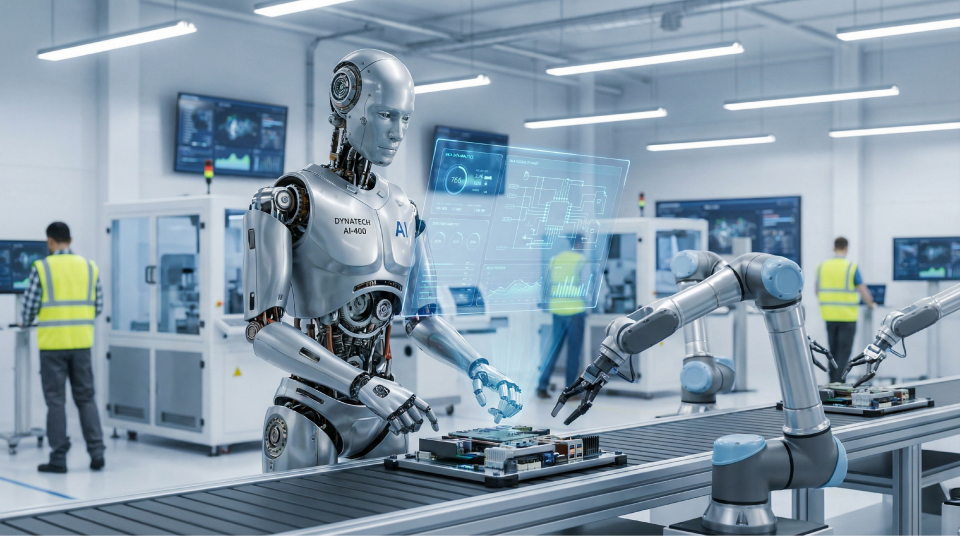
This blog is based on the analysis titled, “Heterogeneous Computing Architectures in Automotive and Robotics Applications,” authored by Frost & Sullivan’s growth expert, Jabez Mendelson, and lead analyst, Gourav Sharma, from the TechVision—Microelectronics team.
Executive Summary
Automotive and robotics systems are becoming increasingly compute-intensive as advanced driver assistance systems (ADAS), automated driving, software-defined vehicles (SDVs), autonomous mobile robots, and intelligent robotics require real-time perception, decision-making, and actuation.
Heterogeneous computing addresses these requirements by combining specialized processing resources within integrated compute platforms. Key developments include:
- Centralized and zonal vehicle architectures consolidating multiple functions onto fewer, higher-performance compute platforms
- Heterogeneous system-on-chips (SoCs) integrating central processing units (CPUs), graphics processing units (GPUs), neural processing units (NPUs), digital signal processors (DSPs), and dedicated safety islands
- Edge AI controllers supporting real-time perception, planning, and control in robotics
- Advanced memory, high-speed interconnects, power management, and packaging improving system performance and efficiency
- Mixed-criticality platforms enabling artificial intelligence (AI) workloads and safety-critical functions to operate within increasingly integrated systems
These developments are creating new opportunities across semiconductor design, automotive compute, robotics platforms, Edge AI, and enabling technologies.
What Is Heterogeneous Computing?
Heterogeneous computing combines different types of processors and accelerators within a single computing architecture, assigning workloads to the processing resources best suited to execute them.
In automotive and robotics applications, heterogeneous SoCs can integrate CPUs for general-purpose processing, GPUs for parallel workloads, NPUs for AI inference, digital signal processors (DSPs) for signal processing, and dedicated safety processors for critical functions.
This architecture allows compute-intensive tasks such as computer vision, sensor fusion, perception, path planning, natural language processing, and real-time control to run efficiently within constrained power and thermal envelopes.
Heterogeneous computing also supports the transition toward centralized vehicle computing and increasingly capable robotics edge platforms, reducing reliance on multiple isolated controllers while creating more scalable foundations for software-defined systems.
Why Heterogeneous Computing Is Gaining Momentum
Automotive and robotics architectures are evolving as intelligence shifts closer to the edge. Vehicles and robots must process growing volumes of camera, radar, light detection and ranging (LiDAR), motion, and other sensor data while making increasingly complex decisions in real time.
Explore the Future of Heterogeneous Computing
Assess the technologies, applications, and growth opportunities shaping heterogeneous computing architectures across automotive and robotics.
Download the Complimentary Sample Analysis.
Traditional architectures built around multiple dedicated controllers can struggle to provide the compute performance, scalability, power efficiency, and software flexibility required for these workloads.
Heterogeneous computing platforms are enabling:
- Higher AI performance within constrained power envelopes
- Real-time perception, sensor fusion, planning, and actuation
- Consolidation of automotive functions through centralized and zonal architectures
- Scalable compute for industrial, logistics, mobile, and service robots
- Integration of AI workloads alongside safety-critical functions
- Greater flexibility for increasingly software-defined vehicles and robotic systems
The shift is also expanding the semiconductor ecosystem. Original equipment manufacturers (OEMs), Tier-1 suppliers, robotics integrators, semiconductor companies, outsourced semiconductor assembly and test (OSAT) providers, and software developers increasingly need to coordinate compute architecture, hardware acceleration, software, safety, and system integration.
How are you integrating advanced computing technologies into your automotive and robotics growth roadmap?

Strategic Imperatives Accelerating Heterogeneous Computing Adoption
The shift toward intelligent, software-defined automotive and robotics systems is being shaped by three strategic imperatives:
- Disruptive Technologies: Automotive and robotics platforms are moving from distributed processors toward heterogeneous architectures integrating CPUs, GPUs, NPUs, DSPs, field-programmable gate arrays (FPGAs), and safety controllers. Centralized vehicle computers and robotics Edge AI platforms are enabling higher compute density, lower latency, and greater power efficiency. Chiplets, advanced packaging, die-to-die interconnects, and AI accelerators will further expand system scalability.
- Transformative Megatrends: Growth in automated driving, intelligent cockpits, industrial and service robotics, and Edge AI is increasing demand for real-time computing. Software-defined platforms are also enabling multi-domain workloads, over-the-air updates, and lifecycle scalability, while AI complexity drives greater demand for heterogeneous processing, sensor fusion, and mixed-criticality computing.
- Competitive Intensity: Competition is intensifying across semiconductor companies, automotive compute providers, robotics platforms, advanced packaging suppliers, and Edge AI ecosystems. Companies are differentiating through silicon performance, software ecosystems, functional safety, power efficiency, and packaging technologies. Partnerships among semiconductor vendors, OEMs, hyperscalers, and robotics developers are becoming increasingly important to accelerate commercialization.
Frost & Sullivan Perspective
Heterogeneous computing is shifting competitive advantage from individual processors toward integrated hardware-software platforms that can balance AI performance, power efficiency, safety, and scalability across multiple workloads.
How are you integrating disruptive technologies into your automotive and robotics growth initiatives?
Subscribe to the TechVision Newsletter for growth opportunities shaping next-generation computing.
Growth Drivers and Challenges Shaping Heterogeneous Computing
The adoption of heterogeneous computing across automotive and robotics is accelerating as software-defined architectures, autonomous functionality, and intelligent edge systems increase compute requirements. At the same time, software complexity, functional safety requirements, and advanced packaging constraints remain significant barriers to scale.
Key Growth Drivers
- Software-defined Vehicle Transition: OEMs are consolidating multiple electronic control units (ECUs) into centralized and zonal compute platforms that combine CPUs, GPUs, NPUs, DSPs, safety islands, and communication engines.
- Rising ADAS and Autonomy Compute Demand: Sensor fusion, driver monitoring, and advanced perception are increasing demand for heterogeneous SoCs capable of delivering higher performance and power efficiency.
- Increasing Semiconductor Content: Electrification, connectivity, autonomy, and digital cockpit functions are increasing semiconductor requirements per vehicle and robot, creating demand for high-performance SoCs and accelerators across multiple domains.
Key Growth Challenges
- Software Complexity and Orchestration: Managing workloads across CPUs, GPUs, NPUs, DSPs, and FPGAs increases software, middleware, memory-management, and debugging complexity, particularly when safety-critical and non-critical workloads share hardware.
- Functional Safety and Certification: Automotive and robotics platforms require rigorous validation, safety assurance, and certification, increasing development complexity and potentially extending deployment cycles.
- Advanced Packaging and Integration Constraints: Adoption depends on ecosystem maturity, manufacturing capacity, memory availability, and integration readiness, creating potential supply-chain and commercialization bottlenecks.
What best practices are improving the scalability and reliability of your next-generation compute platforms?
Technologies Enabling Next-Generation Heterogeneous Compute Platforms
Modern heterogeneous compute platforms combine advanced semiconductors, connectivity, packaging, and intelligent power technologies to support the performance, efficiency, and reliability required by autonomous vehicles and intelligent robotics.
The key technology enablers include:
- Advanced semiconductor technologies for AI acceleration and specialized processing
- Photonic integrated circuits and silicon photonics for high-bandwidth, low-latency data movement
- Radio Frequency (RF) and connectivity technologies including Vehicle-to-Everything (V2X), 5G/6G, Ethernet, and radar
- Advanced packaging and emerging materials supporting higher integration density and bandwidth
- Intelligent power architectures optimizing performance within strict power and thermal limits
Advanced Semiconductor Technologies
- AI Accelerators and Edge AI SoCs: Enable high-density, energy-efficient processing for ADAS, autonomous driving, and robotic perception.
- Domain-specific Accelerators (DSAs): Optimize AI and motion-planning workloads for higher performance-per-watt.
- Wide-bandgap (WBG) Power Semiconductors: Silicon carbide (SiC) and gallium nitride (GaN) technologies improve power conversion efficiency and thermal performance, particularly across electric vehicle systems.
- Chiplets and Heterogeneous Integration: Support high-density compute modules by integrating specialized processing elements while addressing thermal, reliability, and form-factor requirements.
How are you integrating advanced semiconductor technologies to improve scalability across automotive and robotics platforms?
Companies to Action: Platform Strategies Shaping Heterogeneous Computing
Leading semiconductor companies are building differentiated heterogeneous compute platforms around AI acceleration, software ecosystems, connectivity, functional safety, and workload-specific architectures.
| Company | Platform Strategy | Strategic Differentiation |
| Qualcomm | Snapdragon Ride and Digital Chassis combine heterogeneous SoCs with AI engines, vision processing, connectivity, and automotive-grade safety capabilities. | Integrates compute, connectivity, and platform software for OEMs transitioning toward SDVs. |
| NVIDIA | DRIVE targets automotive computing, while Jetson supports robotics and Edge AI, backed by software development kits (SDKs), frameworks, and simulation tools. | Combines high-end AI performance with a broad developer ecosystem across automotive and robotics applications. |
| AMD, Xilinx, NXP, Renesas, and other vendors | Programmable logic, microcontrollers (MCUs), mixed-signal technologies, accelerators, and software stacks support domain controllers, safety systems, industrial robots, and motion-control applications. | Compete through deterministic processing, functional safety, programmability, and workload-specific acceleration. |
Frost & Sullivan Perspective
Competitive differentiation is increasingly centered on the ability to deliver integrated compute platforms that combine silicon performance with software, safety, connectivity, and developer support. Automotive and robotics companies will need ecosystem partnerships that can accelerate platform integration and deployment.
How is your organization strengthening its competitive position across the heterogeneous computing ecosystem?
Download the Transformational Growth Leadership Discussion with Chris Celtruda, CEO of Chromalloy.
Growth Opportunities Accelerating Heterogeneous Computing Adoption
As automotive and robotics platforms become increasingly software-defined and AI-driven, heterogeneous computing is creating opportunities for semiconductor companies, platform providers, OEMs, and ecosystem partners to develop scalable compute architectures that combine AI performance, power efficiency, safety, and software flexibility.
- Growth Opportunity 1: Centralized SDV Heterogeneous Compute Platforms for Automotive Edge AI – Automakers are shifting from electronic control unit (ECU)-centric architectures toward centralized and zonal software-defined vehicle (SDV) platforms. Heterogeneous compute platforms integrating CPUs, GPUs, NPUs, AI accelerators, and safety islands can consolidate ADAS, infotainment, connectivity, and other vehicle workloads onto shared hardware.
Growth opportunities include:
- Developing scalable SDV compute platforms reusable across vehicle models and regions
- Integrating perception, planning, connectivity, and cockpit workloads on shared architectures
- Building open SDKs, safety-qualified reference designs, and development toolchains
- Strengthening partnerships among semiconductor vendors, OEMs, Tier-1 suppliers, and software providers
Key industries: Mobility, electronics and semiconductors, information and communications technologies, government and public sector, defense, and banking and financial services
Priority regions: North America, Western Europe, Central and Eastern Europe, and Asia-Pacific
- Growth Opportunity 2: Heterogeneous Edge AI Platforms for Industrial and Service Robotics – Robots increasingly require local AI capabilities for perception, planning, navigation, human-machine interaction, and real-time control. Heterogeneous Edge AI platforms can combine CPU, GPU, and AI processing with secure over-the-air updates and deterministic control capabilities.
Growth opportunities include:
- Developing standardized heterogeneous controllers across multiple robot platforms
- Creating reference architectures for autonomous mobile robots, industrial robots, healthcare systems, and agricultural robotics
- Integrating automotive-grade heterogeneous SoCs and packaging technologies into robotics platforms
- Building fleet-management platforms for remote monitoring, model deployment, scheduling, and cybersecurity
- Supporting scalable Robot-as-a-service models through reusable hardware and software architectures
Key industries: Manufacturing, mobility, electronics and semiconductors, agriculture, food and nutrition, and healthcare and life sciences
Priority regions: North America, Western Europe, Central and Eastern Europe, and Asia-Pacific
Which heterogeneous computing opportunities should your organization prioritize to capture the next wave of automotive and robotics growth?
Download sample analysis on where heterogeneous computing can unlock new growth across ecosystems.
Future Outlook
Over the next three to five years, heterogeneous computing will become increasingly central to SDVs, autonomous systems, and intelligent robotics. Advances in accelerators, packaging, power management, and safety-centric integration will drive higher performance, efficiency, and platform scalability.
Business leaders should ask themselves:
- Is your technology roadmap aligned with the shift toward centralized, heterogeneous compute architectures?
- Where should you prioritize investment across AI accelerators, advanced packaging, connectivity, and power technologies?
- Which ecosystem partnerships can accelerate automotive and robotics platform development and commercialization?
Ready to Lead the Transformation?
- Schedule a Growth Strategy Dialog: Align your growth roadmap with Frost & Sullivan’s Visionary Growth Pipeline™ Dialog.
- Engage with Growth Experts: Co-design AI-enabled, data-driven operating models that scale industry-specific and commercial impact.
- Showcase Your Transformational Leadership: Position your organization as a transformation leader through Frost & Sullivan’s Transformational Growth Leadership platform.
- Join the Growth Council: Collaborate with industry leaders shaping the future of your ecosystem.
- Explore Best Practices Recognition: Be recognized for excellence in growth strategy, execution, and customer impact.
- Benchmark Your Industry Positioning on the Frost Radar™: Benchmark your growth performance and innovation strength against industry competitors.
- Tell Your Story: Accelerate awareness, engagement, and revenue growth through integrated brand and demand generation strategies.
FAQs
1. What is heterogeneous computing in automotive and robotics?
Heterogeneous computing combines central processing units (CPUs), graphics processing units (GPUs), digital signal processors (DSPs), neural processing units (NPUs), field-programmable gate arrays (FPGAs), and specialized accelerators within a common architecture. It enables vehicles and robots to efficiently execute AI inference, perception, sensor fusion, planning, control, and safety-critical workloads.
2. Why is heterogeneous computing important for software-defined vehicles?
Heterogeneous computing supports the transition from distributed electronic control units (ECUs) toward centralized and zonal architectures. These platforms can consolidate multiple vehicle functions while improving compute performance, power efficiency, software scalability, and support for over-the-air updates.
3. How does heterogeneous computing support autonomous vehicles and robotics?
Heterogeneous architectures allocate workloads to specialized processing resources, enabling real-time perception, sensor fusion, decision-making, motion planning, and actuation. This is critical for ADAS, automated driving, autonomous mobile robots, and intelligent industrial and service robots.
4. Which technologies are enabling next-generation heterogeneous computing platforms?
Key technologies include AI accelerators, Edge AI system-on-chips (SoCs), domain-specific accelerators, advanced packaging, chiplets, high-speed interconnects, radio frequency (RF) connectivity, and intelligent power architectures. Together, they improve compute density, bandwidth, energy efficiency, and scalability.
5. What are the key challenges facing heterogeneous computing adoption?
Major challenges include software orchestration complexity, functional safety and certification requirements, thermal and power constraints, advanced packaging capacity, memory availability, and hardware-software integration.
6. What growth opportunities are emerging in heterogeneous computing?
Two key opportunities are centralized heterogeneous compute platforms for automotive Edge AI and heterogeneous Edge AI platforms for industrial and service robotics. Both are expected to create opportunities exceeding USD 1 billion over five years, with a three-to-five-year timeline for action.
7. How should companies prepare for the growth of heterogeneous computing?
Companies should prioritize reusable compute architectures, hardware-software co-design, functional safety, interoperability, and ecosystem partnerships. Building platforms that can scale across applications and product generations will be critical as automotive and robotics workloads become increasingly AI-intensive.