This blog is based on the analysis, “Impact of Digital Thread on the Future of Connected Manufacturing,” authored by Frost & Sullivan’s growth expert Sujeeta Tripathi, from the TechVision – Advanced Manufacturing Automation team.
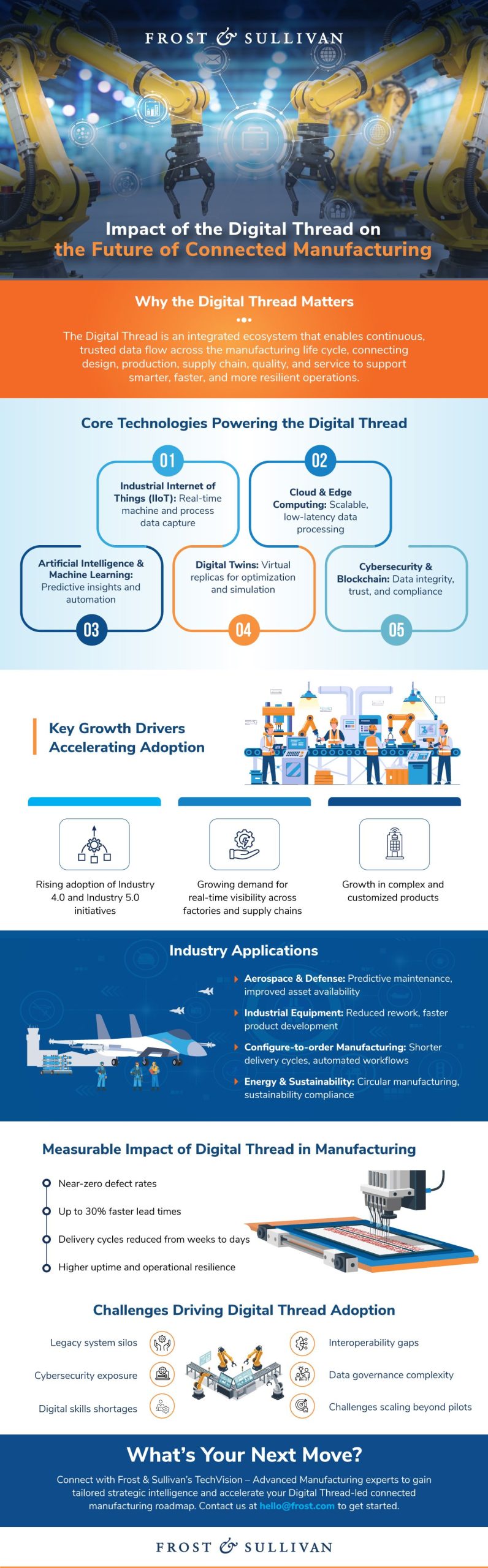
Manufacturers applying Digital Thread-enabled connected manufacturing are reporting near-zero defect rates, lead times up to 30% faster lead times, and delivery cycles shortened from weeks to days, clear indicators that life-cycle data continuity is translating into measurable performance gains.
These results point to a broader shift across global manufacturing. As connectivity expands across products, plants, and supply chains, competitive advantage is increasingly determined by how well data, decisions, and outcomes remain aligned across the manufacturing life cycle.
Discover how the Digital Thread is shaping connected manufacturing, from life-cycle integration and technology convergence to emerging growth opportunities across industries.
The Digital Thread is emerging as a foundation of this evolution, enabling organizations to move beyond isolated digital efforts toward predictive, integrated, and growth-focused manufacturing environments.
Listen to our Growth Podcast Episode on the Impact of Digital Thread
What Is the Digital Thread and Why Does It Matter?
The Digital Thread is a data-driven framework that enables continuous, trusted information flow across the full product life cycle, from initial concept and design through production, operation, service, and end-of-life.
By connecting systems such as computer-aided design (CAD), product life cycle management (PLM), manufacturing execution systems (MES), enterprise resource planning (ERP), Industrial Internet of Things (IIoT) platforms, and service applications, the Digital Thread establishes a single, reliable source of truth. Information created at any stage of the life cycle remains accessible, traceable, and actionable across the organization, reducing handovers and minimizing data fragmentation.
Its value lies in the capabilities it enables:
- Real-time visibility across manufacturing and supply chain systems
- Closed-loop feedback between engineering, production, and service functions
- More informed, timely decisions supported by continuous data context
- Greater operational resilience, quality, and scalability as complexity increases
As industrial organizations advance Industry 4.0 manufacturing initiatives and prepare for Industry 5.0 priorities, the Digital Thread is increasingly viewed as foundational industrial infrastructure, rather than a standalone information technology enhancement.
Strategic Imperatives Shaping the Digital Thread Landscape
Disruptive Technologies
Technologies such as the IIoT, AI and machine learning (ML), cloud computing, digital twins, and blockchain are redefining how manufacturing systems operate. Their convergence is shifting operations from static, rule-based processes toward adaptive, predictive, and data-driven manufacturing environments.
Industry Convergence
The Digital Thread in manufacturing is gaining momentum as information technology (IT), operational technology (OT), AI, telecommunications, cybersecurity, and manufacturing systems are converging. This convergence is improving interoperability and data flow, while increasing coordination demands, driving greater reliance on open platforms, partnerships, and cross-functional collaboration.
Innovative Business Models
Service-led, outcome-based, and circular manufacturing models depend on continuous data flow and life-cycle visibility. As these models scale, the Digital Thread moves beyond operational enablement to support driver of revenue creation and long-term growth.
Impact of Digital Thread Across the Manufacturing Value Chain
The Digital Thread influences every major function across the manufacturing value:
- Design and Engineering: Continuous version control, virtual prototyping, and traceability are reducing rework and accelerating innovation.
- Production and Operations: Real-time data is enabling adaptive planning, dynamic scheduling, predictive maintenance, and in-process quality control.
- Quality Assurance: End-to-end traceability is supporting automated defect detection, compliance reporting, and root-cause analysis.
- Supply Chain and Logistics: Connected data is improving demand forecasting, inventory optimization, and supplier collaboration.
- Aftermarket Services: Usage and performance data is enabling predictive service models while feeding insights back into design and engineering.
Growth Opportunities Accelerating Digital Thread Adoption
- Blockchain-secured Digital Threads are strengthening data integrity, regulatory compliance, and anti-counterfeiting capabilities across complex global supply networks.
- Digital Thread–digital Twin convergence is enabling predictive maintenance, extending asset life, and improving operational resilience through closed-loop intelligence.
- AI-augmented manufacturing planning is shifting production from static schedules toward adaptive, real-time decision models that respond to demand, capacity, and disruption.
Download the full analysis for a detailed view of each growth opportunity
Industry Use Cases: How the Digital Thread Is Applied in Manufacturing
| Industry | Companies Featured | Digital Thread Is Application | Value Delivered |
|---|---|---|---|
| Aerospace & Defense | Boeing, Rolls-Royce | Integrates design, production, and service data across long asset life cycles | Predictive maintenance, improved asset availability, outcome-based service models |
| Industrial & Construction Equipment | Volvo | Consolidates fragmented product and engineering data into a unified Digital Thread | Reduced design rework, improved quality consistency, faster product development |
| Configure-to-order Manufacturing | Infosys | Connects sales configurators, engineering systems, enterprise platforms, and shop-floor operations | Shorter delivery cycles, automated workflows, higher order accuracy |
| Energy & Sustainability | Vestas | Links design, materials, production, and service data across the product life cycle | Life-cycle traceability, circular manufacturing, sustainability compliance |
What Comes Next for Digital Thread–led Manufacturing
The Digital Thread is evolving into an architectural backbone of future manufacturing systems. As data continuity extends across the product life cycle, it is enabling faster decision- making, greater resilience, and more adaptive operations.
Looking ahead, deeper connectivity and rising autonomy are positioning the Digital Thread at the center of smart factories, service-led value creation, and sustainable manufacturing models. For manufacturing leaders, the focus is increasingly on scaling integration deliberately and converting digital continuity into sustained competitive advantage.
FAQs: Digital Thread and the Future of Manufacturing
- How is the Digital Thread different from traditional manufacturing IT systems?
Traditional systems often manage individual stages of the manufacturing process in isolation. The Digital Thread connects data across the entire product life cycle, linking design, production, supply chain, quality, and service, so information remains continuous, traceable, and actionable across functions.
- Where are manufacturers seeing the greatest value from Digital Thread adoption today?
The strongest value is emerging in predictive maintenance, quality management, intelligent planning, and service-led business models. These use cases benefit directly from life-cycle data continuity and closed-loop feedback between engineering, operations, and service.
- What factors influence successful Digital Thread scale-up?
Successful scale-up is influenced by system interoperability, cybersecurity governance, data ownership clarity, and organizational alignment across IT and operational technology teams. Many organizations begin with high-impact use cases and expand integration progressively across the enterprise.
How is your organization preparing to scale Digital Thread integration into sustained growth and competitive advantage?
Ready to Lead the Transformation?
- Book a Growth Strategy Session: Align your growth roadmap with Frost & Sullivan’s visionary Growth Pipeline™ Dialog.
- Engage with Growth Experts: Co-design AI-enabled, data-driven operating models that scale industry-specific and commercial impact.
- Share Your Transformation Story: Position your organization as a transformation leader through Frost & Sullivan’s Transformational Growth Leadership platform.
- Join the Growth Council: Collaborate with industry leaders shaping the future of your ecosystem.
- Nominate for the Best Practices Recognition: Be recognized for excellence in growth strategy, execution, and customer impact.
- Demonstrate Industry Positioning on the Frost Radar™: Benchmark your growth performance and innovation strength against industry competitors.
- Activate Brand & Demand Growth: Accelerate awareness, engagement, and revenue growth through integrated brand and demand generation strategies.