This blog is based on the analyses titled, “Innovations and Growth Opportunities in Virtual Healthcare Assistants,” authored by Frost & Sullivan’s Medical Device & Imaging growth expert, Neeraj Nitin Jadhav from the TechVision team.
Virtual healthcare assistants are emerging as an important component of connected healthcare delivery as healthcare organizations prioritize scalable patient engagement, workflow automation, and operational efficiency. Initially adopted to support basic functions such as appointment reminders, symptom checking, and patient communication, these platforms are rapidly evolving into intelligent healthcare support ecosystems capable of supporting both patient-facing and clinician-facing healthcare environments.
What’s In It for You?
- Key growth opportunities across patient-facing and clinician-facing virtual healthcare assistants
- Emerging innovation trends shaping AI-enabled healthcare delivery and workflow automation
- Strategic opportunities across conversational AI, clinical documentation, and digital patient engagement platforms
Access the Sample Whitepaper on Virtual Healthcare Assistants
Why is this transformation accelerating?
- Healthcare organizations are under increasing pressure to improve operational efficiency while managing rising administrative complexity and labor shortages.
- Artificial intelligence (AI), Natural Language Processing (NLP), generative AI (GenAI), and workflow automation technologies are enabling virtual healthcare assistants to support both patient-facing and clinician-facing healthcare environments.
- Patients increasingly expect personalized, connected, and always-accessible healthcare engagement experiences across digital healthcare platforms.
- Healthcare providers are prioritizing technologies capable of reducing clinician burden, improving documentation efficiency, strengthening decision support, and supporting scalable healthcare delivery models.
- Virtual healthcare assistants are evolving into connected digital healthcare platforms capable of supporting patient engagement, workflow automation, and intelligent healthcare operations across healthcare ecosystems.
How are virtual healthcare assistants reshaping your organization’s patient engagement and healthcare workflow transformation?
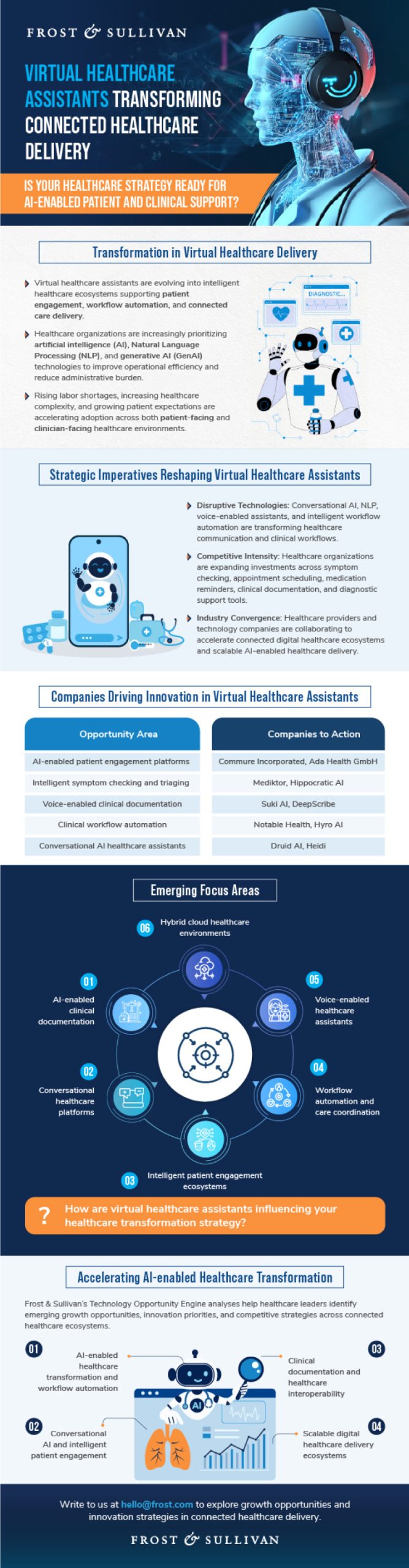
What Is Accelerating Virtual Healthcare Assistant Adoption?
Several healthcare and technology trends are accelerating investments in virtual healthcare assistants across patient engagement, workflow automation, and connected healthcare delivery environments.
- Improved Patient Engagement and Healthcare Accessibility: Patient-facing virtual healthcare assistants are helping individuals manage appointments, medication schedules, symptom tracking, and wellness activities through more personalized and accessible digital healthcare interactions. These technologies are also improving care accessibility through automated support, faster response capabilities, and guided healthcare recommendations, supporting stronger patient satisfaction and health outcomes.
- Rising Administrative and Clinical Workflow Pressures: Healthcare organizations continue facing increasing administrative complexity, clinician workload, and operational efficiency challenges. Virtual healthcare assistants are helping reduce documentation burden, streamline clinical workflows, improve workflow coordination, and support healthcare finance and operational management activities across healthcare systems.
Funding Momentum Continues to AccelerateStrong investment activity across companies such as Hippocratic AI, Heidi, Commure Incorporated, and Tandem Health AB reflects growing confidence in AI-enabled healthcare assistants, clinical workflow automation, and digital healthcare delivery platforms. Funding is increasingly supporting commercialization, geographic expansion, and scalable deployment of intelligent healthcare assistant technologies. |
What Challenges Could Influence Adoption?
Despite strong innovation momentum, several operational and technology challenges could influence large-scale virtual healthcare assistant adoption across healthcare environments.
- Bias and Data Quality Challenges: The performance of AI-enabled healthcare assistants depends heavily on the quality, diversity, and accuracy of training data. Poor-quality or skewed datasets can create algorithmic bias, inaccurate healthcare recommendations, and reliability concerns across healthcare workflows.
- Deployment and Infrastructure Costs: Deploying virtual healthcare assistant technologies often requires significant investments across digital infrastructure, integration, workforce training, ongoing maintenance, and operational support. These costs can create adoption barriers for smaller healthcare providers and resource-constrained healthcare environments.
Two Distinct Innovation Pathways Are Emerging Across Virtual Healthcare Assistants
- Patient-facing Virtual Healthcare Assistants Are Strengthening Digital Patient Engagement
- Patient-facing virtual healthcare assistants use AI, NLP, GenAI, and machine learning (ML) to support appointment scheduling, symptom assessment, medication adherence, chronic disease management, mental health support, and remote patient monitoring across digital healthcare environments.
- Companies such as Commure Incorporated are leveraging conversational AI and digital navigation pathways to improve patient engagement and streamline care coordination, while platforms like Mediktor’s mymediktor use multilingual symptom assessment and intelligent triaging capabilities to strengthen accessible and scalable patient support.
- Clinician-facing Virtual Healthcare Assistants Are Improving Workflow Efficiency
- Clinician-facing virtual healthcare assistants are helping healthcare providers improve clinical workflows, reduce documentation burden, and strengthen operational efficiency through NLP-enabled and voice-enabled AI technologies.
- Solutions such as Suki Assistant are accelerating medical documentation and workflow automation through conversational AI and intelligent language processing, while platforms like epocrates support clinical decision-making through drug reference, disease guidance, and interaction-checking capabilities across healthcare environments.
[Download the Sample Whitepaper on Virtual Healthcare Assistants]
Growth Opportunities Accelerating Virtual Healthcare Assistant Adoption
Hybrid Cloud Computing Supporting Connected Healthcare Ecosystems
- Hybrid cloud environments enable secure integration between private and public healthcare infrastructures
- Supports interoperability, scalable deployment, and seamless healthcare data exchange across providers and platforms
- Strengthens deployment of AI-enabled healthcare assistants across connected healthcare ecosystems
- Helps healthcare organizations improve data governance, regulatory compliance, and operational scalability
- Increasingly important for supporting secure and flexible digital healthcare transformation strategies
Voice-enabled Clinical Documentation and Workflow Automation
- Voice-enabled virtual healthcare assistants and automatic speech recognition technologies are improving clinical documentation workflows
- Reduces manual documentation burden and improves healthcare operational efficiency
- Enables clinicians to focus more on patient care and workflow optimization
- Supports faster deployment and scalable adoption across healthcare environments
- Growing demand for conversational AI, medical transcription, and intelligent workflow automation platforms
How are healthcare organizations aligning virtual healthcare assistant investments with connected and AI-enabled healthcare transformation strategies?
Ready to Lead the Technology Transformation?
- Book a Growth Strategy Session: Align your growth roadmap with Frost & Sullivan’s visionary Growth Pipeline™ Dialog.
- Engage with Growth Experts: Co-design AI-enabled, data-driven operating models that scale industry-specific and commercial impact.
- Share Your Transformation Story: Position your organization as a transformation leader through Frost & Sullivan’s Transformational Growth Leadership platform.
- Join the Growth Council: Collaborate with industry leaders shaping the future of your ecosystem.
- Nominate for the Best Practices Recognition: Be recognized for excellence in growth strategy, execution, and customer impact.
- Demonstrate Industry Positioning on the Frost Radar™: Benchmark your growth performance and innovation strength against industry competitors.
- Activate Brand & Demand Growth: Accelerate awareness, engagement, and revenue growth through integrated brand and demand generation strategies.
Key Questions in Virtual Healthcare Assistant Innovation (FAQs)
What are virtual healthcare assistants in healthcare?
Virtual healthcare assistants are AI-enabled digital platforms that support patient engagement, clinical workflows, and healthcare operations through conversational interfaces, workflow automation, and intelligent healthcare support capabilities.
How are patient-facing virtual healthcare assistants improving healthcare delivery?
Patient-facing virtual healthcare assistants help patients manage appointments, symptom tracking, medication reminders, wellness activities, and healthcare queries through personalized and always-accessible digital healthcare experiences.
How are clinician-facing virtual healthcare assistants reducing administrative burden?
Clinician-facing virtual healthcare assistants support medical documentation, workflow automation, diagnostic assistance, and clinical coordination, helping healthcare professionals improve operational efficiency and reduce repetitive administrative tasks.
What technologies are driving virtual healthcare assistant innovation?
Artificial intelligence (AI), Natural Language Processing (NLP), GenAI, machine learning, conversational AI, and voice-enabled automation technologies are accelerating innovation across virtual healthcare assistant platforms.
Why are healthcare organizations investing in virtual healthcare assistants?
Healthcare organizations are increasingly investing in virtual healthcare assistants to improve patient engagement, strengthen workflow efficiency, reduce clinician workload, support scalable healthcare delivery, and accelerate connected digital healthcare transformation.