This blog is based on the detailed analysis, “Technologies for Preventing Hospital-Acquired Infections—Innovations and Growth Opportunities,” conducted by Frost & Sullivan’s growth experts, Neeraj Nitin Jadhav and Isai Pratha Karthik, from the TechVision Medical Device & Imaging team.
Reinventing Hospital Infection Control: Technologies Driving the Future of HAI Prevention
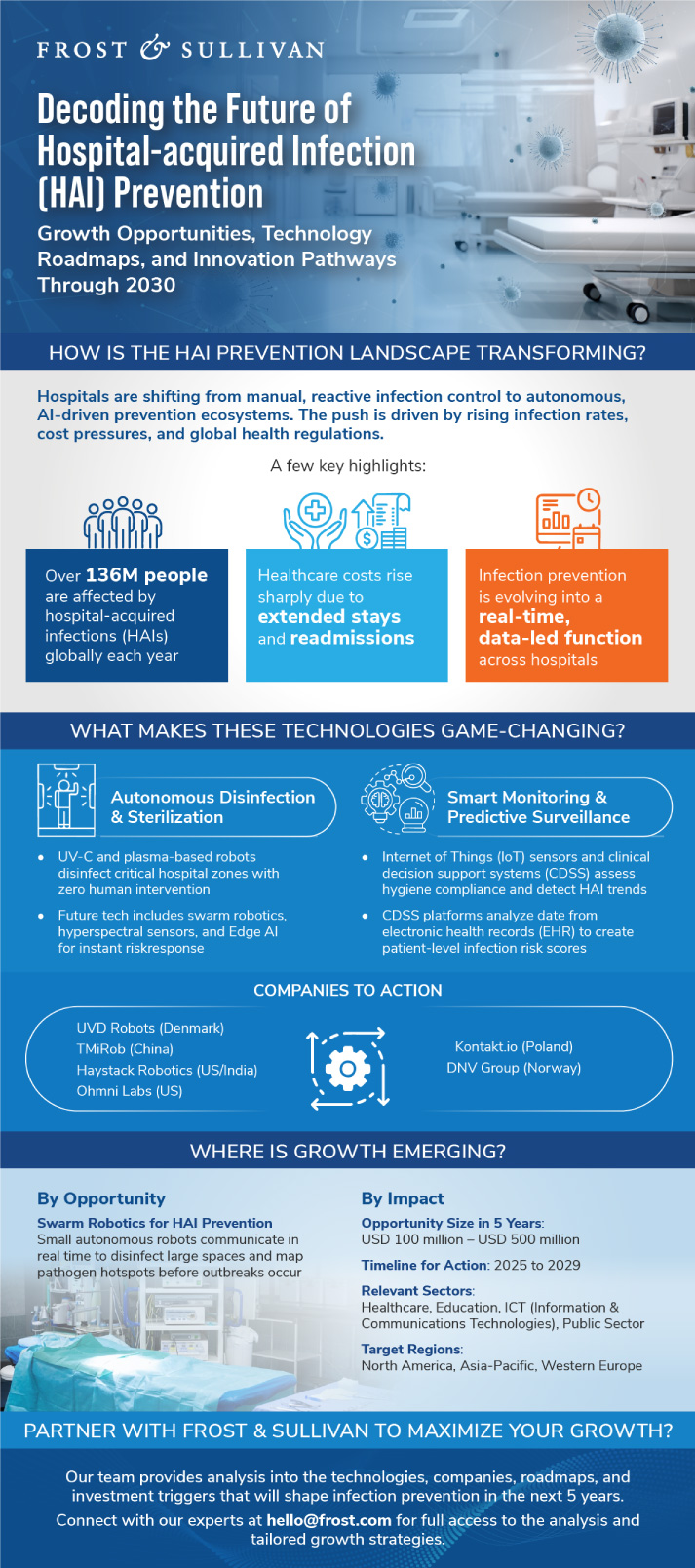
Hospital-acquired infections (HAIs) remain one of the most persistent challenges in healthcare—impacting over 136 million people annually and raising costs due to prolonged hospitalization and re-admissions.
But with the convergence of artificial intelligence (AI), robotics, biosensors, and real-time surveillance systems, hospitals now have access to predictive, scalable, and fully autonomous infection prevention ecosystems.
Want to know how these technologies will shape your next big infection control investment?
[Download the full study or write to us at [email protected] for tailored growth roadmaps.
Technology Frontiers Reshaping Hospital-Acquired Infection (HAI) Prevention
- Autonomous Disinfection & Sterilization Technologies: Reimagining Hospital Hygiene with Intelligent Robotics
Autonomous disinfection technologies are redefining how hospitals sterilize environments—especially high-touch surfaces, surgical theatres, and patient care areas. These systems deploy ultraviolet-C (UV-C), plasma, or electrostatic spray-based robotics to eliminate pathogens efficiently and consistently—without human intervention.
- Technologies & Innovations
- UV-C Disinfection Robots: AI-enabled robots navigate hospital rooms, using powerful UV light to disinfect air and surfaces in real time.
- Plasma and Electrostatic Spray Systems: Robots with mist or reactive gas technology target vertical surfaces and hard-to-reach areas.
- Companies To Action:
-
- UVD Robots (Denmark): Equipped with UV-C sources, obstacle sensors, and tablet-based control
- TMiRob (China): Offers hydrogen peroxide, UV, and plasma-based disinfection for air and surfaces
How is your operations or technology team rethinking hospital sanitation to include autonomous, continuous disinfection protocols?
| Technology Roadmap: Autonomous Disinfection 2025 · UV-C robots integrated with AI-based mobile control systems · Manual disinfection augmented with autonomous floor and surface bots 2026–2027 · Robotic disinfection synced with HVAC (Heating, Ventilation, and Air Conditioning) controls · Cloud-based dashboards for real-time hygiene tracking and intervention2028–2029 · Swarm robotics coordinating full-facility disinfection · Hyperspectral sensors and Edge AI for live pathogen detection and action |
| [Download the full study] or contact us at [email protected]. |
- Smart Monitoring & Predictive Surveillance Technologies: From Real-time Risk Detection to AI-powered Clinical Intelligence
Smart surveillance platforms are helping hospitals get ahead of HAIs. By integrating Clinical Decision Support Systems (CDSS), Electronic Health Records (EHRs), and Internet of Things (IoT) sensors, these solutions identify high-risk patients, hygiene breaches, and infection patterns.
- Technologies & Innovations
-
- Real-time Sensor Networks: Wearables and tags track staff movement and hygiene compliance
- AI-based CDSS Platforms: Combine biosensor data and EHR inputs to generate infection probability scores and trigger alerts
- Companies to Action:
-
- Kontakt.io (Poland): Smart badges using Real-Time Location Sensing (RTLS) to audit staff hygiene behavior
- DNV Group (Norway): SYNERGI™ Life platform for risk scoring, trend analysis, and re-admission mitigation
How is your hospital’s infection prevention team leveraging real-time data and predictive modeling to make faster, more accurate clinical decisions?
| Technology Roadmap: Smart Monitoring & Predictive Surveillance
2025 2026–2027 2028–2029 |
| [Access the complete analysis] or reach out to [email protected] |
Growth Opportunity Highlight: Swarm Robotics for HAI Prevention
Traditional disinfection robots can’t cover entire hospital environments or adapt dynamically to infection spread patterns. Swarm robotics changes that. These small, AI-coordinated robotic units work in parallel, mapping pathogen hotspots, communicating with infection surveillance systems, and disinfecting as a self-regulating network.
Opportunity Snapshot:
- Market Size: USD 100 million – USD 500 million
- Action Window: 2025–2029
- Sectors Impacted: Healthcare, Public Health, Information & Communications Technology (ICT), Education
- Key Regions: North America, Asia-Pacific, Western Europe
Is your organization prepared to deploy AI-synced robotic ecosystems that adapt in real time to infection threats?
[Download the full analysis] or schedule a Growth Pipeline Dialog™ to explore transformation-ready solutions.