This blog is based on Frost & Sullivan’s analysis “US/NATO/Israel Airborne Ammunition Market, 2024–2026,” authored by Avi Kalo from the Aerospace & Defense Practice Area.
Air power is entering its most decisive phase since the Cold War. From the skies over Ukraine to the shifting dynamics in the Middle East, conflicts are proving that control of the air depends on more than platforms. It hinges on the munitions they carry. Advanced airborne ammunition is now the linchpin of modern defense, shaping how nations project strength and defend their interests.
Yet this evolution brings formidable challenges. Supply chain vulnerabilities, rising costs, and the need to rapidly integrate cutting-edge technologies are straining the resilience of defense contractors, suppliers, and policymakers. Success will rely on striking the right balance between meeting urgent operational demands and building sustainable, long-term capabilities.
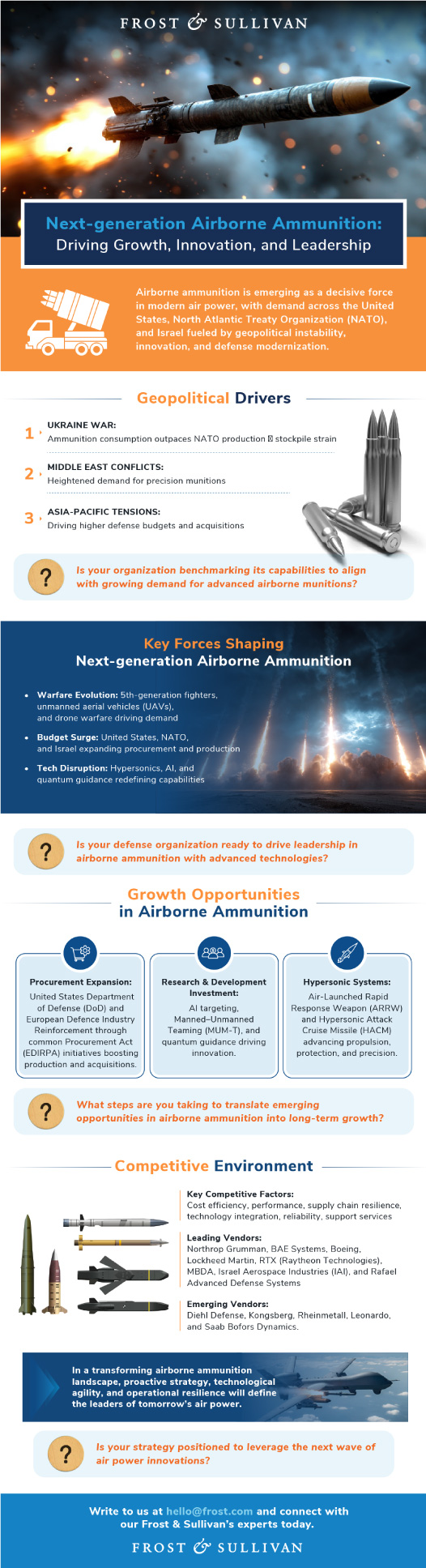
This blog highlights the forces driving change in airborne ammunition and outlines the key factors stakeholders can consider to overcome today’s hurdles and capture tomorrow’s opportunities.
How is your organization balancing immediate defense needs with long-term growth opportunities in the airborne ammunition domain?
Airborne Ammunition Segmentation
This ecosystem is being shaped by four major categories of ammunition:
| Category | Role & Description |
| Air-to-air Missiles (AAMs) | Essential for air superiority, AAMs are evolving to counter advanced electronic warfare systems and sophisticated defenses. |
| Air-to-ground Missiles (AGMs) | Launched from fighters, helicopters, and unmanned aerial vehicles (UAVs); increasingly critical to multi-domain strike missions. |
| Anti-ship Missiles | Address growing naval competition; designed for long-range, precision-guided strikes from manned and unmanned aerial platforms. |
| Anti-missile Missiles (AMMs) | Intercept and neutralize hostile missiles mid-flight; leverage radar, infrared homing, and layered defenses to counter emerging threats. |
Which area of airborne ammunition holds the most potential for growth and innovation in your modern defense strategy?
Strategic Imperatives Shaping the Future of Airborne Ammunition
- Geopolitical Instability: Ongoing conflicts in Eastern Europe and the Middle East highlight the urgent need for advanced airborne munitions. Rising demand, especially in Ukraine, continues to outpace North Atlantic Treaty Organization (NATO) production capacity, forcing difficult procurement trade-offs.
- Industry Convergence: Growing reliance on manned and unmanned aerial platforms is driving modernization of production lines, supply chains, and digital integration. Consolidation among prime vendors will keep the ecosystem concentrated and highly competitive.
- Disruptive Technologies: Hypersonic weapons, electro-optical (EO)/nfrared (IR) sensors, advanced seekers, and electromagnetic warfare are reshaping ammunition design. Defense primes integrating these capabilities will gain a decisive edge in next-generation operations.
What steps is your organization taking to respond to these strategic imperatives and strengthen its competitive position?
Growth Opportunities Driving Airborne Ammunition Landscape
- Procurement Expansion
Rising budgets and stronger political will are reshaping acquisition programs across the United States, NATO, and Israel. From the United States Department of Defense (US DoD)’s centralized approach to the European Union (EU)’s European Defence Industry Reinforcement through common Procurement Act (EDIRPA) initiative, governments are actively channeling funds into expanding munitions production.
Early positioning in procurement cycles and collaboration with regional partners are becoming decisive factors in strengthening supply chains and ensuring integration with next-generation aerial platforms.
- Research & Development (R&D)
The Western airborne ammunition ecosystem is experiencing accelerated R&D activity, opening growth opportunities across multiple technology areas:
- AI-enabled targeting and navigation in GPS-denied environments
- Miniaturized systems enabling manned-unmanned teaming
- Quantum-based technologies advancing future guidance systems
Strategic partnerships with defense agencies and multinational consortiums are increasingly pivotal for stakeholders seeking to sustain technological leadership and stay competitive in this rapidly evolving landscape.
How do you benchmark your innovation readiness compared with leading competitors in this space?
- Hypersonic Technology
Hypersonic systems that deliver unmatched speed and maneuverability are redefining both deterrence and strike capabilities. Flagship programs such as the US Air-Launched Rapid Response Weapon (ARRW) and the Hypersonic Attack Cruise Missile (HACM) underscore the growing emphasis on this domain.
Investments in propulsion, thermal protection, and advanced guidance technologies, combined with deeper collaboration with government research organizations, are shaping the pathway for rapid advancement in hypersonic weapons.
Strategic Path Ahead for Airborne Ammunition
Airborne ammunition is on a trajectory of sustained growth, fueled by heightened geopolitical risks and the rapid integration of advanced technologies. At the same time, the domain will contend with increasing debates around affordability, industrial resilience, and supply chain security.
Thriving in this environment requires stakeholders to:
- Align with major procurement initiatives across the United States, NATO, and Israel.
- Advance collaborative research and development (R&D) efforts centered on affordability, adaptability, and next-generation capabilities.
- Strengthen supply chains to withstand disruptions and maintain operational readiness.
As military strategies shift toward contested airspaces and multi-domain operations, airborne ammunition will remain a central pillar of defense modernization. Those who position effectively today will define the contours of aerial warfare in the years ahead.
How confident are you in your organization’s ability to adapt to the accelerating transformation of airborne ammunition?
Download the analysis to access sector-specific use cases and growth pathways or schedule a Growth Pipeline Dialog™ with our experts to take the first step toward unlocking sustainable growth opportunities.