This blog is based on the recent Frost & Sullivan analysis, “Advanced Wound Care Industry Driving Transformational Growth by Developing Digital Wound Management Solutions, Global, 2024–2030,” authored by Utkarsha Kaustubh Soundankar, Industry Analyst, Healthcare & Life Sciences Practice.
The global wound care landscape is undergoing a dramatic transformation. What was once dominated by traditional dressings and reactive treatment models is now rapidly shifting toward data-driven, preventive, and home-based care, powered by smart technologies, AI, and digital platforms.
From smart sensors to bioengineered skin, explore what’s next in wound care.
Click here to access Frost & Sullivan’s full analysis
Between now and 2030, the advanced wound care industry is poised for transformational growth, led by innovations such as AI-powered diagnostics, wearable sensors, bioengineered skin substitutes, and 3D scaffolds. This shift not only improves clinical outcomes but also addresses critical healthcare challenges such as cost control, resource limitations, and chronic wound management.
In this blog, we explore what’s fueling this transformation, the technologies leading the charge, and how healthcare stakeholders can seize the growth opportunities.
Why Wound Care Is Entering a New Era
The wound care industry has reached a pivotal moment. As patient populations age and chronic wounds (such as diabetic ulcers and pressure injuries) become more prevalent, the need for more effective, personalized, and scalable wound care solutions is rising.
This has triggered a transition from manual, paper-based assessments to digital platforms that support real-time wound monitoring, AI-powered predictions, and smart dressings that deliver feedback and even medication.
Are your current wound care strategies keeping pace with these emerging demands?
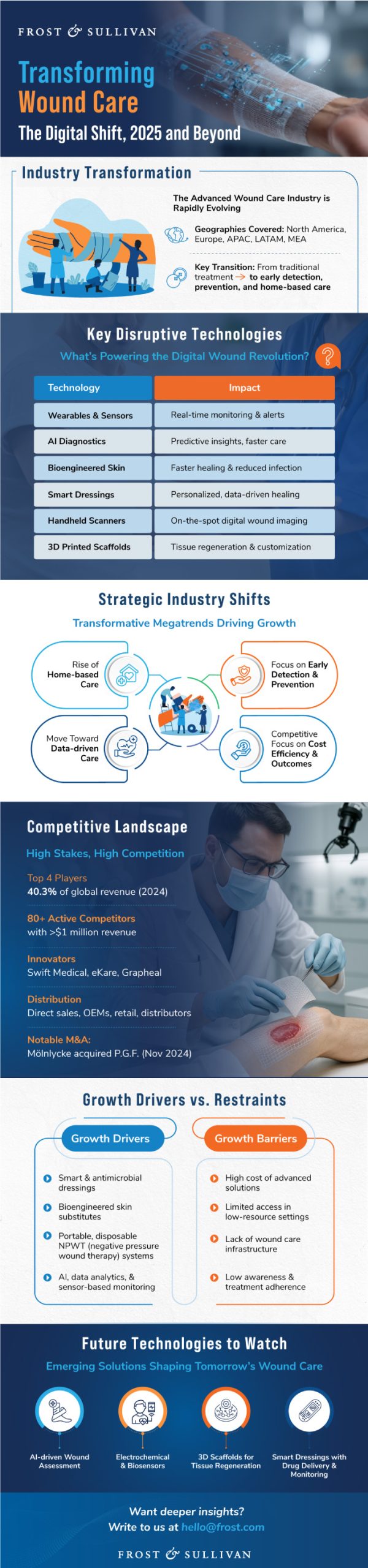
Key Drivers of Growth Include:
- Demand for remote and home-based care
- Rising chronic disease burden
- Advances in digital health infrastructure
- Push for cost-effective, outcome-based treatment
Disruptive Technologies Leading the Shift
- AI-powered Wound Assessment Tools: Artificial intelligence is being embedded into mobile applications and imaging devices to enable automated wound measurement, classification, and healing predictions. These tools reduce assessment variability and provide consistent, evidence-based recommendations for treatment.
- Wearable Sensors and Remote Monitoring Devices: Sensor-based wearables, smart bandages, and digital wound measurement tools are enabling continuous, remote wound tracking. These devices monitor parameters like pH, temperature, moisture levels, and bacterial presence, alerting clinicians to complications before they escalate.
- Bioengineered Skin Substitutes: Biologics such as bioengineered skin and tissue scaffolds are gaining traction for their ability to promote faster healing by supporting cell growth, providing moisture, and reducing inflammation.
- Smart Dressings and 3D Scaffolds: Next-gen wound dressings are evolving into smart therapeutics. Innovations include stimuli-responsive dressings that react to changes in moisture or pH, self-healing materials, and dressings that deliver drugs on demand.
How are you leveraging AI to eliminate variability and improve wound care outcomes?
Global Shifts in Care Delivery
The adoption of these technologies is accelerating across North America, Europe, Asia-Pacific, Latin America, the Middle East, and Africa. While advanced economies lead in R&D and deployment, emerging regions are rapidly adopting portable and affordable digital solutions, especially for community-based care.
Notably, the shift to home-based wound care is gaining momentum. With the help of portable NPWT (negative pressure wound therapy) devices, telehealth platforms, and mobile apps, patients can now receive professional wound care from the comfort of their homes, improving continuity and reducing hospital load.
How prepared is your organization to shift wound care from hospitals to homes?
Competitive Landscape: Big Players and Bold Innovators
The advanced wound care market is intensely competitive, with over 80 players generating revenues above $1 million. Key market leaders such as Solventum, Smith & Nephew, Mölnlycke, and Convatec continue to invest in new technologies and strategic acquisitions to maintain dominance.
At the same time, emerging digital-first companies like Swift Medical and eKare are disrupting the space with innovative software and AI-based tools.
Are you partnering with digital disruptors or being disrupted by them?
In 2024, Mölnlycke’s acquisition of P.G.F. Industry Solutions GmbH marked a strategic move to expand its smart wound care portfolio and reinforce leadership in digital health integration.
Challenges Hindering Widespread Adoption
Despite the momentum, several barriers must be overcome:
- High cost of advanced wound solutions
- Limited awareness among patients and providers
- Lack of specialized wound care departments
- Inconsistent reimbursement models
What’s your plan to overcome cost and adoption barriers in scaling digital wound care?
However, as clinical evidence grows and technology costs fall, these hurdles are expected to diminish, paving the way for broader adoption and measurable impact.
Opportunities for Innovation and Impact
The most exciting opportunities in wound care over the next five years will be shaped by the integration of data, digital tools, and personalized medicine.
- Data-driven Wound Care: AI-powered platforms are transforming wound documentation, enabling better treatment decisions, predictive modeling, and improved reimbursement documentation.
- Next-gen Monitoring Sensors: Future sensors will offer even more precision, detecting infection risk, antibiotic resistance, and healing progress in real time.
- Global Expansion of Home-based Care: Portable NPWT devices, remote diagnostics, and mobile wound care apps are enabling healthcare systems to shift wound care from hospitals to homes.
Is your strategy aligned with the shift toward real-time, evidence-based, home-first care models?
Strategic Imperatives for Stakeholders
For manufacturers, providers, and investors, the imperative is clear: innovate early and align with emerging care models. Whether developing smart wound dressings or partnering with digital health platforms, success will come to those who enable:
- Preventive care over reactive treatment
- Scalable, cost-effective digital tools
- Integration with clinical workflows and reimbursement models
Conclusion: Wound Care’s Digital Future Is Now
The future of wound care is being reshaped by digital technologies and that future is now.
From AI diagnostics and smart monitoring to bioengineered dressings and remote patient engagement, the industry is no longer about healing wounds—it’s about predicting, preventing, and personalizing wound care at scale.
Will you lead the digital wound care revolution or be left behind?
Want to Learn More?
Explore the full strategic study: “Advanced Wound Care Industry Driving Transformational Growth by Developing Digital Wound Management Solutions, Global, 2024–2030.”