This blog is based on Frost & Sullivan’s recent analysis, “Global Motor Services Market, 2021–2029,” authored by Krishnan Ramanathan from the Industrial Practice Area.
Electric motors are foundational to the global industry. Across oil refineries and power plants to automotive factories and food processing lines, they consume a significant share of global electricity. As energy costs rise, efficiency regulations tighten, and downtime tolerance declines, motor services are shifting from a maintenance function to a strategic enabler of performance and reliability.
Download the Full Analysis
For industrial leaders facing aging assets and constrained capital budgets, this transformation reframes motor services as a high-impact investment lever. The critical question is no longer whether to service motors, but how to prioritize service strategies that deliver measurable operational returns while strengthening efficiency and resilience.
Listen to Our Growth Podcast Episode on the Global Motor Services Industry
Strategic Imperatives Reshaping the Global Motor Services Industry
- Innovative Business Models
Service offerings are evolving from transactional repairs toward long-term outcome-driven partnerships. Bundled service packages and even Motor-as-a-Service (MaaS) models, where customers pay for uptime rather than asset ownership, are gaining traction in large industrial facilities. - Transformative Megatrends
Ultra-efficient motors, permanent magnet technologies, and digital twins are transforming how industrial motors are designed, operated, and serviced. Motor maintenance is becoming increasingly data-driven and software-enabled through digital monitoring and predictive analytics. - Rising Competitive Intensity
OEMs are facing increasing competition from low-cost service providers once warranties expire. Sustaining differentiation is now depending on clearly demonstrating reliability, safety, energy savings, and lifecycle cost advantages, with digital services providing a critical edge.
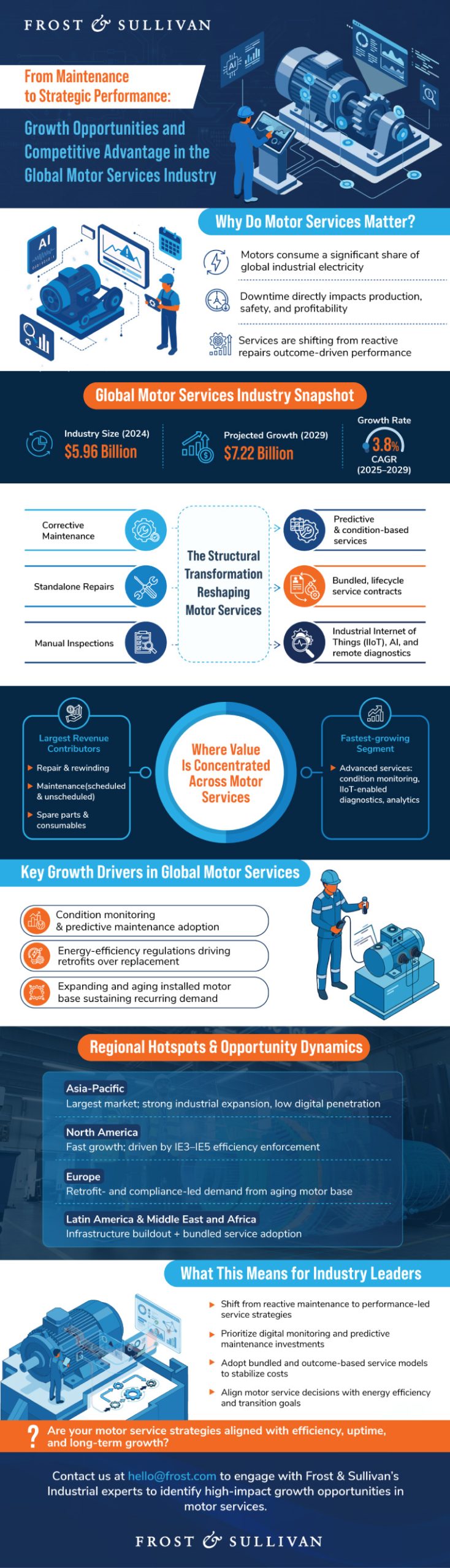
Key Growth Drivers Powering the Global Motor Services Industry
- Condition Monitoring and Predictive Maintenance Adoption: Industrial operators are shifting from time-based maintenance toward condition-based and predictive approaches. Online and offline monitoring systems are enabling continuous visibility into motor health, efficiency, and failure patterns, significantly reducing unplanned outages.
- Energy-efficiency Regulations Driving Retrofit Demand: Stricter energy-efficiency mandates across North America, Europe, and Asia-Pacific are compelling end users to upgrade or retrofit existing motors rather than replace them outright.
- Expanding Installed Base of Industrial Motors: Global industrial expansion is increasing the global installed motor base, ensuring long-term service demand. Aging motors, particularly in heavy industries, are requiring more frequent maintenance, repairs, rewinding, and end-of-life management, thereby sustaining recurring revenue streams.
Companies to Action in Global Motor Services Landscape
- ABB: Industry leader with strong digital motor services, condition monitoring services, and Industrial Internet of Things (IIoT)-enabled solutions through its ABB Ability platform.
- Siemens/Innomotics: Offers comprehensive lifecycle motor services, turnkey maintenance contracts, and advanced digital diagnostics.
- Nidec: Expanding global service footprint through acquisitions and high-efficiency motor technologies.
- WEG: Strong aftermarket services and growing presence through strategic acquisitions and regional expansion.
Growth Opportunities Driving Transformation Across the Motor Services Industry
- Packaged Services to Drive Recurring Revenue and Retention: Bundling maintenance, repairs, condition monitoring services, spare parts, and extended warranties is shifting motor services from transactional work to recurring, lifecycle-driven revenue models, strengthening customer retention beyond the warranty period.
- Condition Monitoring as the Fastest-growing Value Pool: IIoT-enabled condition monitoring systems and predictive maintenance are the fastest-growing opportunity, enabling higher uptime, lower energy consumption, and reduced unplanned downtime, especially in asset-intensive, high-risk industries.
- Aligning Services with Emerging End-user and Energy Transition Needs: Demand is rising for services supporting ultra-efficient motors (IE4/IE5), explosion-proof applications, and emerging sectors such as renewables, hydrogen, batteries, and electric vehicle (EV) supply chains, alongside new models like MaaS.
Access the full analysis to uncover deeper growth opportunities in the motor services industry.
Organizations that treat services as a strategic capability rather than a reactive necessity will be best positioned to capture the next phase of growth. By embedding digital intelligence, predictive maintenance, and lifecycle optimization into service portfolios, leaders can reduce downtime, improve energy efficiency, and strengthen customer loyalty.
Ready to Lead the Transformation?
- Book a Growth Strategy Session: Align your growth roadmap with Frost & Sullivan’s visionary Growth Pipeline™ Dialog.
- Engage with Growth Experts: Co-design AI-enabled, data-driven operating models that scale industry-specific and commercial impact.
- Share Your Transformation Story: Position your organization as a transformation leader through Frost & Sullivan’s Transformational Growth Leadership platform.
- Join the Growth Council: Collaborate with industry leaders shaping the future of your ecosystem.
- Nominate for the Best Practices Recognition: Be recognized for excellence in growth strategy, execution, and customer impact.
- Demonstrate Industry Positioning on the Frost Radar™: Benchmark your growth performance and innovation strength against industry competitors.
- Activate Brand & Demand Growth: Accelerate awareness, engagement, and revenue growth through integrated brand and demand generation strategies.
FAQs: Global Motor Services Market
- Why are motor services becoming a strategic priority for industrial leaders?
Motor services directly impact uptime, energy efficiency, and asset life, three areas under intense pressure from rising energy costs, stricter regulations, and aging infrastructure. Digital and predictive service models now deliver measurable operational and financial returns, elevating services from maintenance to strategy.
- What is driving growth in the industrial motor services?
Growth is driven by a large and aging installed base of motors, tighter energy-efficiency mandates, and rising adoption of predictive maintenance and condition monitoring. Bundled service contracts and digital diagnostics are also improving revenue stability for providers and reducing risk for end users.
- How do bundled service models benefit end users?
Bundled services simplify vendor management, reduce unplanned downtime, and lower total cost of ownership (TCO). For asset-intensive industries, they also provide predictable operating costs and ensure compliance with efficiency and safety regulations.
- Where are the strongest future opportunities in industrial motor services?
The biggest opportunities lie in Asia-Pacific, digital monitoring services, and emerging sectors such as renewables, hydrogen, batteries, and EV supply chains. Service providers that align offerings with energy transition goals and outcome-based models will capture the most value.