Redefining Solar Energy for Integrated, High performance Applications
Third-generation (3G) solar cells are transforming how solar energy is generated, integrated, and deployed. Unlike conventional silicon modules designed primarily for large-scale installations, emerging photovoltaic (PV) technologies enable lightweight, flexible, transparent, and application-integrated energy solutions. These advancements are enabling solar deployment across buildings, connected infrastructure, mobility platforms, and intelligent devices.
Breakthroughs in perovskite, organic PV, quantum dot (QD) systems, and tandem architectures are improving efficiency, reducing manufacturing complexity, and enabling deployment in environments previously inaccessible to conventional solar technologies. Advanced deposition methods, hybrid material stacks, and scalable production approaches are accelerating commercialization readiness and enabling new categories of solar-enabled products.
3G Solar Cells: Accelerating the Future of Integrated Energy Systems
Access:
- Breakthrough photovoltaic technologies enabling lightweight, flexible, and high-efficiency solar deployment
- Innovation leaders advancing perovskite, organic, tandem, and quantum dot solar commercialization
- Strategic growth opportunities shaping building-integrated solar, decentralized energy, and intelligent infrastructure
Strategic Imperatives Accelerating 3G Solar Cell Adoption
- Disruptive Technologies: Integrated and Flexible Photovoltaics
Perovskite, organic, and tandem solar architectures are enabling lightweight, flexible, and high-efficiency modules. These technologies allow solar functionality to be embedded into buildings, infrastructure, devices, and mobility systems, expanding deployment beyond traditional installations. - Transformative Megatrends: Decentralized and Integrated Energy Systems
Global sustainability targets, urban electrification, and intelligent infrastructure are accelerating demand for adaptable, integrated energy solutions. 3G PV support decentralized generation, architectural integration, and distributed energy deployment. - Industry Convergence: Materials, Electronics, and Infrastructure Integration
Advancements across materials science, coatings, flexible electronics, and energy systems are converging to enable solar integration into windows, building materials, connected devices, and industrial systems. This convergence is creating entirely new categories of solar-enabled applications.
How will integrated solar technologies reshape energy deployment across infrastructure, devices, and intelligent systems?
Growth Drivers Accelerating Commercial Deployment
- Global Energy Transition and Climate Policy
Government mandates, corporate net-zero commitments, and sustainability programs are accelerating investments in high-efficiency PV technologies. - Materials and Manufacturing Innovation
Advancements in perovskite, QD, and thin-film materials are improving efficiency, durability, and scalability. Roll-to-roll manufacturing and modular production approaches support pilot-scale commercialization. - Building-integrated Photovoltaics (BIPV)
Transparent and flexible PV materials are enabling integration into windows, facades, and architectural structures, expanding deployment across commercial and urban infrastructure. - Indoor and Low-light Energy Harvesting
Organic and QD PV technologies are enabling energy generation for sensors, wearables, and Internet of Things devices operating in indoor environments.
| Classification of 3rd-generation Solar Technologies
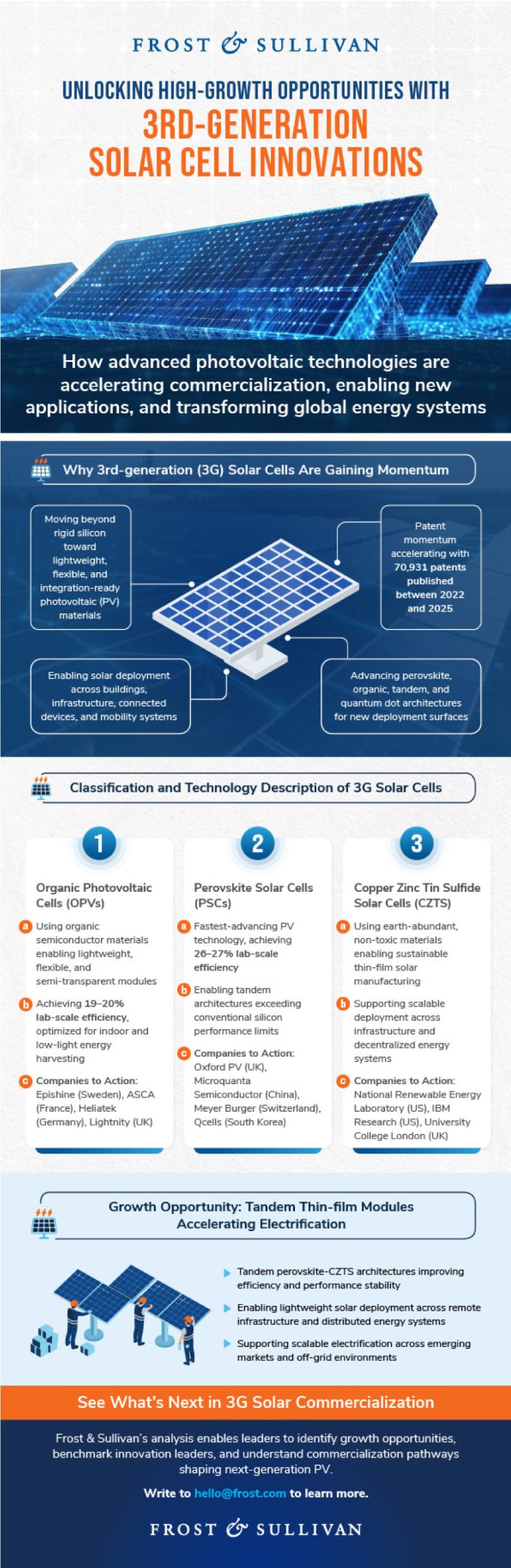
3G PV technologies are surpassing the efficiency limitations of traditional single-bandgap solar cells by enabling multi-mechanism charge generation and advanced absorber designs. 1. Perovskite Solar Cells (PSCs) and Organic Photovoltaics (OPVs) technologies are leading commercialization due to efficiency and scalability advancements 2. Tandem architectures improve performance by combining complementary PV materials 3. Copper Zinc Tin Sulfide (CZTS) Solar Cells provides sustainable alternatives to conventional thin-film materials 4. Quantum Dot Solar Cells (QDSCs) and Dye-sensitized Solar Cells (DSSCs) enable deployment across low-light and integrated environments |
| Download the sample analysis to explore growth opportunities and commercialization pathways shaping 3G solar technologies. |
Growth Restraints Impacting Commercialization
- Stability and Durability Challenges
Perovskite and QD materials require improved encapsulation and protection from moisture, heat, and ultraviolet exposure. - Manufacturing Scale-up Limitations
Scaling uniform thin-film deposition across large modules remains complex and requires further process optimization. - Certification and Standardization Gaps
Limited long-term field validation and evolving certification frameworks are slowing deployment. - Cost Competitiveness vs. Silicon Technologies
Initial production costs remain higher than mature silicon PV systems, though cost reductions are expected with scale.
What commercialization strategies will accelerate stability improvements, manufacturing scale-up, and deployment readiness?
Companies to Action: Innovation Leaders Advancing Commercialization
- Epishine (Sweden)
Manufacturing printed organic PV modules optimized for indoor energy harvesting across sensors and connected devices. - Microquanta Semiconductor (China)
Deploying perovskite modules enabling building-integrated PV and transparent solar applications. - National Renewable Energy Laboratory (United States)
Advancing scalable CZTS solar technologies and supporting commercialization through standardized research and validation. - Solaronix (Switzerland)
Enabling dye-sensitized and perovskite PV development through specialized materials and pilot manufacturing support. - ML System (Poland)
Developing QD transparent solar coatings for windows and architectural integration.
| 3rd-generation Solar Cells: Patent Momentum Accelerating Commercialization
The global 3G solar ecosystem has published 70,931 patents between 2022 and 2025, signalling strong innovation momentum and accelerating commercialization readiness. 1. Rapid growth in perovskite and tandem thin-film architectures improving efficiency and scalability 2. Increasing innovation in portable, flexible, and integrated solar modules enabling new deployment models 3. Strong patent leadership across Asia-Pacific, United States, and Europe, accelerating global adoption These innovation trends are strengthening the transition toward high-performance, integrated photovoltaic systems across infrastructure, mobility, and distributed energy applications. |
Growth Opportunity: Tandem Perovskite-CZTS Solar Modules for Off-grid Electrification
Tandem thin-film solar modules combining perovskite and CZTS technologies are enabling high-efficiency, low-cost energy generation for off-grid applications.
This growth opportunity is enabling:
- Higher efficiency and performance stability: Tandem absorber stacks are improving spectral utilization and overall energy generation efficiency
- Sustainable and supply-resilient manufacturing: CZTS uses earth-abundant, non-toxic materials, reducing dependence on scarce elements and enabling scalable production
- Deployment across off-grid and distributed energy systems: Lightweight, flexible modules are supporting rural electrification, microgrids, telecom infrastructure, and remote industrial operations
- Integration into infrastructure and portable energy systems: Thin-film tandem modules are enabling deployment across buildings, mobility platforms, and decentralized energy applications
- Accelerated commercialization pathways: Advances in deposition methods, encapsulation, and scalable manufacturing are improving durability, yield, and production readiness
FAQs: Growth Opportunities in 3rd-generation (3G) Solar Cells
- What are 3G solar cells?
Third-generation solar cells are advanced photovoltaic technologies using materials such as perovskites, organic semiconductors, QDs, and tandem architectures. These technologies enable higher efficiency, flexible form factors, and integration into buildings, devices, and infrastructure beyond traditional silicon-based solar modules.
- Why are 3G solar cells important for future energy systems?
3G solar cells are improving efficiency, reducing material constraints, and enabling deployment across new applications such as building-integrated photovoltaics, indoor energy harvesting, and decentralized energy systems. These capabilities are supporting global electrification, infrastructure modernization, and distributed energy deployment.
- Which industries will benefit most from 3G solar technologies?
Key industries include construction and infrastructure, telecommunications, mobility, consumer electronics, and industrial systems. These technologies are enabling solar integration into buildings, connected devices, vehicles, and off-grid infrastructure, expanding deployment beyond traditional utility-scale installations.
- Which regions are leading innovation and commercialization in 3G solar cells?
Asia-Pacific is leading manufacturing scale-up and patent activity, while North America and Europe are advancing research, pilot deployments, and commercialization programs. These regions are accelerating development through government support, research leadership, and industrial partnerships.
- What growth opportunities are emerging in 3G solar cells?
Key growth opportunities include tandem thin-film modules, building-integrated photovoltaics, flexible solar applications, and off-grid electrification. Artificial intelligence (AI)-enabled material discovery and scalable manufacturing technologies are accelerating commercialization and enabling broader deployment across global energy systems.
Ready to Lead the Transformation?
- Book a Growth Strategy Session: Align your growth roadmap with Frost & Sullivan’s visionary Growth Pipeline™ Dialog.
- Engage with Growth Experts: Co-design AI-enabled, data-driven operating models that scale industry-specific and commercial impact.
- Share Your Transformation Story: Position your organization as a transformation leader through Frost & Sullivan’s Transformational Growth Leadership platform.
- Join the Growth Council: Collaborate with industry leaders shaping the future of your ecosystem.
- Nominate for the Best Practices Recognition: Be recognized for excellence in growth strategy, execution, and customer impact.
- Demonstrate Industry Positioning on the Frost Radar™: Benchmark your growth performance and innovation strength against industry competitors.
- Activate Brand & Demand Growth: Accelerate awareness, engagement, and revenue growth through integrated brand and demand generation strategies.