This blog is based on Frost & Sullivan’s recent analysis, “Phytonutrients Market, Global, 2025–2032,” authored by Akheela Dhiman from the Chemicals, Materials & Nutrition Practice Area.
The global phytonutrients ecosystem is evolving from traditional plant-based extracts to science-backed, high-performance bioactives. This transformation is driven by rising demand for preventive healthcare, advanced delivery technologies, and greater emphasis on clinical validation.
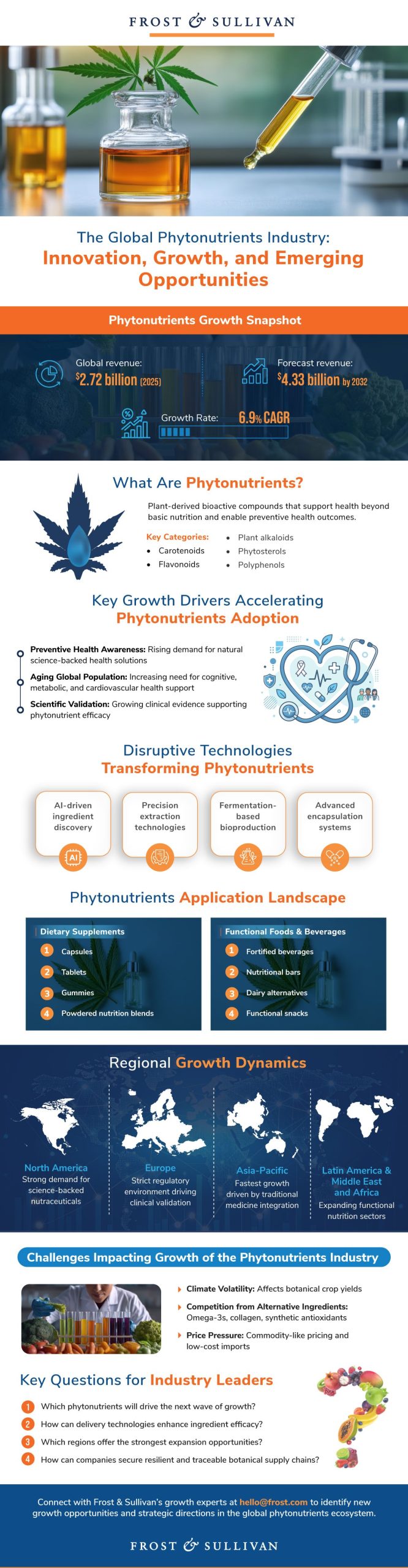
Valued at $2.7 billion in 2025 and projected to reach $4.3 billion by 2032 (6.9% CAGR), the opportunity is expanding across how phytonutrients are developed, formulated, and commercialized.
As consumers shift toward targeted, outcome-based health solutions, manufacturers are moving from bulk ingredient supply to bioavailability-driven innovation. For industry leaders, the growth mandate is clear:
Looking to lead in the next phase of phytonutrients growth?
To Access:
1. Emerging Technologies
2. Regional Dynamics
3. High-growth opportunities
4. Competitive Benchmarking
- Transitioning from commoditized ingredients to clinically validated, high-value formulations
- Advancing delivery technologies to enhance bioavailability, efficacy and product differentiation
- Building resilient, traceable, and sustainable supply chains across sourcing and production
- Realigning portfolios toward high-growth, outcome-driven health segments such as metabolic, cognitive, and immune health
How is your organization positioning itself to capture value in phytonutrients growth?
Listen to Our Podcast Episode on Growth Opportunities in the Phytonutrients Industry
Phytonutrients: The Foundation of Modern Preventive Nutrition
Phytonutrients are plant-derived bioactive compounds that deliver health benefits beyond basic nutrition. Unlike vitamins and minerals, they are not essential for survival but play a critical role in disease prevention and overall wellness.
Key categories include:
- Carotenoids (lutein, beta carotene, astaxanthin) supporting eye and skin health
- Flavonoids (quercetin, catechins, anthocyanins) supporting cardiovascular and immune support
- Plant alkaloids and polyphenols (berberine, resveratrol) supporting metabolic and longevity benefits
Phytonutrients are gaining strategic importance as consumers shift toward natural, plant-based solutions to manage chronic conditions such as cardiovascular disease, diabetes, and cognitive decline.
Strategic Imperatives Reshaping the Phytonutrients Industry
Disruptive Technologies
Advancements in AI, precision extraction, fermentation, and delivery systems are enabling better bioavailability, consistent potency, and faster innovation.
Geopolitical Chaos
Climate risks, resource nationalism, and trade uncertainties are disrupting botanical sourcing. Companies are responding by building resilient, diversified, and traceable supply networks to maintain consistency and compliance.
Transformative Megatrends
Demand is moving toward targeted health solutions and clean-label products. Companies are aligning portfolios with condition-specific applications and adopt transparent, sustainable sourcing practices.
Is your organization aligned with the key forces reshaping the phytonutrients industry?
Download the full analysis to discover strategic priorities in phytonutrients.
Technology as a Strategic Enabler: Advancing Phytonutrients from Extraction to High-performance Delivery Systems
Technology is emerging as a critical enabler in the evolution of the phytonutrients ecosystem, shifting the focus from traditional extraction to precision-driven, performance-oriented formulation.
Advanced Delivery Systems Enhancing Bioavailability
- Nanoemulsions
- Liposomal encapsulation
- Microencapsulation
These delivery technologies are improving bioavailability, stability, and targeted release, enabling more effective formulations and optimized dosage efficiency.
AI and Digital Innovation Accelerating Formulation
- AI-driven formulation
- Bioinformatics and digital modelling
- Real-time quality analytics and monitoring
Digital tools are enabling faster innovation cycles, precision formulation, and data-driven product development, supporting the shift toward personalized nutrition.
Fermentation and Bioproduction Enhancing Scalability
Fermentation-based production is enabling consistent, high-quality output at scale, reducing reliance on variable agricultural inputs and improving supply reliability.
Key Challenges in the Phytonutrients Industry
- Climate and Supply Chain Vulnerability: Phytonutrients rely on agricultural sources that are significantly affected by climate change, extreme weather, and geopolitical factors, leading to supply instability and cost volatility.
- Competition from Alternative Ingredients: Ingredients such as omega-3 fatty acids, collagen, and synthetic antioxidants offer overlapping health benefits and are often easier to formulate, creating competitive challenge.
- Pricing Pressure and Commoditization: The presence of low-cost global suppliers and limited differentiation in some ingredient categories is driving commoditization and margin compression.
- Bioavailability Limitations: Many phytonutrients suffer from poor absorption and instability, necessitating continued investment in advanced delivery technologies.
Emerging Growth Opportunities Across the Phytonutrients Ecosystem
- Healthy Aging and Longevity Solutions: Ingredients such as resveratrol and astaxanthin are gaining traction in anti-aging and cellular health applications.
- Metabolic and Gut Health: Berberine and flavonoids are being used in blood sugar management, weight control, and gut health formulations.
- Beauty-from-within Nutrition: Phytonutrients are being integrated into nutricosmetics, supporting skin health, hydration, and anti-aging benefits.
- Functional Foods and Beverages: While supplements remain dominant, functional foods are the fastest-growing segment, driven by consumer demand for convenient, everyday health solutions.
Access the full analysis to explore detailed growth opportunities in phytonutrients.
Leading Companies Driving Innovation in the Phytonutrients Industry
The phytonutrients industry is characterized by a moderately fragmented competitive landscape, with over 80 global participants competing across ingredient development, formulation, and supply. While no single player dominates, leading companies are differentiating through scientific validation, advanced processing technologies, and strong global supply networks.
Key players shaping the industry include:
- DSM-Firmenich – Focused on science-backed ingredients, advanced formulation capabilities, and global distribution strength
- BASF – Leveraging strong R&D and portfolio depth in carotenoids and nutraceutical ingredients
- Kemin Industries – Known for innovation in specialty ingredients and application-focused solutions
- Indena S.p.A. – Specializing in botanical extracts with strong emphasis on clinical validation
- ADM (Archer Daniels Midland) – Expanding presence in plant-based nutrition and functional ingredients
These companies are mainly competing on:
- Ingredient purity, standardization, and clinical evidence
- Advanced delivery technologies and formulation expertise
- Supply chain control, traceability, and sustainability practices
The Future of Phytonutrients Lies in Precision, Innovation, and Strategy
The phytonutrients industry is transitioning from a commodity-driven ingredient industry to a technology-enabled, outcome-focused ecosystem.
Future growth will be shaped by the ability of organizations to:
- Advance high-efficacy, bioavailability-driven formulations that deliver measurable outcomes
- Align portfolios with evolving consumer health priorities and targeted applications
- Strengthen resilient, sustainable, and traceable supply chains
- Differentiate through scientific validation, advanced technologies, and innovation-led positioning
As the industry evolves, leading organizations will be those that move beyond traditional approaches and adopt a strategic, innovation-driven vision for the future of plant-derived bioactives.
Is your organization ready to lead in a precision-driven, innovation-led phytonutrients ecosystem?
Download the full analysis to identify key growth drivers and competitive shifts in phytonutrients.
Frequently Asked Questions: Phytonutrients
- What are the most powerful phytonutrients?
Some of the most widely recognized phytonutrients include carotenoids (lutein, astaxanthin), flavonoids (quercetin, catechins), and polyphenols (resveratrol, curcumin), known for their antioxidant, anti-inflammatory, and metabolic health benefits.
- What are phytonutrients used for?
Phytonutrients are used in dietary supplements, functional foods, beverages, and nutraceuticals to support health areas such as immunity, cardiovascular health, cognitive function, metabolic wellness, and skin health.
- Are there any risks with phytonutrients?
Phytonutrients are generally safe when consumed in recommended amounts. However, excessive intake or improper formulation may lead to reduced effectiveness or interactions, highlighting the importance of standardized, clinically validated products.
- What are the key health benefits of phytonutrients?
Phytonutrients provide antioxidant, anti-inflammatory, and protective benefits, supporting heart health, immune function, metabolic balance, cognitive performance, and healthy aging.
- What is driving the growth of the phytonutrients industry?
Growth is driven by rising demand for preventive healthcare, clean-label and plant-based ingredients, scientific validation of health benefits, and advancements in delivery technologies that improve bioavailability and efficacy.
Ready to Lead the Transformation?
- Book a Growth Strategy Session: Align your growth roadmap with Frost & Sullivan’s visionary Growth Pipeline™ Dialog.
- Engage with Growth Experts: Co-design AI-enabled, data-driven operating models that scale industry-specific and commercial impact.
- Share Your Transformation Story: Position your organization as a transformation leader through Frost & Sullivan’s Transformational Growth Leadership platform.
- Join the Growth Council: Collaborate with industry leaders shaping the future of your ecosystem.
- Nominate for the Best Practices Recognition: Be recognized for excellence in growth strategy, execution, and customer impact.
- Demonstrate Industry Positioning on the Frost Radar™: Benchmark your growth performance and innovation strength against industry competitors.
- Activate Brand & Demand Growth: Accelerate awareness, engagement, and revenue growth through integrated brand and demand generation strategies.