This blog is based on the analysis Trend Opportunity Profile Series: New Mobility, authored by Frost & Sullivan’s growth expert, Sukriti Mahna and, lead analyst Bhavesh Prasad from the TechVision – Megatrend team.
A Structural Shift in Mobility Systems
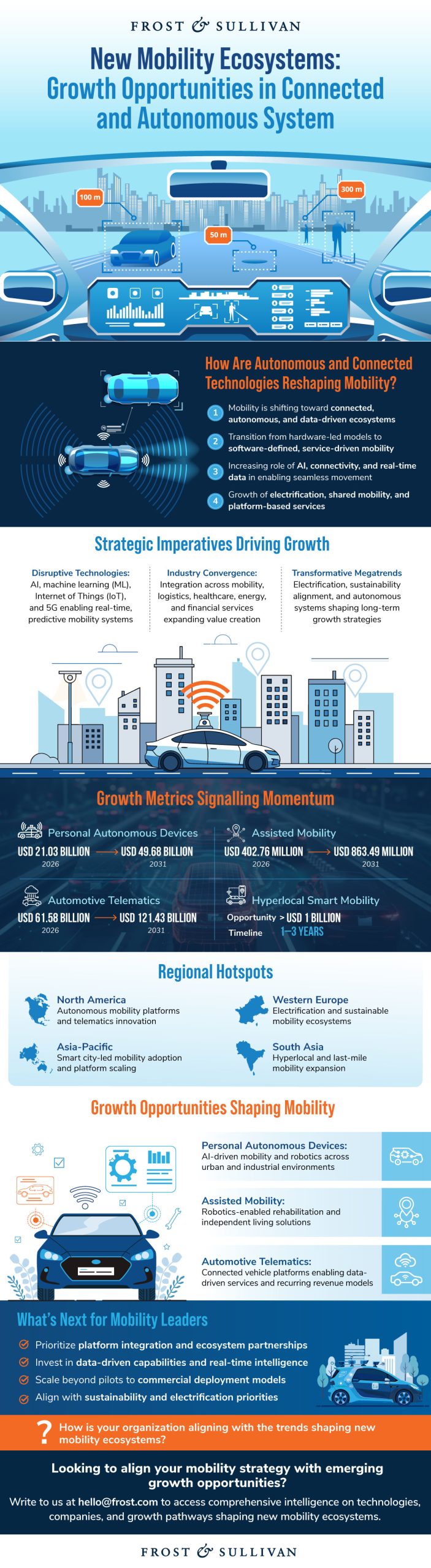
Mobility ecosystems are expanding beyond transportation to include integrated services, data platforms, and cross-industry applications. Organizations are moving from pilot deployments to commercial-scale implementations across autonomous systems, assisted mobility, and connected vehicle platforms.
The emergence of software-defined vehicles, real-time analytics, and platform-based mobility services is shifting value from hardware to digital capabilities. At the same time, ecosystem partnerships are becoming critical, enabling collaboration across technology providers, mobility operators, and service platforms.
As these systems scale, mobility is increasingly defined by continuous connectivity, data monetization, and service integration, creating new revenue streams and operational efficiencies.
How is your organization aligning its strategy with emerging mobility ecosystems?
- Disruptive Technologies Accelerating Intelligent Mobility
Advancements in artificial intelligence (AI), machine learning (ML), Internet of Things (IoT), and 5G are enabling predictive, adaptive, and autonomous mobility systems. These technologies are shifting mobility from reactive operations to real-time, data-driven decision-making, improving safety, efficiency, and user experience across mobility ecosystems. - Industry Convergence Expanding Mobility Ecosystems
Mobility is increasingly intersecting with logistics, healthcare, energy, information and communication technology (ICT), and financial services. This convergence is enabling integrated solutions such as connected supply chains, assisted mobility systems, and data-driven insurance models, creating new value pools across industries. - Transformative Megatrends Driving Sustainable and Autonomous Mobility
Electrification, environmental, social, and governance (ESG) alignment, and autonomous systems are shaping long-term mobility strategies. Organizations are prioritizing sustainable operations, energy-efficient systems, and autonomous capabilities to meet regulatory requirements and evolving user expectations.
How is your organization aligning strategic priorities with the technologies and ecosystem shifts shaping new mobility?
| Growth Drivers Accelerating Adoption | Growth Challenges Impacting Adoption |
| Key forces are driving adoption across mobility ecosystems:
1. Rising demand for autonomous and on-demand mobility solutions 2. Advancements in AI, ML, and connectivity enabling real-time decision-making 3. Increasing focus on sustainability, electrification, and energy efficiency 4. Expansion of data-driven services and platform-based business models |
Despite strong momentum, several challenges continue to influence adoption:
1. High capital requirements and infrastructure readiness for autonomous and connected systems 2. Regulatory complexity across regions impacting deployment and scalability 3. Data privacy, cybersecurity, and interoperability concerns in connected ecosystems 4. Integration challenges across legacy systems and emerging platforms |
Trend Opportunity Profile: Key Mobility Themes Driving Growth
The evolving mobility ecosystem is being shaped by a set of interconnected trends that are redefining how people and goods move, interact, and access services. These trends reflect the shift toward connected, autonomous, and service-led mobility models, creating new opportunities across industries and value chains.
- Personal Autonomous Devices: Enabling autonomous movement across mobility, logistics, and robotics through AI-driven perception and real-time decision-making
- Assisted Mobility: Integrating robotics, AI, and connectivity to support rehabilitation, independent living, and enhanced accessibility
- Truck Platooning: Improving fuel efficiency, safety, and fleet coordination through connected and synchronized vehicle operations
- Augmented Reality (AR) Navigation: Enhancing real-time navigation and driver awareness through immersive, data-driven visual interfaces
- Autonomous Ride-sharing Networks: Enabling scalable, on-demand mobility services through shared, driverless transportation models
- Automotive Telematics: Driving connected vehicle ecosystems through real-time monitoring, predictive maintenance, and data-driven services
How is your organization prioritizing and aligning with the mobility trends shaping future growth?
Companies Driving Scalable Growth in New Mobility Ecosystems
Leading organizations are translating emerging mobility trends into scalable, commercially viable solutions by integrating autonomy, connectivity, and data-driven capabilities across ecosystems.
- Waymo: Scaling autonomous mobility platforms and accelerating commercial robotaxi deployments across urban environments
- Boston Dynamics: Advancing robotics-driven automation for industrial, logistics, and real-world applications
- Ekso Bionics: Enabling rehabilitation and mobility restoration through wearable exoskeleton technologies
- Toyota Mobility Foundation: Driving assisted mobility solutions focused on accessibility, aging populations, and community integration
- Octo Telematics: Enabling connected insurance and data-driven risk assessment through telematics platforms
- Geotab: Delivering real-time fleet intelligence, optimization, and compliance through connected vehicle ecosystems
How is your organization translating mobility trends into scalable, data-driven growth strategies?
| Key Industry Statistics Signalling Momentum
Market signals indicate strong acceleration across core mobility segments:
These trajectories reflect sustained adoption of autonomous systems, assisted mobility solutions, and connected vehicle platforms across industries. |
|
Growth Opportunity: Hyperlocal Smart Mobility
Hyperlocal smart mobility enables on-demand, location-specific mobility within urban zones through integrated, platform-driven ecosystems. It combines ride-hailing, transit, micro-mobility, and delivery into unified Mobility-as-a-Service (MaaS) platforms powered by AI, IoT, and real-time data.
-
- Opportunity Snapshot
- Opportunity size: Over USD 1 billion (5-year horizon)
- Timeline: 1 to 3 years
- Key regions: South Asia, Western Europe, North America, Asia-Pacific
- What Is Driving Adoption
- Rising demand for last-mile and short-distance mobility
- Urban congestion and need for efficient traffic management
- Smart city initiatives enabling integrated mobility platforms
- Push toward low-emission and electrified transport systems
- Where Value Is Created
- Platform integration across multimodal mobility services
- Real-time route optimization and fleet coordination
- Data-driven traffic, curbside, and parking management
- Scalable, subscription-based MaaS models
- Key Focus Areas
- Integration of ride-hailing, transit, micro-mobility, and delivery
- AI-driven traffic and multimodal data platforms
- Smart parking and IoT-enabled fleet tracking
- Gradual integration of autonomous vehicles into urban fleets
- Who Is Driving the Shift
- Mobility platforms expanding into integrated service ecosystems
- Smart city developers deploying AI-led urban mobility infrastructure
- Public sector enabling policy, data, and infrastructure alignment
- Opportunity Snapshot
Navigating the Future of Hyperlocal Smart Mobility
As hyperlocal smart mobility reshapes urban transportation, advantage will come from integrating platform-driven models into mobility, infrastructure, and data strategies. Organizations that align real-time intelligence, multimodal integration, and ecosystem partnerships will scale more effectively. Frost & Sullivan is ready to support this transition. Are you prepared to lead the next phase of urban mobility transformation?
Frequently Asked Questions (FAQs)
-
-
- What is hyperlocal smart mobility and how does it work?
Hyperlocal smart mobility is a location-based transportation model that enables on-demand mobility within urban areas such as neighborhoods and districts. It works by integrating ride-hailing, micro-mobility, public transit, and delivery services into a single Mobility-as-a-Service (MaaS) platform using artificial intelligence (AI), Internet of Things (IoT), and real-time data. - What technologies are used in hyperlocal smart mobility systems?
Hyperlocal smart mobility systems use artificial intelligence (AI) for route optimization, Internet of Things (IoT) for fleet tracking, global positioning systems (GPS) for navigation, cloud platforms for data integration, and real-time analytics for traffic and mobility management. - Why is hyperlocal smart mobility important for urban transportation?
Hyperlocal smart mobility improves last-mile connectivity, reduces traffic congestion, lowers emissions, and enhances urban mobility efficiency. It enables cities to manage transportation demand more effectively while providing seamless, on-demand mobility services to users. - What are the key growth drivers for hyperlocal smart mobility?
Key growth drivers include increasing urbanization, rising demand for last-mile connectivity, smart city initiatives, adoption of electric and shared mobility solutions, and advancements in artificial intelligence (AI) and connected technologies.
- What is hyperlocal smart mobility and how does it work?
-
Ready to Lead the Transformation?
-
- Book a Growth Strategy Session: Align your growth roadmap with Frost & Sullivan’s visionary Growth Pipeline™ Dialog.
- Engage with Growth Experts: Co-design AI-enabled, data-driven operating models that scale industry-specific and commercial impact.
- Share Your Transformation Story: Position your organization as a transformation leader through Frost & Sullivan’s Transformational Growth Leadership platform.
- Join the Growth Council: Collaborate with industry leaders shaping the future of your ecosystem.
- Nominate for the Best Practices Recognition: Be recognized for excellence in growth strategy, execution, and customer impact.
- Demonstrate Industry Positioning on the Frost Radar™: Benchmark your growth performance and innovation strength against industry competitors.
- Activate Brand & Demand Growth: Accelerate awareness, engagement, and revenue growth through integrated brand and demand generation strategies.