This blog is based on the analysis Advancements in Edge AI-Enabled Sensor Solutions for Autonomous Systems and Industrial IoT, authored by Frost & Sullivan’s growth expert, Varun Babu and, lead analyst Jacinth Matthew from the TechVision – Sensors & Instrumentation team.
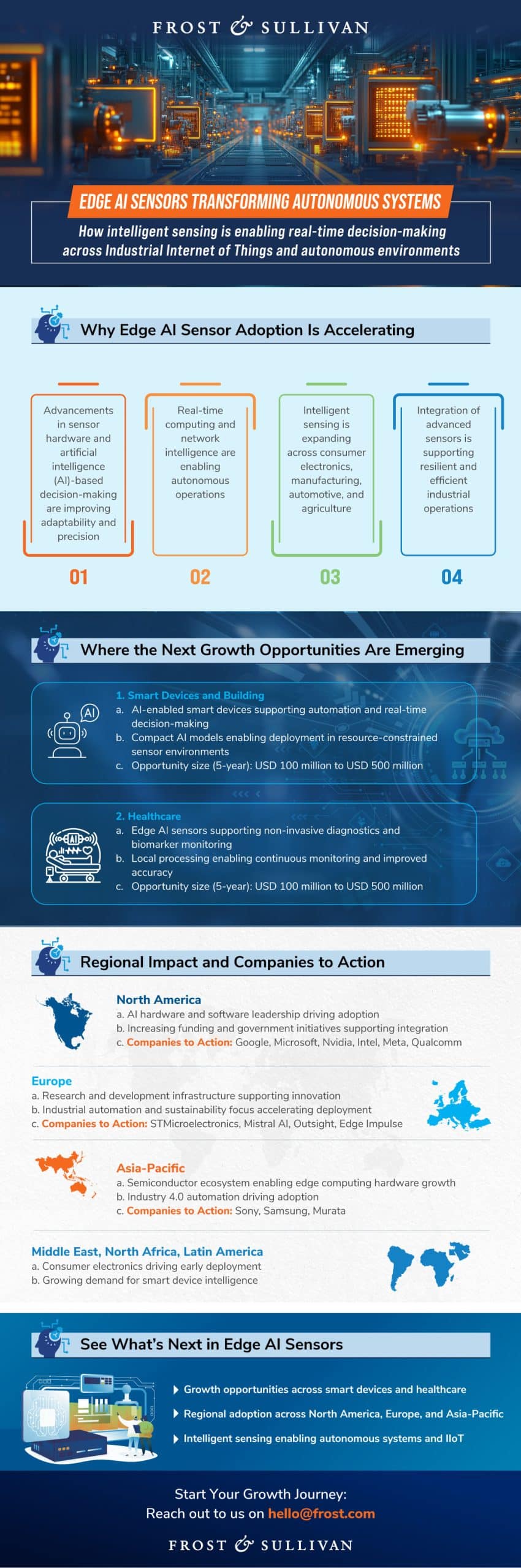
Edge AI-enabled sensor solutions are transforming industrial operations by embedding intelligence, adaptability, and precision directly into core processes. Across consumer electronics, manufacturing, automotive, and agriculture, sensors are evolving from passive monitoring tools into real-time decision engines supporting autonomous response.
Advancements in sensor hardware and artificial intelligence (AI)-driven decision-making are reshaping modern robotics. These capabilities enable downtime-free operations, improved human-robot collaboration, and higher dexterity across complex industrial environments. As intelligence shifts closer to the edge, organizations benefit from reduced latency, faster decision cycles, and more responsive automation.
At the same time, innovations in materials, real-time computing, and network intelligence are accelerating adoption. Over the next five to seven years, intelligent sensing architectures will support resilient, sustainable, and highly efficient industrial ecosystems across autonomous systems and Industrial Internet of Things (IoT) deployments.
Edge Artificial Intelligence Sensors: Capturing Autonomous Industrial Intelligence
Access:
- Strategic imperatives accelerating edge artificial intelligence sensor adoption
- Enabling technologies shaping distributed and centralized edge architectures
- Growth opportunities across smart buildings, healthcare, and IIoT
Where will edge intelligence create the strongest growth opportunities?
Listen to the Growth Podcast: Edge AI Sensors and Autonomous Systems
Strategic Imperatives Shaping Edge AI-enabled Sensor Solutions
- Innovative Business Models
- Shifting from standalone sensing units to intelligent decision endpoints
- Enabling subscription, analytics-led, and outcome-based value delivery
- Generating continuous data through embedded on-device intelligence
- Bundling sensor hardware with AI models and lifecycle analytics
- Creating recurring revenue through intelligence-driven sensor platforms
- Competitive Intensity
- Intensifying competition from sensor suppliers and AI hardware startups
- Introducing low-power NPUs and model-optimized architectures
- Expanding semiconductor integration within sensor platforms
- Accelerating localization through domestic chip initiatives
- Strengthening regional sensor-AI innovation ecosystems
- Transformative Megatrends
- Accelerating demand for real-time, on-device intelligence
- Increasing adoption across autonomous mobility and industrial automation
- Supporting sustainability-focused operational efficiency
- Driving low-latency requirements in healthcare and safety applications
- Reinforcing local processing due to data privacy considerations
Which growth opportunities are emerging as intelligence moves directly to the sensor edge?<
Key Growth Drivers for Edge AI-enabled Sensor Solutions
Edge AI-enabled sensors are gaining momentum as advancements in AI, materials, and automation needs reshape industrial operations. These drivers are accelerating adoption across autonomous systems and industrial IoT environments.
- AI/Machine learning (ML) maturity: Expanding use of reinforcement learning and AI/ML is improving autonomy and decision-making at the edge, enabling high-performance on-device models
- Material and sensor innovation: Advancements in lightweight materials and smart sensors are improving efficiency, dexterity, and high-speed data processing while reducing energy consumption
- Labor shortages: Growing workforce gaps are accelerating AI-enabled automation, ensuring operational continuity, reducing human error, and sustaining productivity
Are these drivers accelerating your shift toward autonomous, edge-intelligent operations?
|
Strategic Edge AI Sensor Architecture Models
|
||
|
Key Advantages of Edge AI-enabled Sensors
These capabilities are improving responsiveness, lowering operational costs, and supporting scalable IIoT deployments across autonomous systems.
- Lower latency: On-device processing is enabling ultra-low latency decision-making for robotics, industrial automation, and wearable monitoring applications. Real-time analytics at the sensor level is improving responsiveness while reducing dependence on cloud connectivity.
- High privacy: Localized data processing is minimizing data transfer to centralized systems, improving data governance and supporting secure automation across smart devices, surveillance systems, and industrial environments.
- Scalability: Growing computational capabilities are enabling deployment across larger numbers of AI -compatible edge devices. Distributed intelligence is supporting expansion without centralized bottlenecks.
- Energy efficiency: Low-power distributed computing and smaller AI models are improving energy efficiency. These capabilities are supporting predictive maintenance, process optimization, and continuous monitoring applications.
How are these advantages shaping your edge AI sensor strategy?
Enabling Technologies Accelerating Edge AI Sensor Adoption
- Edge Computing
- Advancing parallel processing and graphics processing units for on-device inference
- Enabling high-density chips supporting edge AI models
- Separating training and inference chips for edge deployments
- Artificial Intelligence and Machine Learning
- Expanding hybrid models combining cloud training and edge deployment
- Advancing narrow AI and tiny machine learning models
- Enabling compact generative models with fewer parameters
- Power Efficiency and Energy Harvesting
- Improving low-power distributed computing architectures
- Enabling solar, thermal, radio frequency, and vibration energy harvesting
- Supporting autonomous sensors in remote environments
Which technologies are enabling your edge AI deployments?
Growth Opportunities in Edge AI -enabled Sensor Solutions
- AI-enabled Smart Devices and Building Automation
Artificial intelligence-enabled smart home and building automation applications are expanding as edge intelligence enables real-time, privacy-aware decision-making. Sensor-based lighting, temperature monitoring, and surveillance systems are increasingly integrating compact AI models to support personalized and autonomous environments.
- Key Actions for Vendors:
Investing in multimodal perception for smart automation
Customizing models to reduce cost and power consumption
Developing modular edge AI architectures
- Artificial Intelligence Growth in Healthcare
Healthcare adoption is increasing as edge AI sensors support non-invasive diagnostics and real-time biomarker monitoring. Local processing is improving accuracy, reducing latency, and enabling continuous health monitoring across clinical and wearable applications.
- Key Actions for Vendors:
Improving model accuracy through training and retraining
Developing biomarker-specific AI models
Strengthening data security and healthcare integration
Which growth opportunities are accelerating your edge AI sensor strategy?
Frequently Asked Questions
- What are edge AI-enabled sensors?
Edge AI -enabled sensors are sensing devices with built-in AI processing that analyze data locally instead of sending it to centralized systems. These sensors are enabling real-time decision-making, reducing latency, and supporting autonomous operations across IIoT, robotics, and smart environments.
- Why are edge AI sensors important for autonomous systems?
Edge AI sensors are improving responsiveness by enabling real-time perception and decision-making directly at the device level. This is supporting autonomous robotics, predictive maintenance, and intelligent automation while reducing reliance on cloud connectivity.
- What technologies are enabling edge AI sensor adoption?
Advancements in edge computing hardware, artificial intelligence and machine learning models, energy-efficient processing, and 5G and 6G communication are enabling deployment. These technologies are supporting low-latency processing, scalable sensor networks, and continuous on-device intelligence.
- What industries are adopting edge AI-enabled sensors?
Adoption is expanding across manufacturing, automotive, consumer electronics, healthcare, agriculture, and smart buildings. These sectors are using edge artificial intelligence sensors for automation, monitoring, safety, and real-time operational optimization
Ready to Lead the Transformation?
- Book a Growth Strategy Session: Align your growth roadmap with Frost & Sullivan’s visionary Growth Pipeline™ Dialog.
- Engage with Growth Experts: Co-design AI-enabled, data-driven operating models that scale industry-specific and commercial impact.
- Share Your Transformation Story: Position your organization as a transformation leader through Frost & Sullivan’s Transformational Growth Leadership platform.
- Join the Growth Council: Collaborate with industry leaders shaping the future of your ecosystem.
- Nominate for the Best Practices Recognition: Be recognized for excellence in growth strategy, execution, and customer impact.
- Demonstrate Industry Positioning on the Frost Radar™: Benchmark your growth performance and innovation strength against industry competitors.
- Activate Brand & Demand Growth: Accelerate awareness, engagement, and revenue growth through integrated brand and demand generation strategies.