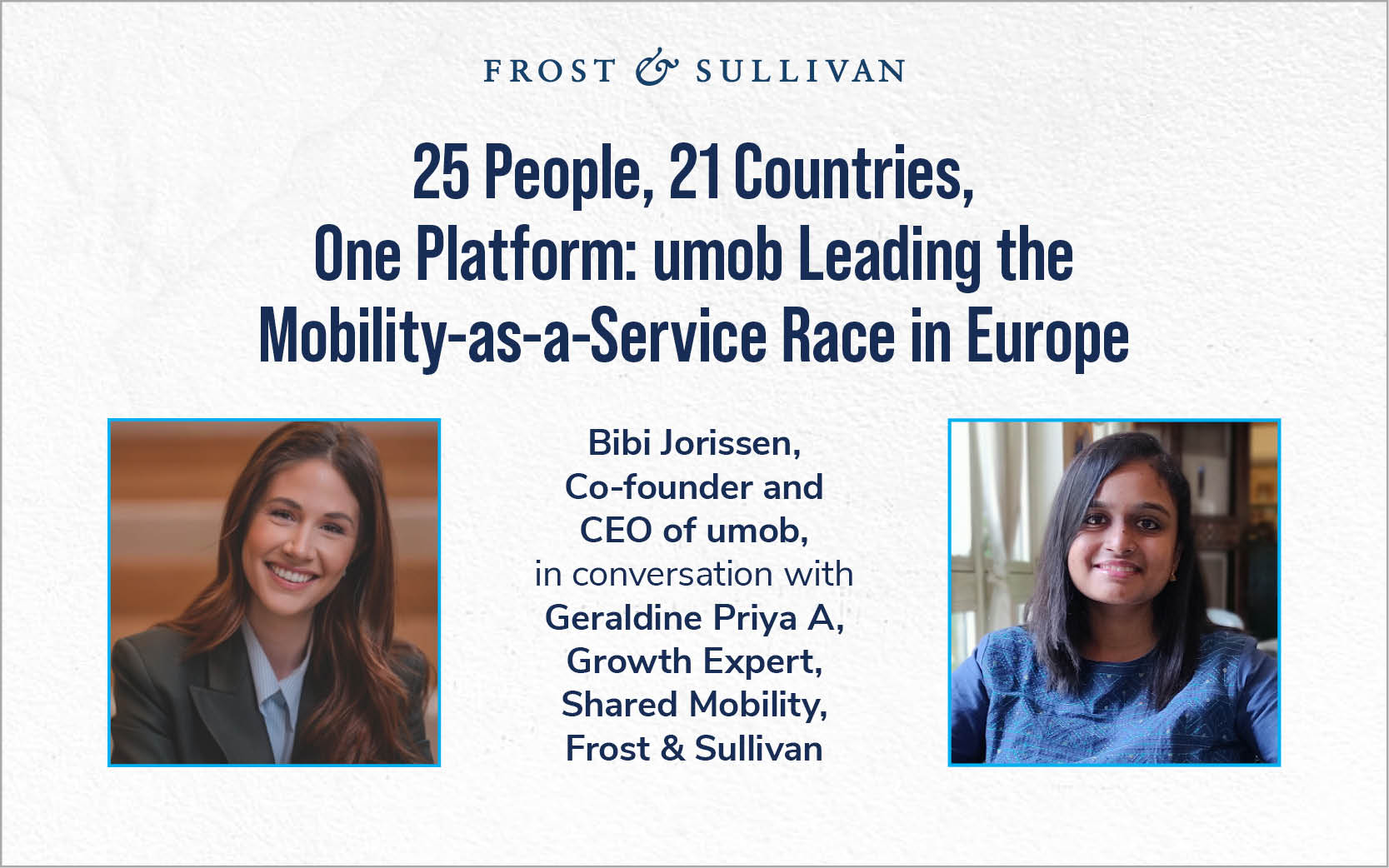
Bibi Jorissen, co-founder and CEO of umob, in conversation with Geraldine Priya A, Growth Expert, Shared Mobility at Frost & Sullivan
CLICK HERE to Download this Transformational Growth Leadership Interview with Bibi Jorissen, CEO & Co-founder of umob.
In Europe, shared mobility platforms have moved well past the pilot phase, and the conversation is shifting from whether multimodal integration works to who gets to own the infrastructure that makes it work at scale. Against this backdrop, umob is positioning itself not as another app competing for screen time, but as an embedded operating layer within city mobility systems.
In this Transformational Growth Leadership discussion, Geraldine Priya A, Growth Expert and Research Manager, Shared Mobility, at Frost & Sullivan speaks with Bibi Jorissen, co-founder and CEO of umob, about the evolving role of multimodal mobility platforms in building city-embedded transport ecosystems across Europe. The conversation explores the shift from fragmented, single-mode applications to end-to-end Mobility-as-a-Service (MaaS) integration.
“The future of mobility is not about more vehicles, but about better collaboration. Only by connecting technology, mobility providers, and cities can we create a smarter, more sustainable, and truly accessible mobility system.”
— Bibi Jorissen, co-founder and CEO of umob
From Fragmented Pilots to Platform Maturity: The MaaS Transformation
Geraldine Priya A: Give us a brief overview of umob; how MaaS has evolved over the past few years, and what lies ahead for this industry?
Bibi Jorissen: umob is a European mobility platform integrating public transport, taxi, and sharing services into a single application. Users are currently exploring, booking, and paying for services across more than 500,000 vehicles in nearly 300 cities, spanning 21 countries, without ever being redirected to a third-party application. Services from operators including Lime, Voi, and Dott are all bookable directly within the platform.
Umob aims to make mobility as seamless as booking a hotel. One interface, one payment, one experience. The MaaS industry itself has moved through a necessary maturation cycle. What started as technology experimentation in localized pilot environments is now focused on scalability, reliability, and embedding multimodal mobility into genuine everyday behavior. The next phase is driven by deeper city integration, real-time optimization, and data-driven systems that are improving efficiency and sustainability at the infrastructure level.
Three Megatrends Rewriting the Rules of Success in Urban Mobility
Geraldine Priya A: What three transformative megatrends are changing your industry?
Bibi Jorissen: The first is the shift from ownership to usage. Private car ownership as the default mobility choice is being actively displaced, and urban populations are increasingly open to accessing mobility rather than owning it.
The second is the rapid digitalization and consolidation of mobility services into unified platforms. The broader platform economy, from Booking.com to Uber Eats, has conditioned users to expect convenience and integration as a baseline. Mobility is catching up, and the same user behavior patterns are now driving demand for single-interface access to multimodal transport.
The third is the growing role of cities and governments in actively orchestrating sustainable mobility ecosystems. Eindhoven, for example, became the first European Union city to award exclusivity to a MaaS operator for all shared mobility bookings, on an 11-year concession basis. This is a fundamentally different kind of city-platform relationship, and it is creating a structural competitive advantage for operators willing to commit to deep, long-term municipal partnerships.
Leveraging Disruptive Technologies, Like AI, as an Operational Enabler
Geraldine Priya A: How are you leveraging AI at umob? Do you consider AI a boon or a bane?
Bibi Jorissen: AI is a clear enabler for us. The primary applications today are real-time journey optimization, personalized travel recommendations, and demand forecasting combined with capacity planning. When integrated with purpose, it meaningfully improves efficiency and user experience. Organizations that build AI strategies disconnected from real operational problems risk ending up with impressive technology that delivers little commercial value.
For a platform aggregating millions of multimodal journeys across 21 countries, AI-driven real-time optimization is not a differentiator; it is a baseline requirement for delivering on the seamless experience promise.
CLICK HERE to Download this Transformational Growth Leadership Interview with Bibi Jorissen, CEO & Co-founder of umob
City Partnerships Creating a Strong Competitive Advantage
Geraldine Priya A: How are these transformations creating new challenges and opportunities for umob?
Bibi Jorissen: Fragmented regulations across regions, legacy systems embedded within public transport networks, and the behavioral shift required to move users away from private car ownership are all genuine friction points.
For umob, the opportunity lies in connecting all stakeholders across the mobility value chain. Partnerships with municipalities like Rotterdam and Eindhoven are not supplementary relationships; they are core to the model. With city support, services become more visible, more affordable, and more efficient, which directly benefits transport operators by improving vehicle utilization without displacing their existing revenue base.
The Eindhoven concession model is also creating defensibility that is rare for software-led businesses. It is slow, political, and unglamorous to win. But once established, it compounds in competitive value over time.
umob’s Balanced Approach to Funding Growth
Geraldine Priya A: What is your strategy to capitalize and fund growth in the future?
Bibi Jorissen: The approach combines investment capital with strategic partnerships and growing platform revenues. Collaborations with cities and regions play a meaningful role in scaling adoption and creating long-term value, because these relationships carry both commercial and reputational weight that pure investor capital cannot replicate.
On mergers & acquisitions (M&A), the primary focus right now is organic growth, following the MaaS Global Ltd acquisition. Inorganic activity remains an option for accessing new technologies or entering new geographies in a compressed timeframe.
Competitive Differentiation: How Is umob Scaling Smarter Than the Competition
Geraldine Priya A: What is your strategy to stay ahead of competition, particularly as some players are scaling back from this space?
Bibi Jorissen: The competitive landscape operates across multiple layers simultaneously.:
- On one side are other MaaS platforms, most of them locally subsidized.
- On the other are single-mode mobility apps and, at a broader level, private car ownership itself.
What differentiates umob is a commitment to true integration rather than simple aggregation. Showing availability is not enough. Building a seamless, end-to-end mobility experience, where the booking and payment journey never leaves the platform, is the actual product.
The 2024 acquisition of MaaS Global Ltd, the world’s first MaaS platform with over 70 million euros invested in its software, was a pivotal acceleration point. That software has been merged into the umob platform. Combined with the Eindhoven concession win and expansion to 21 countries, the company has executed this with a team of 25 people, which reflects the operational efficiency that comes from deep technology ownership rather than dependency on external platforms.
The Strategic Bet Defining umob’s Long-Term Position
umob’s growth thesis is built on the premise that mobility platforms creating the deepest institutional relationships with cities and operators will outlast those competing purely on features or user acquisition.
The Eindhoven concession is the most visible proof point of this strategy, but the broader pattern holds consistently. Every city partnership secured, every multimodal transport integration completed with a public transport authority, and every B2B relationship established adds a layer of defensibility that pure software businesses rarely achieve. In an industry where several MaaS players have pulled back due to unit economics and funding pressures, umob is building the kind of compounding competitive position that comes from embedding the platform into urban infrastructure rather than sitting above it.

About Bibi Jorissen
Bibi Jorissen is the co-founder and CEO of umob, a fast-scaling Mobility-as-a-Service platform redefining how people access transport across Europe. With prior experience at global players like General Motors and Greenwheels, she combines deep industry expertise with a sharp execution mindset. As CEO, she leads the company’s strategy, growth and team building. She scaled jumbo in the past two years to over 20 countries, 260 cities while securing more than 12 million in funding to fuel expansion. Under her leadership, umob has strengthened its position in the industry through strategic moves including the acquisition of MaaS Global Ltd.
Geraldine Priya A is a Research Manager at Frost & Sullivan with over 14 years of experience specializing in shared mobility and growth opportunity analytics. Her extensive industry expertise covers domains such as autonomous transport, micromobility, and smart city technologies across the North American, European, and Asia-Pacific regions. Throughout her career, she has contributed to more than 30 research studies and developed sophisticated data intelligence platforms for shared business models. Currently, she leads strategic consulting and industry forecasting initiatives to identify high-value opportunities for global automotive OEMs and mobility startups.

About Geraldine Priya A
Ready to Lead the Transformation?
- Book a Growth Strategy Session: Align your growth roadmap with Frost & Sullivan’s Visionary Growth Pipeline™ Dialog.
- Engage with Growth Experts: Co-design AI-enabled, data-driven operating models that scale industry-specific and commercial impact.
- Share Your Transformation Story: Position your organization as a transformation leader through Frost & Sullivan’s Transformational Growth Leadership platform.
- Join the Growth Council: Collaborate with industry leaders shaping the future of your ecosystem.
- Nominate for the Best Practices Recognition: Be recognized for excellence in growth strategy, execution, and customer impact.
- Demonstrate Industry Positioning on the Frost Radar™: Benchmark your growth performance and innovation strength against industry competitors.
- Activate Brand & Demand Growth: Accelerate awareness, engagement, and revenue growth through integrated brand and demand generation strategies.
Annexure
To know more about lucrative growth opportunities, emerging megatrends, companies to action, and best practices in shared mobility, view Frost & Sullivan’s detailed portfolio of exclusive analyses.
Some of the growth analyses that you may like reading: