This blog is based on Frost & Sullivan’s “Top Growth Opportunities in AI-native Cybersecurity and Autonomous Threat Defense,” built from four Technology Opportunity Engine analyses. Developed by Frost & Sullivan’s ICT growth expert, Heena Juneja, from the TechVision team.
Enterprise cybersecurity is entering a transformative phase where artificial intelligence (AI)-native security operations, cloud-native protection, identity intelligence, autonomous threat defense, and Zero Trust architectures are reshaping enterprise cyber resilience strategies. Organizations are increasingly prioritizing technologies that improve threat visibility, strengthen identity governance, accelerate incident response, and support adaptive cybersecurity operations across distributed digital ecosystems.
From agentic AI-driven threat hunting and behavioral anomaly detection to cloud-native secure access, identity intelligence, and unified authorization governance platforms, emerging cybersecurity technologies are enabling more intelligent, adaptive, and continuously resilient enterprise security ecosystems.
What’s In It for You?
- Key growth opportunities across AI-native cybersecurity and autonomous threat defense ecosystems
- Emerging innovation themes shaping identity-centric and cloud-native security transformation
- Strategic opportunities across Zero Trust security, fraud intelligence, and intelligent cyber resilience platforms
[Access the Sample Whitepaper on AI-native Cybersecurity and Autonomous Threat Defense]
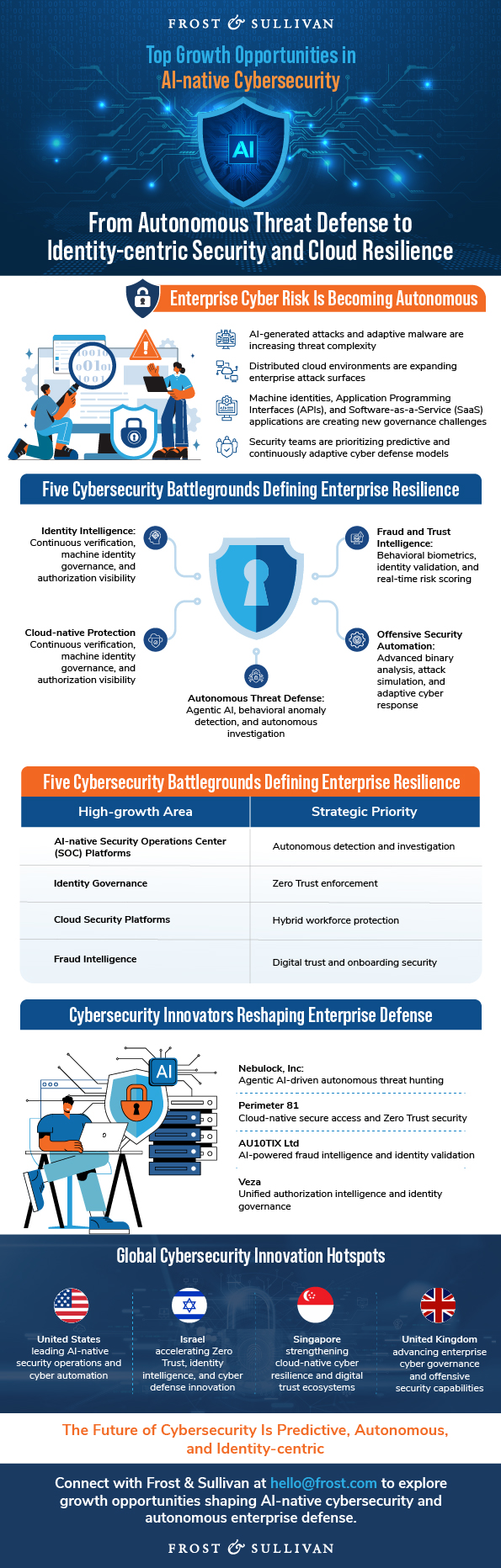
Technology Shifts Driving AI-native Cybersecurity Transformation
Several innovation themes are accelerating the transition toward more intelligent, adaptive, and identity-centric cybersecurity ecosystems. AI-native security operations, autonomous threat defense, cloud-native protection, identity intelligence, and unified authorization platforms are expanding how organizations approach cyber resilience, threat detection, access governance, and enterprise security transformation.
These technologies are improving real-time threat visibility, enabling adaptive cyber response, strengthening fraud prevention, simplifying secure access management, and supporting scalable security operations across cloud, hybrid, and Software-as-a-Service (SaaS) environments.
The following opportunity areas highlight selected innovations accelerating the future of AI-native cybersecurity transformation.
- Agentic AI-driven Threat Hunting and Behavioral Anomaly Detection Platforms: Organizations are accelerating investments in AI-native cybersecurity platforms to improve threat visibility, reduce false positives, strengthen incident response efficiency, and support autonomous cyber defense strategies across increasingly distributed enterprise environments. Intelligent behavioral analytics, autonomous investigation capabilities, and real-time anomaly detection are emerging as critical enablers of adaptive cybersecurity operations and cloud-native security transformation. The following innovator highlights this shift toward AI-native and autonomous cybersecurity ecosystems.
Nebulock, Inc. (United States): Autonomous Cyber Defense Platform
- AI-driven cybersecurity platform focused on autonomous threat hunting and behavioral anomaly detection
- Multi-threaded AI agents establish behavioral baselines and detect abnormal activity in real time
- Integrated across Security Information and Event Management (SIEM), Identity and Access Management (IAM), and Endpoint Detection and Response (EDR) environments
- Natural language investigation interface accelerates threat analysis and incident response workflows
Growth Snapshot
- Operating at the seed investment stage
- Raised $8.5 million in total funding
- Positioned within the emerging AI-native cybersecurity segment
How are AI-native threat detection platforms reshaping enterprise cyber resilience strategies?
- Cloud-native Secure Access and Zero Trust Security Platforms: Hybrid work environments and cloud-native enterprise operations are accelerating demand for secure and scalable access management platforms. Organizations are prioritizing Zero Trust architectures, cloud-delivered security, and unified network protection to strengthen secure connectivity across distributed enterprise ecosystems.
Perimeter 81, Israel: Cloud-native Secure Access Platform
- Cloud-native Secure Access Service Edge (SASE) and Secure Web Gateway (SWG) platform
- Supports Zero Trust Network Access (ZTNA) across distributed enterprise environments
- Integrates secure access, threat protection, and network security within a unified platform
- Simplifies secure connectivity across hybrid work and cloud-native enterprise ecosystems
Growth Snapshot
- Acquired by Check Point Software Technologies Ltd in 2023
- Raised approximately $165 million before acquisition
- Positioned within the growing cloud-native network security ecosystem
How are Zero Trust and cloud-native security platforms reshaping enterprise access strategies?
- AI-powered Identity Validation and Fraud Intelligence Platforms: The rapid expansion of digital onboarding and online transactions is accelerating demand for intelligent identity verification and fraud prevention technologies. Organizations are increasingly investing in AI-powered identity intelligence platforms to strengthen digital trust, improve compliance management, and reduce fraud risks across digital ecosystems.
AU10TIX Ltd., Israel: AI-powered Identity Verification Platform
- AI-based identity verification engine supporting fraud prevention and compliance workflows
- Combines document forensics, liveness detection, and behavioral biometrics for identity authentication
- Integrates Optical Character Recognition (OCR), Anti-Money Laundering (AML), and Politically Exposed Persons (PEP) screening capabilities
- Supports real-time risk assessment and automated digital onboarding workflows
Growth Snapshot
- Serves the global digital identity and fraud prevention ecosystem
- Operating at the Series C investment stage
- Reported approximately $80 million in total funding
How are AI-powered identity intelligence platforms strengthening digital trust and fraud prevention strategies?
Strategic Outlook
AI-native cybersecurity platforms are accelerating the convergence of autonomous threat defense, identity intelligence, cloud-native protection, fraud detection, and Zero Trust security across enterprise ecosystems. Organizations prioritizing adaptive cyber resilience, intelligent threat detection, and scalable security transformation are expected to strengthen operational visibility, improve risk mitigation, and accelerate enterprise cybersecurity modernization.
Ready to Lead the Technology Transformation?
- Book a Growth Strategy Session: Align your growth roadmap with Frost & Sullivan’s visionary Growth Pipeline™ Dialog.
- Engage with Growth Experts: Co-design AI-enabled, data-driven operating models that scale industry-specific and commercial impact.
- Share Your Transformation Story: Position your organization as a transformation leader through Frost & Sullivan’s Transformational Growth Leadership platform.
- Join the Growth Council: Collaborate with industry leaders shaping the future of your ecosystem.
- Nominate for the Best Practices Recognition: Be recognized for excellence in growth strategy, execution, and customer impact.
- Demonstrate Industry Positioning on the Frost Radar™: Benchmark your growth performance and innovation strength against industry competitors.
- Activate Brand & Demand Growth: Accelerate awareness, engagement, and revenue growth through integrated brand and demand generation strategies.
FAQs: AI-native Cybersecurity and Autonomous Threat Defense
- What is AI-native cybersecurity?
AI-native cybersecurity uses Artificial Intelligence (AI), behavioral analytics, and autonomous investigation capabilities to detect threats, improve threat visibility, reduce false positives, and accelerate cyber response across enterprise environments.
- Why is Zero Trust security important for enterprise cybersecurity?
Zero Trust security continuously verifies users, devices, applications, and workloads to reduce unauthorized access risks across cloud-native, hybrid, and distributed enterprise ecosystems.
- How do AI-powered identity verification platforms prevent fraud?
AI-powered identity verification platforms use behavioral biometrics, document verification, liveness detection, and real-time risk intelligence to strengthen digital trust and reduce fraud across online transactions and digital onboarding workflows.
- What are the benefits of cloud-native cybersecurity platforms?
Cloud-native cybersecurity platforms improve secure access management, strengthen threat protection, support scalable security operations, and simplify protection across multi-cloud and hybrid enterprise environments.
- How are autonomous threat defense platforms transforming cybersecurity operations?
Autonomous threat defense platforms use AI-driven anomaly detection, behavioral baselining, and automated investigation capabilities to improve cyber resilience and accelerate enterprise incident response.
- What is driving demand for identity-centric cybersecurity strategies?
Expanding digital ecosystems, hybrid work environments, machine identities, and cloud-native operations are increasing demand for identity intelligence, access governance, and continuous verification frameworks.