This blog is based on our analysis, Test and Measurement in Artificial Intelligence Networks, Global, 2025–2030 authored by growth expert Sujan Sami from the Industrial Practice Area.
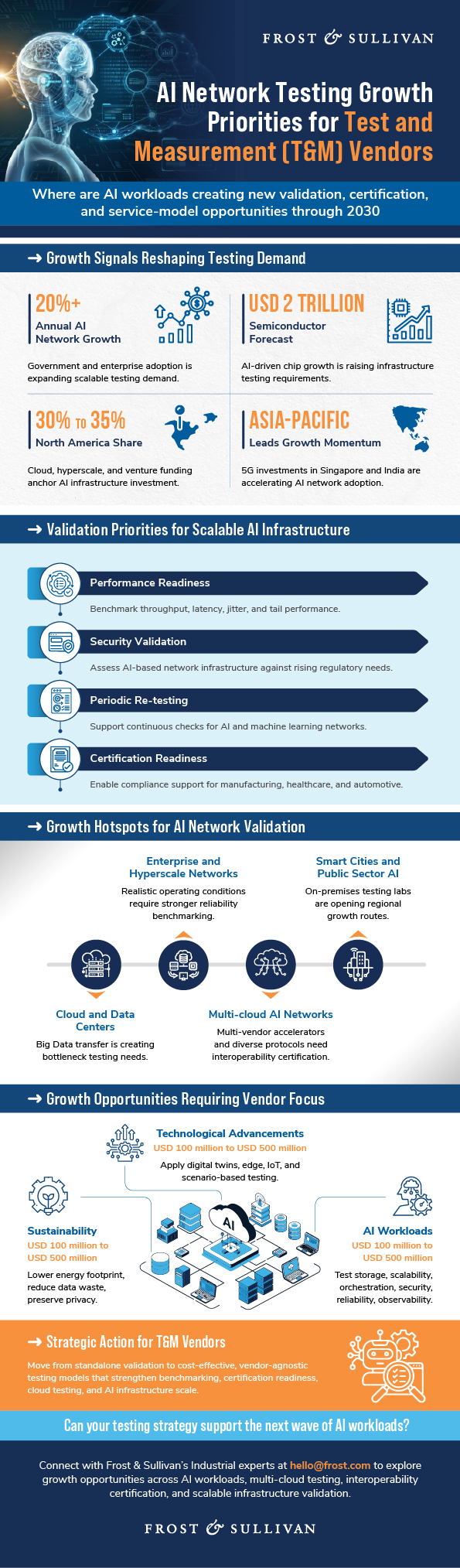
Artificial intelligence (AI) infrastructure is entering a more complex growth cycle as workloads move across cloud environments, data centers, telecom networks, and autonomous systems. With AI networks growing above 20% annually, testing must support lifecycle analysis, periodic re-testing, and infrastructure validation. Enterprises need clearer proof that their networks can handle higher data traffic, maintain low latency, secure critical applications, and operate reliably across distributed environments.
This creates a sharper role for test and measurement vendors. Network benchmarking, cloud testing, emulation, simulation, and interoperability checks are becoming essential as customers work with multi-vendor infrastructure and evolving AI workloads. The opportunity is not only to improve testing accuracy, but to reduce capital expenditure pressure through flexible service-based models, autonomous testing, and certification support.
Turning AI Network Testing into Growth Action
Frost & Sullivan’s analysis helps test and measurement vendors assess:
- Flexible testing models that reduce capital expenditure barriers and improve adoption
• Network benchmarking and cloud testing priorities for evolving AI workloads
• Interoperability, certification, security, and compliance requirements across multi-vendor infrastructure
• Growth opportunities across sustainability, technological advancements, and AI workload testing
Strategic Imperatives Paving New Growth Pathways in AI Network Testing
These imperatives indicate where test and measurement vendors should focus execution, from flexible delivery models and network benchmarking to certification, interoperability, and service-led support.
Innovative Business Models
Reduce CapEx Barriers with Flexible Testing Models: Test and measurement vendors should expand beyond traditional hardware and software testing by offering testing as a service, outcome-based testing, emulation and simulation testing, pay per experiment models, autonomous testing, software as a service, and certification as a service. These models can make AI infrastructure validation easier to adopt while helping customers manage cost, scale, and testing complexity.
Transformative Megatrends
Build Testing Capabilities for AI Network Infrastructure: AI is strengthening the role of network automation, data analytics, cloud processing, and communication technology. Vendors need future ready solutions that can support application agnostic AI networks across research and development, manufacturing, regulated sectors, and high-performance computing environments.
Competitive Intensity
Differentiate through Precision, Security, and Interoperability: Customer expectations are shifting toward faster, more precise, and more secure validation. Stronger positioning will come from solutions that support edge and cloud testing, standardization, cross vendor interoperability, multi cloud environments, multi-vendor accelerators, diverse protocols, and interoperability certification.
Customer Value Chain Compression
Make Testing Easier to Adopt and Support: Vendors should reduce friction across the customer journey with vendor agnostic testing, after sales service, technician training, and 24/7 on site test support. A smoother implementation model can improve customer confidence and accelerate adoption.
Disruptive Technologies
Use Advanced Tools to Improve Validation Accuracy: Digital twins, edge capabilities, Internet of Things (IoT) capabilities, and scenario-based testing should become core parts of AI network validation. These tools can help address architecture, workload, security, operational, interoperability, and compliance complexities with greater accuracy.
Industry Convergence
Create Stronger Ecosystems for Standards and Certification: AI network testing will require closer collaboration across test vendors, peer competitors, system integrators, enterprise customers, government, academia, and testing, inspection, and certification companies. Shared platforms and common standards can strengthen interoperability and regulatory confidence.
Internal Challenges
Close Capability Gaps Before They Limit Adoption: Insufficient domain knowledge and a shortage of trained technicians can slow AI infrastructure testing. Vendors should pair advanced tools with training, technical guidance, and service led support to help customers implement testing with greater confidence.
Geopolitical Chaos
Align Testing Strategies with Regional Compliance Priorities: Regional regulation, security requirements, public sector AI adoption, 5G investment, smart city programs, and on premises testing labs will shape demand. Vendors should adapt testing strategies to local compliance needs, infrastructure maturity, and customer readiness.
Which Strategic Imperatives will shape your next AI network testing priority?
FAQs
1. Why are AI workloads creating new testing priorities?
AI workloads require higher data movement, low latency, stronger reliability, and secure performance across cloud, edge, data center, and multi-vendor environments. This increases the need for advanced test and measurement solutions that can validate infrastructure before customers scale deployments.
2. Why do network benchmark requirements matter for AI network infrastructure?
Network benchmark requirements help enterprises assess throughput, latency, jitter, tail performance, reliability, and interoperability under realistic operating conditions. This is critical as AI network infrastructure becomes more complex and data intensive.
3. How does cloud testing support AI infrastructure?
Cloud testing helps validate how AI workloads move across cloud environments, multi-cloud systems, and distributed infrastructure. It allows vendors and customers to identify bottlenecks, security risks, and performance issues before AI infrastructure is scaled across critical environments.
4. What is the role of flexible business models in AI network testing?
Flexible models such as testing as a service, outcome-based testing, pay per experiment models, autonomous testing, Software-as-a-Service (SaaS), and Certification-as-a-Service (CaaS) help reduce CapEx pressure. They also make advanced AI network testing easier for customers to adopt and scale.
5. How can test and measurement vendors differentiate in AI network testing?
Vendors can strengthen differentiation by combining network benchmarking, cloud testing, emulation, simulation, interoperability certification, technician training, and continuous retesting. The strongest position will come from solutions that address both technical validation and customer adoption challenges.
Ready to Lead the Transformation?
- Book a Growth Strategy Session: Align your growth roadmap with Frost & Sullivan’s visionary Growth Pipeline™ Dialog.
- Engage with Growth Experts: Co-design AI-enabled, data-driven operating models that scale industry-specific and commercial impact.
- Share Your Transformation Story: Position your organization as a transformation leader through Frost & Sullivan’s Transformational Growth Leadership platform.
- Join the Growth Council: Collaborate with industry leaders shaping the future of your ecosystem.
- Nominate for the Best Practices Recognition: Be recognized for excellence in growth strategy, execution, and customer impact.
- Demonstrate Industry Positioning on the Frost Radar™: Benchmark your growth performance and innovation strength against industry competitors.
- Activate Brand & Demand Growth: Accelerate awareness, engagement, and revenue growth through integrated brand and demand generation strategies.